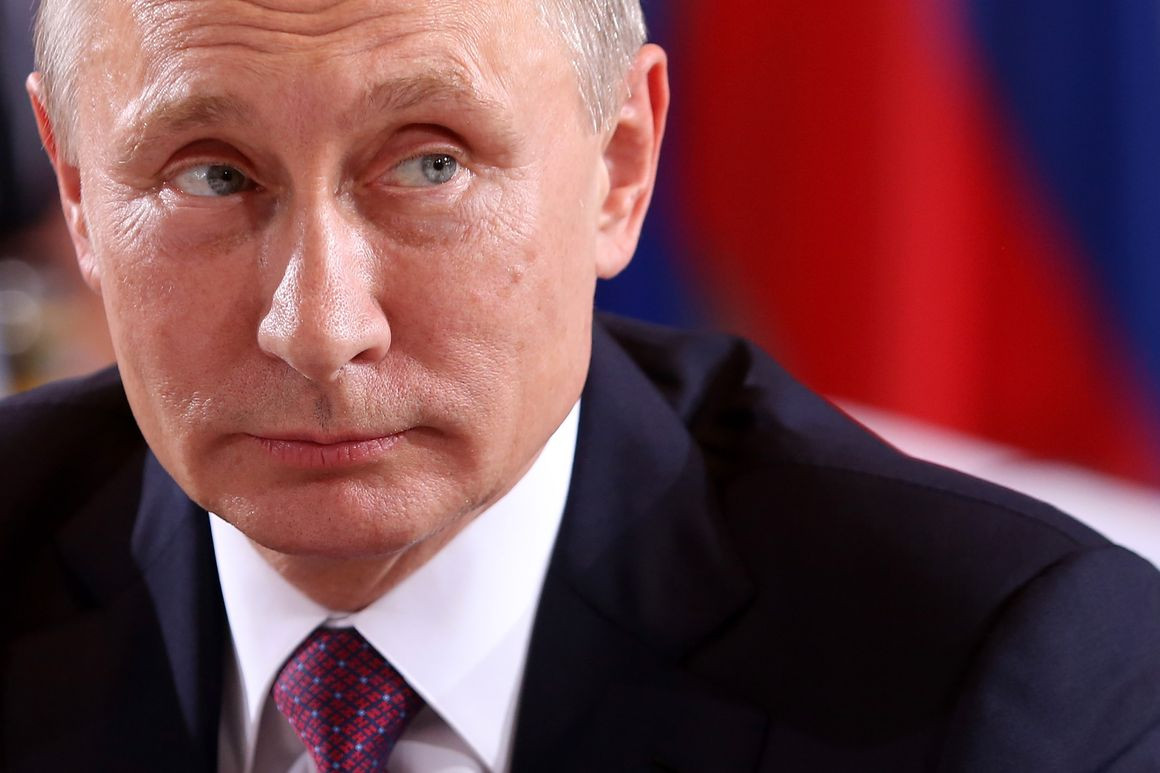
Putin OKs revised Russian national security strategy
Putin OKs revised Russian national security strategy
○
3 mins read
viaMOSCOW — Russian President Vladimir Putin has approved a revised version of Russia’s national security strategy that envisages “symmetrical and asymmetrical measures” in response to foreign states’ “unfriendly actions that threaten the sovereignty and territorial integrity” of Russia.Putin signed a […]
via MOSCOW — Russian President Vladimir Putin has approved a revised version of Russia’s national security strategy that envisages “symmetrical and asymmetrical measures” in response to foreign states’ “unfriendly actions that threaten the sovereignty and territorial integrity” of Russia. Putin signed a decree approving the strategy on Friday, according to the Kremlin website. The 44-page document was published Saturday on a government website and outlined Russia’s national interests and priorities. It stated that “actions of some countries are aimed at instigating disintegration processes in the Commonwealth of Independent States in order to destroy Russia’s ties with its traditional allies,” and claimed that “a number of states call Russia a threat and even a military adversary.” Russia remains committed to using political and diplomatic means to resolve international and national conflicts, the document read. At the same time, Moscow “considers it legitimate to take symmetrical and asymmetric measures” to thwart and prevent “unfriendly actions” by foreign states that “threaten the sovereignty and territorial integrity of the Russian Federation.” Russia’s relations with the U.S. and its allies have been at post-Cold War lows over Moscow’s 2014 annexation of Ukraine’s Crimean Peninsula, accusations of Russian interference in U.S. elections, hacking attacks and other events. Earlier this week Putin described as a “provocation” a June 23 incident in the Black Sea in which Russia said one of its warships fired warning shots and a warplane dropped bombs in the path of Britain’s HMS Defender to force it from an area near Crimea that Moscow claims as its territorial waters. Britain, which like most other nations does not recognize Russia’s 2014 annexation of Crimea, insisted the Defender wasn’t fired upon and said it was sailing in Ukrainian waters. “It was clearly a provocation, a complex one involving not only the British but also the Americans,” Putin said Wednesday during his annual televised call-in show, charging that a U.S. reconnaissance aircraft that took off from the Greek island of Crete was operating in concert with the British ship to monitor the Russian military’s response to the British destroyer. The Russian leader lamented that the incident closely followed his summit with U.S. President Joe Biden in Geneva. “The world is undergoing a radical change,” he said. “Our U.S. partners realize that, and that’s why the Geneva meeting took place. But on the other hand, they are trying to secure their monopolist stance, resulting in threats and destructive action such as drills, provocations and sanctions.”
Donald Trump Should Not Repeat Woodrow Wilson’s Failure
April 30th is an important date in American politics. This is the day 100 for the American President in the White House, and all attention will be on the reports of his achievements and failures. But nothing can be more critical than Peace…
○
6 mins read
A Holocaust perpetrator was just celebrated on US soil. I think I know why no one objected.
Russia’s invasion has made ordinarily outspoken critics of antisemitism wary of criticizing Ukrainian Nazi collaborators
○
1 min read
Qi Book Talk: The Culture of the Second Cold War by Richard Sakwa
Richard Sakwa has for many years been one of the most distinguished and insightful observers of relations between the West and Russia, and one of the leading critics of Western policy. In this talk with Anatol Lieven, director of the Eurasia program at the Quincy Institute, Sakwa discusses his book, The Culture of the Second Cold War (Anthem 2025). The book examines the cultural-political trends and inheritances that underlie the new version of a struggle that we thought we had put behind us in 1989. Sakwa describes both the continuities from the first Cold War and the ways in which new technologies have reshaped strategies and attitudes.