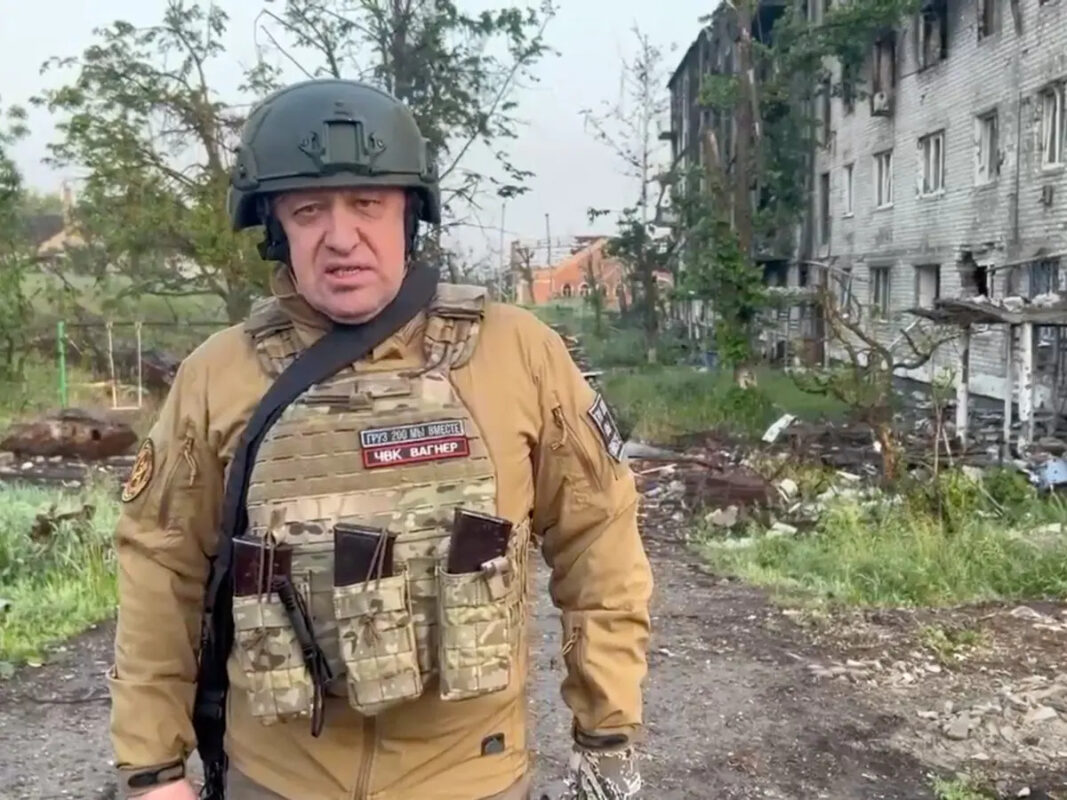
How should we assess the Wagner Group Coup That Never Was in Russia? The finest independent minds we have who closely monitor these and related developments such as Colonel Douglas Macgregor and Scott Ritter have presented conflicting but all possible and persuasive interpretations of these events.
My own assessment combines insights culled from three disparate sources – 13th century English philosopher of science William of Occam, 16th century English political history as dramatically interpreted by William Shakespeare and finally, the authority who knows more about this than anyone else at all – Russian President Vladimir Putin himself.
It was the extraordinary English Franciscan friar and philosopher William of Occam nearly 800 years ago who provided for us arguably the greatest tool of logic to assess the infinite myriad of human as well as scientific data we confront in our infinitely complex universe. It is known as Occam’s Razor: It states that the simplest hypothesis that explains the greatest number of facts//verifiable data points is likely to be the correct one, or the one that at least most closely approximates to the actual explanation. Ever since it has been the fundamental tool to interpret the data of all the hard sciences. To shave away extraneous hypotheses and assumptions with Occam’s Razor remains the best way to evaluate the assembled facts surrounding so many problems.
Here, the simplest explanation is the one President Putin himself offered for Wagner Group leader Yevgeny Prigozhin’s march on Moscow: It was treason, it was a stab in the back , it was a grave crisis. The Russian leader’s assessment should be accepted at face value.
One of the reasons Putin has so long been underestimated and misinterpreted by successive generations of Western leaders is that – far from being far more lying and devious than they are, he has consistently been remarkably open, honest and consistent.
Putin’s public broadcast to the Russian people on Prigozhin’s march fits the strange but verifiable facts of the event and are also consistent with the Russian leader’s own deeply ingrained modus vivendi and pattern of communicating with his own public.
If this is the case, then indeed, as Scott Riter, Colonel Macgregor and others have rightly deduced, Prigozhin was marching to seize the defense ministry in Moscow and topple the government of Russia because of its failure to rapidly and more cheaply win the Ukraine war.
But does this mean that the Russian government is weak and about to collapse? Or that Russia itself is about to militarily and politically disintegrate?
The second question should be answered first: That isn’t going to happen. There is absolutely no evidence anywhere to support it.
Russian supermarkets remain well stocked – Better stocked indeed than British ones have been owing to the bungled dislocations of Brexit – the British withdrawal from the European Union.
Russia’s economy is booming, ironically in large part because the defense sector is once again rapidly expanding precisely because it had not been configured originally for a long duration war in Ukraine.
And the ruble, as Colonel Macgregor has pointed out, is currently one of the strongest global currencies and likely to get more so as Russia is now economically and diplomatically aligned not only with China but also with Saudi Arabia – the other dominant global oil and producing giant.
Nor is patriotism weakening in Russia. An overwhelmingly popular Twitter feed currently shows multiple thousands of Russian teenagers and twenty somethings – Russia’s current “Friends” generation – happily and eagerly singing patriotic songs in great and informal crowds. There is nothing totalitarian or orchestrated about this abundance of footage. It appears to be a genuine nationwide grassroots phenomenon.
Richard on Twitter: “”I am Russian” — *Я Русский” The biggest hit in Russia right now. At the same time western mainstream media wants us to believe Vladimir Putin is getting less popular…” / Twitter
What then, about the threat to the Russian government? Prigozhin was certainly marching. As Putin himself acknowledged, the mercenary leader’s challenge was serious enough to pose the gravest threat to the central government in Moscow at least this century. I would suggest, in the neARLY 30 years since then-President Boris Yeltsin ordered the Russian Army to shell the Moscow White House – the then-home of the Parliament of Russia – into submission on October 4, 1993.
That event indeed was an act of tyranny and contempt for the national political constitution of Russia far more outrageous and openly brutal than anything President Putin has ever done in domestic politics. It was of course enthusiastically supported by US President Bill Clinton and his administration at the time.
Some facts of the strange Prigozhin affair are already very clear. Prigozhin did not have a military background: He was a powerful oligarch and longtime supporter of Putin. But he had set up, organized and run the Wagner mercenary group which has played an increasingly major role in the combat fighting in Ukraine, especially recently in the very serious engagements in and around Bakhmut.
Why did the Russian government and mainstream armed forces, which clearly remain effective, efficient, loyal and coherent, allow this to happen?
The answer to this in fact is clear too. Mercenaries join such organizations for a variety of motives including political ones., But they do so by choice and they are not part of the national army. They can therefore be used more easily for heavy casualty or brutal operations such as the fighting at Bakhmut without eroding morale, patriotism and cohesiveness seriously among the main national army. The Wagner Group mercenaries were hired and used to do the dirty work and mop up the heavy casualties when the fighting got serious.
As Colonel Macgregor and many esteemed Russian military commentators have pointed out, the pattern of Russian combat operations from the very beginning in Ukraine has been to minimize Russian casualties.
Russia still has a low birthrate: the heritage of 75 years of catastrophic social and economic policies under communism. Successive Russian governments have struggled to try and reverse this trend with some success but not yet remotely as much as they would like. The number of families with only single sons, or single offspring is therefore large.
Russia’s military commanders today, like Field Marshal Bernard Montgomery commanding the highly efficient and successful British army in the European Theater of Operations in 1944/45 have been using massed firepower rather than the bodies and blood of their own soldiers to win combat operations and major battles.
The Zelenskyy regime in Kiev, it should be noted, has done the opposite. They have thrown away the lives of probably well over 100,000, possibly as many as a quarter of a million, of their own young conscript soldiers’ lives in wasteful, meaningless operations dreamed up for them by armchair pundits and political con artists in the US government, think tanks and NATO.
The only reason this was done was to create appropriate political climates in their home countries conducive to eventual direct US and NATO military intervention: A sure recipe for a thermonuclear world war. And it was also urged in the deluded fantasy that these bloody suicidal attacks were somehow “draining the Russians dry.” They weren’t and they haven’t.
Wars, even when one side is winning them, cost lives and suffering. The Wagner group took more than its share. The strain clearly told on Prigozhin. It is extremely feasible, as Russian analysts have concluded, that he has been influenced by Ukrainian contacts and their Western manipulators over the past year.
The strain got to Prigozhin. And like other political and military unsuccessful leaders before him, he concluded it was not his fault, but those of his own commanders or handlers and that he could do a better job of running the war than they did.
Such behavior is usually delusional and Prigozhin certainly was. There are some parallels here with the buffoonish General George McClellan, whom Abraham Lincoln unwisely made commander of the Army of the Potomac and even general-in-chief during the US Civil War.
(Lincoln was far from the all-wise, always all-knowing demigod he was made out to be in retrospect: His towering statue in the Lincoln Memorial in Washington, DC was deliberately modeled on that of Zeus, leader of the Greek gods, at Olympia, carved by Phidias himself).
However, a far closer parallel to Prigozhin’s behavior comes from more than 400 years ago when an popular English grandee, aristocrat and military commander, Robert Devereux, Earl of Essex, marched on the Tower of London in 1601 in an attempt to openly topple the government of Queen Elizabeth I, most powerful and revered of all English monarchs and allegedly free the Queen from her own advisers.
Such behavior was literally insane. Essex, like McClellan – and Prigozhin too – had never won a single war or major battle. His campaign in Ireland in 1599 against Hugh O’Neill, Earl of Tyrone had been a fiasco: There was nothing militarily impressive about him at all. So why did he do it?
The widespread political gossip of the time in fact averred that he was convinced he was the Queen’s own illegitimate son – and he had certainly been her unworthy political favorite – for many years.
In fact, Essex proved as inept in leading a failed coup as he had been as a general. His followers melted away during his fateful march, just as Prigozhin’s troops did. Essex was quickly rounded up. When it came to threats to her power and majesty Elizabeth Tudor played no favorites. Illegitimate son or just ridiculous favorite, Essex had his head chopped off on the executioner’s block.
The precedents of modern history assure us that we will not likely know the full details of why Prigozhin marched, how and why it all fell apart and what deal he has cut – or has been imposed upon him – for many years to come.
However, the main parameters of the affair are now clear. Putin and the Russian military high command had Prigozhin organized the Wagner group for serious and pressing regions. It performed its part – but at a high cost in casualties and Prigozhin, no military man to start with, was deeply upset and personally destabilized by this.
The revolt was genuine. It briefly looked serious. It was quickly extinguished. It had no broad popular support. And it certainly did not herald the spread of a widespread peace movement to end the war on the Russian side. There is no sign of that whatsoever.
Joe Lauria, editor-in-chief of Consortium News concluded in his own assessment of The Revolt That Never Was: “The entire Russian nation had rallied around Putin, leaving him in a much stronger position, exposing the continuing line that Russia is now a dangerously unstable nation.”
This appears to me to be a sound and accurate conclusion – and it ought to be carefully heeded in Washington and London before policymakers in either capital indulge any new insane fantasies about destabilizing and toppling the government of a thermonuclear superpower.
The United States and NATO continue to support the Zelenskyy regime. But the Russian government and the broad consensus of the Russian people see this support as an existential threat aimed at destroying their own country and inflicting a new dark age of suffering on them that would be even worse than the Great Depression of the Yeltsin Decade through the 1990s when multiple millions died. (I can testify to that. I was there repeatedly in those years and saw the suffering and destitution with my own eyes).
If any change in policy comes in Russia, it will be to prosecute the war far more aggressively and ruthlessly rather than to end it.
The Earl of Essex’s bizarre march on the Tower of London was doomed to end as it did. The government of England emerged from the fiasco stronger than ever: Just as Vladimir Putin’s has done now.
Essex appears to have been the model for Hamlet, Prince of Denmark – a doomed, beloved loser who failed and died because he could never make up his mind about anything. William Shakespeare wrote that strange and haunting play around 1601, right after Essex’s rebellion and execution. He might have had Prigozhin in mind too.
Shakespeare’s plays remain extremely popular and appreciated in Russia to this day: It is easy to see why.