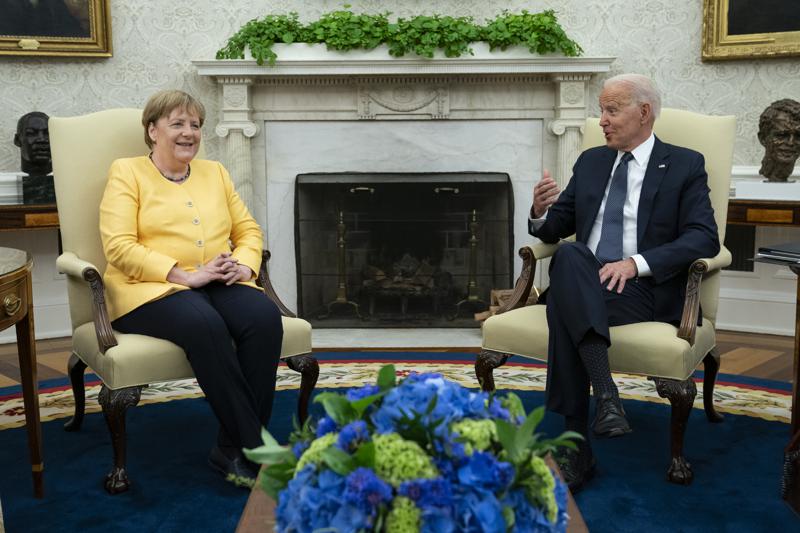
Biden and Merkel Agree to Disagree in Farewell Meeting
Biden and Merkel Agree to Disagree in Farewell Meeting
○
4 mins read
By James W. Carden viaOn Thursday afternoon, US president Joe Biden met with outgoing German chancellor Angela Merkel at the White House. By most accounts the hour long meeting was a cordial affair. Said Biden right before the meeting, “The […]
By James W. Carden via On Thursday afternoon, US president Joe Biden met with outgoing German chancellor Angela Merkel at the White House. By most accounts the hour long meeting was a cordial affair. Said Biden right before the meeting, “The cooperation between the United States and Germany is strong and we hope to continue that, and I’m confident that we will.” However, there was little progress on areas of disagreement: The US continues in its opposition to the Nord Stream 2 (NS2) pipeline which will provide liquified natural gas (LNG) from Russia directly to Germany. The US opposition is being led in the US Senate by the Republican senator from Texas Ted Cruz, who is holding up President Biden’s European ambassadorial appointments over the issue. The administration’s concerns center around the not unreasonable assumption that Ukraine’s position as a transit hub for Russian LNG will be hurt by NS2. And in the Washington of 2021, Ukraine’s grievances are, somehow, also ours. The other area of contention seems to be Washington’s wariness over Berlin and Beijing’s growing economic ties. A Reuters report released just after the meeting noted that the US and Germany also “disagree over the wisdom of partnering with China on business projects.” Given the immense damage China’s accession to the WTO has done to the American economy over the past 20 years (3.7 million jobs lost and counting) the administration is right to be focusing on overextended supply chains and re-shoring manufacturing jobs. However, the effort to pressure a close ally over how they conduct their own trade relations seems, in this instance, hypocritical at best since it was the Clinton administration (along with then-Senator Joe Biden of Delaware) that enthusiastically pushed China’s accession to the WTO. Are we really in a position to lecture others over their business dealings China? Probably not. Press reports on the Biden-Merkel meeting also invariably mention the damage a certain former American president did to US-German relations, particularly with his pledge to remove 12,000 US troops from Germany nearly 80 years after the end of the Second World War and 30 after the end of first Cold War. In April, Biden put a halt to the move. Currently, the US has 38,000 troops in Germany, while Ramstein Air Base has been used as a staging ground for US military interventions in the Middle East and North Africa. As the indispensable Norman Solomon has reported in The Nation: Ramstein serves crucial functions for drone warfare and much more. It’s the most important Air Force base abroad, operating as a kind of grand central station for airborne war—whether relaying video images of drone targets in Afghanistan to remote pilots with trigger fingers in Nevada, or airlifting special-ops units on missions to Africa, or transporting munitions for airstrikes in Syria and Iraq. Soaking up billions of taxpayer dollars, Ramstein has scarcely lacked for anything from the home country, other than scrutiny. Trump’s decision to withdraw a portion of American troops was seen as a reckless departure from US policy at the time. Yet perhaps it is worth recalling that the first man to serve as NATO Supreme Allied Commander (SACEUR), Dwight D. Eisenhower, might very well have been in agreement. In a recent study of Charles de Gaulle, the historian William Keylor notes that by 1958, President Eisenhower… …recalled that when he arrived as the first SACEUR in 1951, “there had been talk that the United States assistance to the NATO countries’ defense efforts would be for a maximum of five years.” It was high time, the president believed, to “wean,” the Allies from this excessive dependence” and “encourage them to make better efforts of their own.” The American forces had been placed in Europe “on a stop-gap emergency basis,” he argued, and where not meant to be “a permanent and definite commitment.”
Donald Trump Should Not Repeat Woodrow Wilson’s Failure
April 30th is an important date in American politics. This is the day 100 for the American President in the White House, and all attention will be on the reports of his achievements and failures. But nothing can be more critical than Peace…
○
6 mins read
A Holocaust perpetrator was just celebrated on US soil. I think I know why no one objected.
Russia’s invasion has made ordinarily outspoken critics of antisemitism wary of criticizing Ukrainian Nazi collaborators
○
1 min read
Qi Book Talk: The Culture of the Second Cold War by Richard Sakwa
Richard Sakwa has for many years been one of the most distinguished and insightful observers of relations between the West and Russia, and one of the leading critics of Western policy. In this talk with Anatol Lieven, director of the Eurasia program at the Quincy Institute, Sakwa discusses his book, The Culture of the Second Cold War (Anthem 2025). The book examines the cultural-political trends and inheritances that underlie the new version of a struggle that we thought we had put behind us in 1989. Sakwa describes both the continuities from the first Cold War and the ways in which new technologies have reshaped strategies and attitudes.