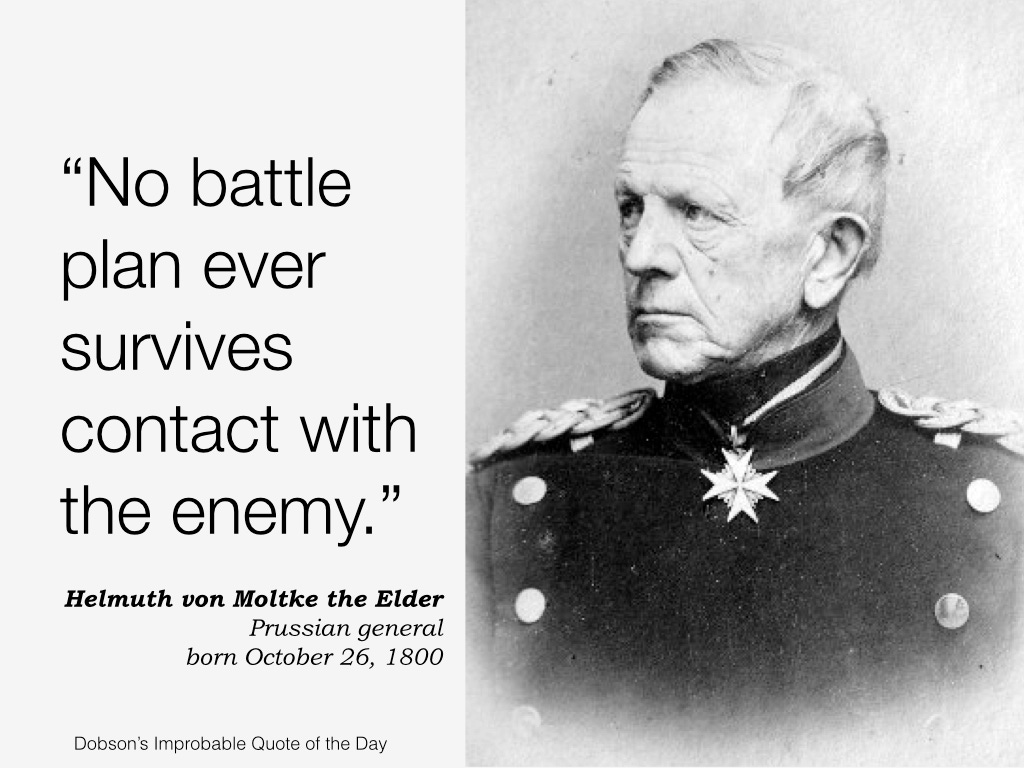
Helmuth von Moltke, a 19th Century German Field Marshall, is credited with the aphorism, “no plan survives contact with the enemy”. The essence of his observation is this — no matter how meticulously you plan a military operation, you must be prepared to adjust on the fly based on what is happening on the battlefield. Planning is a dynamic, not a static set of unit maneuvers and rules of engagement.
Which brings me to some observations about the U.S. and NATO plans at the outset of the Russian “Special Military Operation” in Ukraine (aka “invasion”). There was an awful lot of hope undergirding the West’s plan to topple Putin and break up Russia. The West bet heavily on the “hope” that the Ukrainian Army was better trained, equipped and led than their Russian counter parts. That turned out not to be true. Russia, with a numerically inferior force, quickly knocked out key military infrastructure in the early days of the war, which included radars, air fields, air defense systems and aircraft. Western planners apparently did not realize that the ability of Ukrainian pilots to target Russian combat aircraft hinged on a ground radar system that Russia obliterated within the first 24 hours of the attack.
Western “hopium” also banked on the Russian military being a motley collection of angry conscripts led by a bevy of fat, corrupt generals raking in cash from criminal entrepreneurial endeavors. When Russia unleashed hypersonic missiles on Yavoriv — a de facto NATO base in western Ukraine near the Polish border — Western planners were caught by complete surprise. Still, notwithstanding the success of that attack, Western intelligence continued to insist during the first few months of the invasion that Russia fielded a Potemkin army and its luck was bound to run out.
Hopium also was the refrain, starting the end of March 2022, with respect to Russia’s ability to launch missile attacks. I wrote about this last November (FOR THE LOVE OF GOD, SOMEONE TELL PUTIN HE’S OUT OF PRECISION MISSILES!!). Here is one of the early examples from April 2022.
“Russian have exhausted more than half their missile stocks against Ukraine, reports Uraaine’s Ministry:
The West’s “hope” strategy also bet the farm that the West could easily isolate Russia on the international stage and devastate its economy with sanctions. Whoops!! Instead of isolating Russia and inflicting economic chaos, Russia quickly responded and re-established itself as a leader of the Global South, coalesced with China in a de facto alliance, and ramped up its defense industry to levels not seen since World War II. I think the quote attributed to Admiral Yamamoto at the end of the movie, Tora, Tora, Tora, captures the unexpected results of Western hubris — “I fear all we have done is to awaken a sleeping giant and fill him with a terrible resolve.”
The West was put on notice over the past week by Russian leaders. Foreign Minister Lavrov, Defense Chief Shoigu, former President Medvedev and Speaker of the Duma Volodin all communicated a simple message — Ukraine must capitulate or it will cease to exist as a nation.
Donald Trump Should Not Repeat Woodrow Wilson’s Failure
April 30th is an important date in American politics. This is the day 100 for the American President in the White House, and all attention will be on the reports of his achievements and failures. But nothing can be more critical than Peace…
○
6 mins read
A Holocaust perpetrator was just celebrated on US soil. I think I know why no one objected.
Russia’s invasion has made ordinarily outspoken critics of antisemitism wary of criticizing Ukrainian Nazi collaborators
○
1 min read
Qi Book Talk: The Culture of the Second Cold War by Richard Sakwa
Richard Sakwa has for many years been one of the most distinguished and insightful observers of relations between the West and Russia, and one of the leading critics of Western policy. In this talk with Anatol Lieven, director of the Eurasia program at the Quincy Institute, Sakwa discusses his book, The Culture of the Second Cold War (Anthem 2025). The book examines the cultural-political trends and inheritances that underlie the new version of a struggle that we thought we had put behind us in 1989. Sakwa describes both the continuities from the first Cold War and the ways in which new technologies have reshaped strategies and attitudes.