Country’s counteroffensive hasn’t achieved a breakthrough, and global attention is shifting to conflict in the Middle East
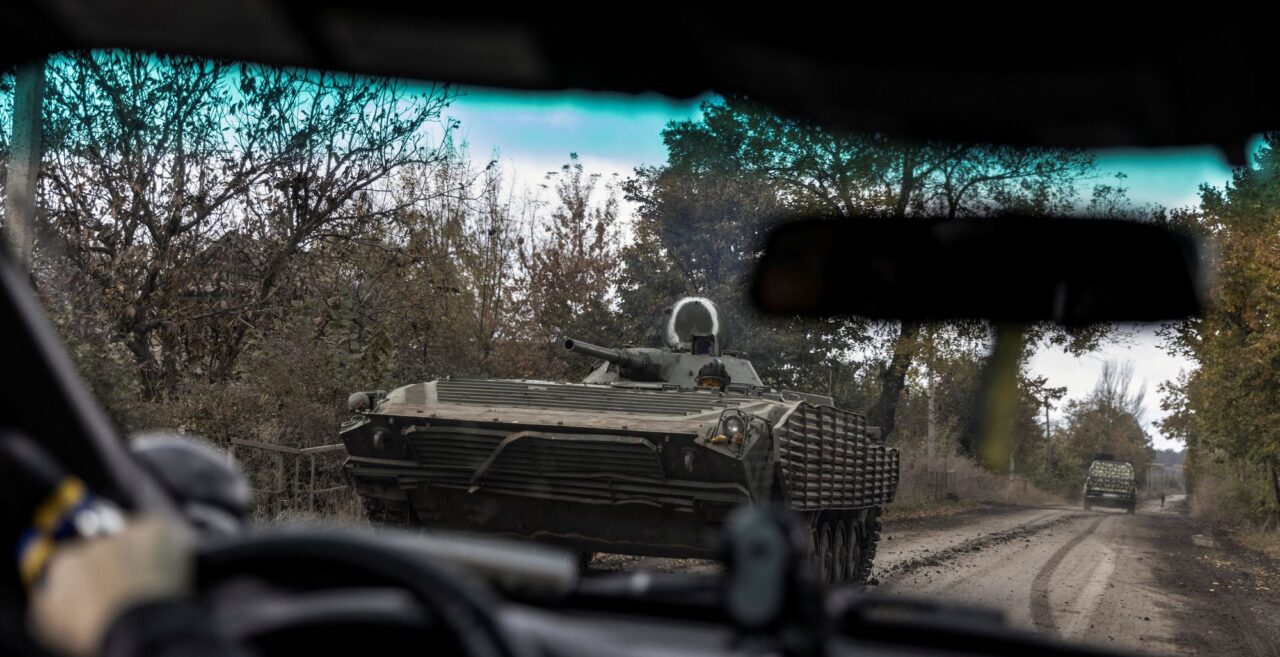
An armored vehicle in Avdiivka, where Ukraine repelled a Russian offensive. YEVHEN TITOV/REUTERS
When Ukrainian armored vehicles breached the main Russian defensive line in southeastern Ukraine last month, it raised hopes for a decisive breakthrough.
It hasn’t happened. Instead, nearly five months into the counteroffensive, Ukrainian infantry are still toiling forward in small groups along tree lines packed with Russian trench systems and mines while under fire from artillery and explosive aerial drones.
“We are advancing,” said one officer serving in southeastern Ukraine, “but it doesn’t look like a breakthrough.”
Russia, meanwhile, launched an offensive of its own this month to try to seize the eastern city of Avdiivka, suggesting Moscow thinks the Ukrainian counteroffensive is running out of steam. Russian forces gained very little ground at the cost of dozens of armored vehicles and hundreds of troops, according to Ukraine’s military.
Ukraine’s failure, so far, to slice deep into occupied territory presents a series of political and military challenges for Kyiv and its Western backers, who want to avoid a stalemate.
Ukraine will need to raise and train more troops while at the same time keeping pressure on Russian forces to prevent them from further strengthening defensive lines. Ukraine’s supporters will have to muster additional financial and military support amid political headwinds in the U.S. and a fresh conflict in the Middle East that is demanding attention and resources.
European diplomats say Western governments might be distracted and slower to react to developments on the ground in Ukraine. Israeli military operations could also force the U.S. and allies to divert ammunition from Ukraine, diplomats say, particularly if Israel is drawn into a war with Hezbollah militants in Lebanon as well as Hamas in Gaza.
President Biden has said the U.S. can support both. In an Oval Office address Thursday, he tied support for Ukraine and Israel together, saying the world was facing “an inflection point in history.” On Friday, Biden sent a supplemental funding request to Congress including $14 billion for Israel and $61 billion for Ukraine. But the Republican-led House remains without a speaker to shepherd the legislation amid friction over continuing support to Ukraine, which is opposed by the leading GOP contender for the presidential nomination, former President Donald Trump.
In the address, Biden cited a recent comment by Russian President Vladimir Putin that Ukraine wouldn’t survive more than a week if the West withdrew its backing.
“But we’re not withdrawing,” Biden said.
There have been positive signs for Ukraine in recent weeks. Ukraine for the first time used long-range missiles provided by the U.S. to strike two Russian airfields, demonstrating how they can be used to damage Russian military equipment and logistical hubs well behind the front line. And in the east, Ukraine’s repelling of the offensive against Avdiivka demonstrated Moscow’s own difficulties to achieve even small gains.
Ukraine and its backers had hoped that thousands of troops equipped by the West with armored vehicles could make a significant advance in the southeast that would cut Russian occupying forces in two and turn the war decisively in Kyiv’s favor. But attempts at lightning thrusts were thwarted by fortified Russian defenses, including dense minefields, south of the Ukrainian city of Orikhiv.
Ukrainian forces pressed forward slowly in small infantry groups, piercing the main defensive line of antitank barriers, including a ditch and concrete obstacles known as dragon’s teeth. But progress has been slow, thwarting hopes that armored vehicles could smash southward.
“We are exhausted,” said the Ukrainian officer in the area. “There were big losses.”
Russia quickly sent reserves to shore up its defenses. Fortifications on and behind the main line proved dense and located in advantageous positions on higher ground with clear views over broad and flat agricultural areas, Ukrainian soldiers said. Every line of trees on the edge of a field is a defensive complex of trenches, bunkers and firing positions for machine guns and antitank missiles. Even reaching the front line is a perilous journey along thin paths that have been cleared of mines but are often known to the Russians, who spot movements from aerial surveillance drones, then use mortars or explosive drones to attack Ukrainian troops.
Russian forces are using 1,100-pound guided bombs, adapted from Soviet-era munitions, to hit farm buildings or houses that look like they could shelter troops or vehicles, said Oleksandr Solonko, a Ukrainian drone operator who was deployed in the area until recently. The Russians even target roads in an attempt to hamper movements, he said.
One problem for Ukraine is that slow advances give Russia the chance to prepare new defenses. Still, Ukrainian forces recently received an injection of fresh troops and are fighting for the high ground around the village of Novoprokopivka. Every mile gained makes it easier for Ukraine to strike Russian supply lines along the coast of the Sea of Azov.
“The closer we are to the sea, we can reach their rear and it won’t be easy for them,” said Solonko.
New ATACMS missiles provided by the U.S. will allow Ukraine to strike almost anywhere in occupied territory, destroying military equipment and hampering logistics. On Tuesday, Ukraine for the first time used the missiles to strike two airfields, saying they destroyed nine Russian helicopters that have long menaced Ukrainian troops and armored vehicles in the south.
Ukraine is also seeking to surprise the Russians elsewhere on the 600-mile-long front line. Russian war bloggers say Ukrainian forces have crossed the Dnipro River in the south near the city of Kherson and are seeking to establish a bridgehead. Ukraine hasn’t commented.
A Ukrainian advance around the occupied eastern city of Bakhmut in September has gained the high ground over the city and its surroundings and pinned down Russian forces there.
At the same time, Ukraine has so far thwarted Russian attempts to advance in the northeast toward Kupyansk, which Ukraine retook last fall, and the eastern city of Avdiivka.
Russia launched an assault on that industrial city on Oct. 10 after weeks of trying to soften up Ukrainian defenses with artillery and self-detonating drones. Ukrainian defenders rushed to rebuild defenses almost every night, carrying logs and digging new fortifications, soldiers there said.
Russia sent columns of tanks and other armored vehicles from the north and south in an effort to surround the city. Videos shared on social media by Ukrainian units show Ukrainian artillery and antitank missiles smashing into one Russian vehicle after another.
Russian infantry sought to advance into the city, which Ukraine has been defending since 2014, when Russia covertly sent its military to install separatist leaders in eastern Ukraine.
One Ukrainian soldier from the 110th Mechanized Brigade, which is defending inside the city, described how they stood firm against waves of assaults.
The soldier, a 50-year-old factory worker from central Ukraine who gave his name only as Serhiy, said the Russians tried unorthodox tactics, such as digging a 100-yard tunnel then emerging from it close to Ukrainian positions. But the Ukrainian soldiers had noticed and killed a half-dozen of them, injured more, and forced the rest to retreat.
At one point, the Russians managed to push forward a little along the road toward the industrial zone in Avdiivka’s southeast and started to use an armored vehicle to bring forward more supplies and troops. But the Ukrainians were watching and destroyed it with an antitank missile, killing the dozen Russians inside.
“They thought we couldn’t reach them, but we could,” said Serhiy. “Now they go only on foot.”
After a few days, attacks died down as the Russians ran out of men and vehicles. They had advanced a few hundred yards and taken only a few positions that are vulnerable and costly to hold, Serhiy said.
The Russians launched a fresh assault on Oct. 19, again with little success.
“We know every bush here, every road,” said Serhiy.
The details of the peace deal presented today by US special envoy Steve Witkoff are consistent with the report in the Financial Times discussed in my previous article and with Larry Sparano in the posted interview. Putin will halt the Russian advance prior to driving Ukrainian soldiers out of all of the territory that has been reincorporated into Russia. It appears to be the case that the borders between Russia and Ukraine will be the current front line, so Putin is withdrawing Russia’s claim to the Russian territories still under Ukrainian occupation.
Russia and the US seem near a Ukraine peace deal. Kyiv’s role may be moot.
President Donald Trump’s hopes of securing a quick Ukraine peace deal hang in the balance after Washington’s envoy, Steve Witkoff, held his fourth Kremlin meeting with Russian President Vladimir Putin Friday.