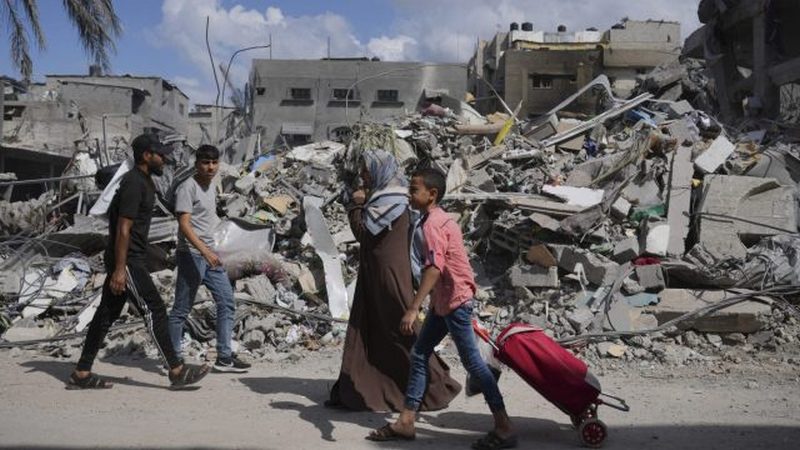
Palestinians by the buildings destroyed in Israeli airstrikes in Bureij refugee camp, Gaza Strip, Wednesday, Oct. 18, 2023. (AP Photo/Hatem Moussa)
These words attributed to Prussian general and military strategist Carl von Clausewitz have been repeated so often they now appear banal. But their truth should remind us that war is never an end in itself. War should only be undertaken when all other means have been exhausted. Even then, a realistic and achievable political outcome must remain clearly in view. Otherwise, even success on the battlefield will lead to failure.
Whatever outcome Hamas thought it might achieve by carrying out such atrocities, the result will hardly be positive for the Palestinian people. The truly brutal attacks by Hamas on innocent Israeli citizens have now led to an almost inevitable reaction: a war to remove Hamas as a threat. Yet the military invasion of Gaza is already creating a humanitarian disaster, undercutting the widespread sympathy and support Israel received. Even if the leadership of Hamas is somehow eradicated, the resulting suffering of innocent Gazans will likely reinforce the grievances that led to Hamas.
The terrorist attacks have been called “Israel’s 9/11.” That analogy should prompt a search for lessons learned. The earlier terrorist attack on the U.S. also led a reflexive military reaction: a prolonged “war on terror” with the invasion and intractable occupations of Iraq and Afghanistan. Innumerable lives were lost, and the threat from al Qaeda morphed into ISIS.
The same logic, sadly, is at work in the Russian war with Ukraine. Viewing NATO expansion as a threat, Putin sought a military solution — a full invasion of Ukraine in the apparent belief that his forces would take Kyiv within days. Such thinking was folly and delusion. Rather than deterring NATO expansion, Russia’s invasion prompted formerly neutral Sweden and Finland to join the alliance, and public opinion within Ukraine — formerly opposed to membership — swung decisively in favor of joining.
But Western powers display their own folly in seeking a military solution. Ukrainians understandably want to repel their invaders. Debates in the West continue about whether the provision of HIMARS, F-16s, ATACMS, and Abrams and Leopard tanks will somehow lead to a decisive victory. Yet with Russian forces dug into rings of defensive positions, more sober analysis must ask what realistically can be gained through greater destruction and loss of life. Publics inevitably tire of war, especially those not immediately threatened but asked to sacrifice, as is already evident in the U.S. and Europe. Yet the Biden administration is apparently telling Congress that the war could last for three to five years – about as long as WWI’s futile trench warfare.
Then there is the deteriorating relationship between the U.S. and China, where if pundits and politicians are to be believed we are slow-walking into an inevitable military confrontation over Taiwan. Unlike the war in Ukraine, this would be a direct clash between two nuclear states. Moreover, the U.S. and China are the world’s two greatest economic powers. An overt conflict between them could well lead to the mutually assured destruction of the global economy.
The misplaced faith in military solutions prompts ever-increasing demands to expend more resources on weapons of war. While a polarized and dysfunctional U.S. Congress struggles to choose a speaker of the House, a congressionally appointed bipartisan panel has now called for intensifying our nuclear arsenal and preparing to fight a war with both Russia and China at the same time.
Such thinking is not only delusional; it is dangerous. Preparing for war inevitably detracts from solving truly existential challenges. Greater military arsenals will not help solve the impending catastrophe of our climate, or the next worldwide pandemic, or the next global economic crisis. Nor will it alleviate the suffering of various people at home and around the world, suffering that leads to polarization and the search for extreme solutions.
All too often, the search for such solutions leads to violence and war. We must work to convince those choosing such a path — whether stateless terrorists or global superpowers — that that road leads only to greater death and destruction.
Donald Trump Should Not Repeat Woodrow Wilson’s Failure
April 30th is an important date in American politics. This is the day 100 for the American President in the White House, and all attention will be on the reports of his achievements and failures. But nothing can be more critical than Peace…
○
6 mins read
A Holocaust perpetrator was just celebrated on US soil. I think I know why no one objected.
Russia’s invasion has made ordinarily outspoken critics of antisemitism wary of criticizing Ukrainian Nazi collaborators
○
1 min read
Qi Book Talk: The Culture of the Second Cold War by Richard Sakwa
Richard Sakwa has for many years been one of the most distinguished and insightful observers of relations between the West and Russia, and one of the leading critics of Western policy. In this talk with Anatol Lieven, director of the Eurasia program at the Quincy Institute, Sakwa discusses his book, The Culture of the Second Cold War (Anthem 2025). The book examines the cultural-political trends and inheritances that underlie the new version of a struggle that we thought we had put behind us in 1989. Sakwa describes both the continuities from the first Cold War and the ways in which new technologies have reshaped strategies and attitudes.