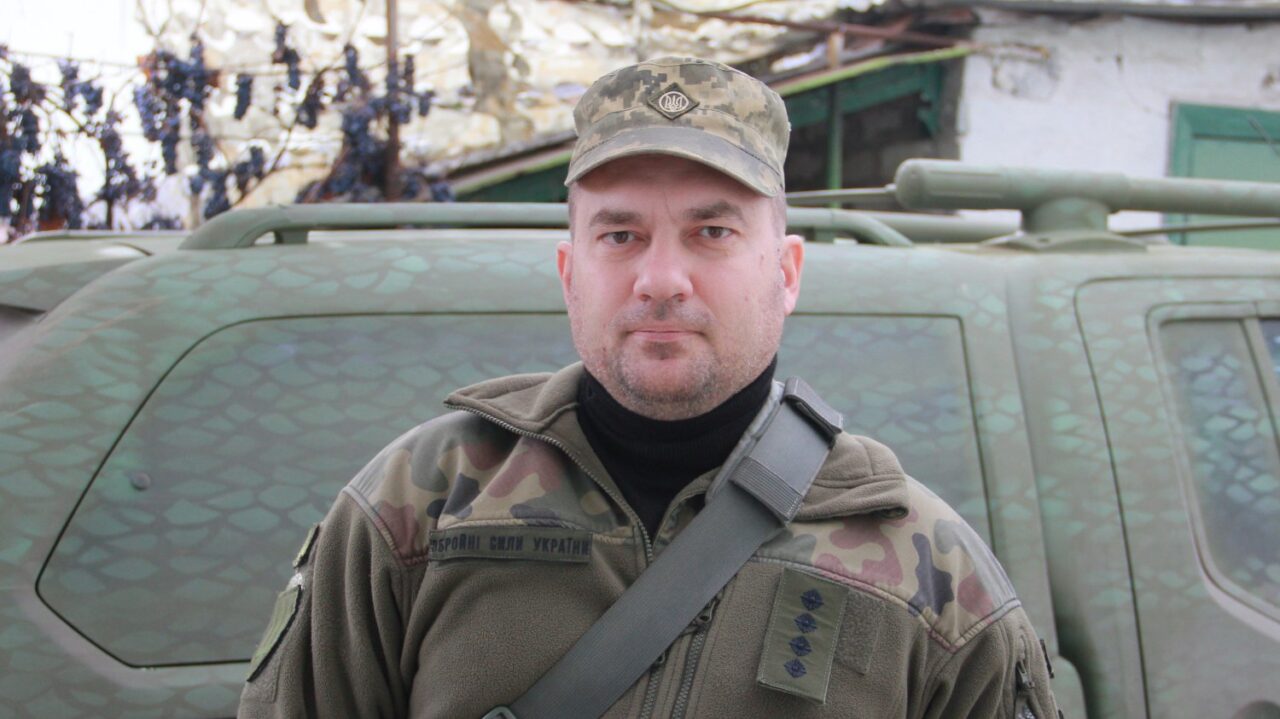
Zelensky insists his army can beat Russia, but ground troops say otherwise
Dmytro Berlym, a battalion commander with Ukraine’s 32nd brigade, said: “Everyone will dig in — like in the First World War”
In the Ukrainian village of Kupyansk Vuzlovyi, seven miles from Russian lines, the relentless boom of artillery and the clatter of air defence guns is a noisy reminder that there is no end in sight to Europe’s biggest war since 1945.
Russia’s invading army is making minuscule advances here, with success measured out in ravines littered with corpses and fields soaked in blood, as it tries to recapture Kupyansk, a transport hub that was held by President Putin’s forces for six months last year.
The intensifying battle for the town, 25 miles from the Russian border, has been described by Ukraine’s ground forces as one of the “hottest” on the 600-mile front. But advanced drones on both sides and Russia’s fortification of its defensive lines mean there are few prospects of a significant breakthrough.
“We see everything as they try to advance, all their manoeuvres. And they do the same. Every movement of every soldier is visible, and everything can be predicted,” Dmytro Berlym, a battalion commander with Ukraine’s 32nd brigade, told The Times during an interview at a makeshift base for soldiers resting from combat action. When asked what form the war would take now, he replied without hesitation: “Trench warfare. Everyone will dig in. Like in the First World War.”
Although Russia was forced into a series of humiliating retreats last year, it has repelled Ukraine’s counteroffensive and built vast minefields that have slowed its advances. Twenty months on since the start of the war, Russia still occupies about one fifth of Ukraine’s territory.
Putin’s army is also launching waves of attacks to try to capture Avdiivka in the Donetsk region. On Saturday, about 20 Ukrainian soldiers were said to have been killed when a Russian Iskander ballistic missile hit an award ceremony near the front line in the Zaporizhzhia region.
“We are running out of people and the quality of our reinforcements is lower every time,” said Berlym, a former police officer who rose rapidly through the ranks after joining the military at the start of the invasion. “The average age of a soldier in my battalion is 45.” He paused to give orders on a field communications device.
Western weapons secured after months of pleading came too late to make a difference in the war, Berlym said. “If we had received American and German tanks last autumn, then the breakthrough to Crimea would have been successful. But by the time we got them they had laid mines everywhere and the tanks couldn’t play the role they were supposed to.”
Mykhailo Lysenko, a chief of staff in the battalion, nodded. “A tank breakthrough on our part is now something from the realm of science fiction,” he said.
Both men said that they had attended Nato training sessions before the counteroffensive but that almost none of the tactics they learnt were effective against massed Russian forces.
“The basic principle that we were taught is that you must see the enemy before they see you in order to call in artillery, mortars, planes and destroy them,” Lysenko said. “This is impossible. Here the enemy knows where you are sitting. You know where the enemy is sitting. We just watch each other.”
Last week General Zaluzhny, the head of the Ukrainian army, said that the war had reached a stalemate that could only be broken by unspecified technological advances akin to the invention of gunpowder.
Zaluzhny admitted that American F-16 fighter jets that are due next spring would not be the game-changer as hoped because Russia had improved its air defences. “These systems were most relevant to us last year, but they only arrived this year,” he told The Economist.
His comments appeared to cause a rift with President Zelensky. Ihor Zhovkva, in the presidential office, issued a rare rebuke of Zaluzhny, telling national television that the military should refrain from commenting on the war. He also said that western officials had called him “in a panic” to ask if Ukraine had abandoned hope of driving back Putin’s forces. “Is this the effect we wanted to achieve?” he asked.
Zelensky denied that the war was at an unsurmountable deadlock. “Time has passed, and people are tired. But this is not a stalemate,” he said during a meeting with Ursula von der Leyen, president of the European Commission, in Kyiv. “We have no right to give up. Because what is the alternative?”
Separately, he said that Ukraine would not hold talks with Russia or surrender land to Moscow. “We are not ready to give our freedom to this f***ing terrorist Putin,” he told NBC News.
His remarks came after he abruptly dismissed General Khorenko, one of Zaluzhny’s deputies, in a move seen as a warning to Ukraine’s top general. However, the public’s unwavering support appears to be for the armed forces rather than the government. There have been protests across the country in recent months over what critics say is the misuse of funds during wartime.
Berlym and his comrades said that while they understood the frustrations of protesters, now was the time for solidarity. “When we come back from the war, we’ll sort it out. Everyone will answer for where they were during the war and what they did. Everyone.”
In the town of Kupyansk, locals and soldiers ignored yet another air raid siren to shop at an open-air street market, stocking up on food and clothes for winter. Every other building in the town showed signs of shell damage and many were mangled ruins, including a factory that was once a big employer.
“If we don’t get 20 to 30 incoming missiles a day, then we consider that quiet,” Oleksandr, a stall owner, said. A nervous police officer scanned the sky. “It’s a perfect day for drones,” he told me. “Don’t stick around too long.”
City moves underground
Last month almost 60 people were killed when an Iskander missile slammed into the village of Groza. A short time later, eight people died in Kharkiv city when two S-300 missiles struck a postal distribution centre. The missiles were fired from Belgorod, 20 miles away in Russia.
Kharkiv is so close to Russia that missiles can hit targets before the air raid sirens sound. Public events have been banned since the start of the war and children have studied mostly online, with some lessons taking place in metro stations.
Ihor Terekhov, the city mayor, said Kharkiv was planning build its first underground school so that children could continue to study even during air raid sirens. His comments came as opera singers began rehearsing for concerts in a bomb shelter under the city’s Soviet-era Congress Hall.
“We are trying to establish a normal life, if we can call it that, in these conditions,” Oleh Syniehubov, Kharkiv’s regional governor, told The Times. “The enemy will always be close and we have to be ready for any of its sick plans.”
The details of the peace deal presented today by US special envoy Steve Witkoff are consistent with the report in the Financial Times discussed in my previous article and with Larry Sparano in the posted interview. Putin will halt the Russian advance prior to driving Ukrainian soldiers out of all of the territory that has been reincorporated into Russia. It appears to be the case that the borders between Russia and Ukraine will be the current front line, so Putin is withdrawing Russia’s claim to the Russian territories still under Ukrainian occupation.
Russia and the US seem near a Ukraine peace deal. Kyiv’s role may be moot.
President Donald Trump’s hopes of securing a quick Ukraine peace deal hang in the balance after Washington’s envoy, Steve Witkoff, held his fourth Kremlin meeting with Russian President Vladimir Putin Friday.