Even Republicans who support arming Ukraine are skeptical of providing more cash to the country’s government
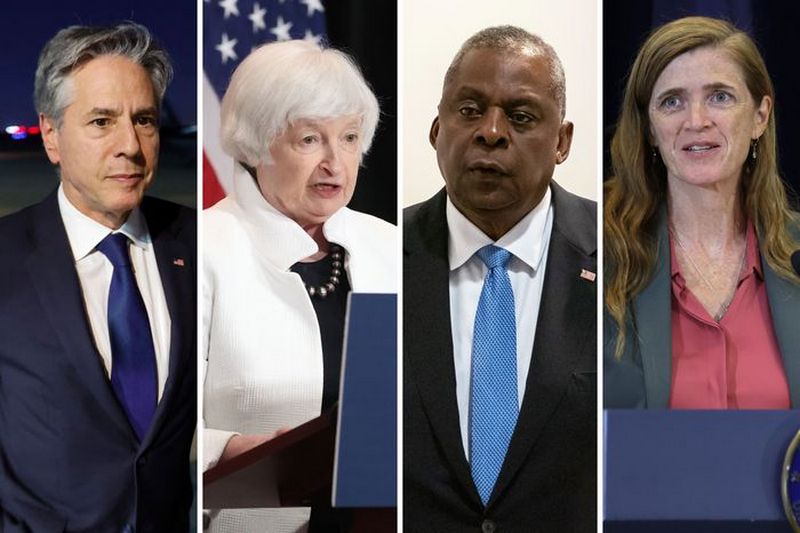
From left, Secretary of State Antony Blinken, Treasury Secretary Janet Yellen, Defense Secretary Lloyd Austin and Agency for International Development Administrator Samantha Power wrote a letter asking for $11.8 billion in aid to Ukraine. PHOTO: JONATHAN ERNST/PRESS POOL; RONDA CHURCHILL/BLOOMBERG NEWS; NATHAN HOWARD/AP; ALEX WONG/GETTY IMAGES
WASHINGTON—Biden administration officials are pressing Congress to approve more economic aid to Ukraine, trying to overcome growing Republican opposition to financial support that has stabilized the Ukrainian economy after Russia’s invasion.
In a letter sent to Capitol Hill, four top Biden administration officials urged lawmakers to provide $11.8 billion in direct budget support to Kyiv to help pay its day-to-day bills. While Republicans are divided over whether to supply Ukraine with more materiel, there is broad skepticism within the GOP over offering more economic aid.
That stance has alarmed the Biden administration, which is seeking the money as part of a roughly $106 billion emergency funding request covering Ukraine, Israel and other issues.
“If Russia can destroy Ukraine’s economy, it will hobble the Ukrainian state to the point that it cannot defend itself on the battlefield,” wrote Treasury Secretary Janet Yellen, Defense Secretary Lloyd Austin, Secretary of State Antony Blinken and U.S. Agency for International Development Administrator Samantha Power. The group sent the letter to House Speaker Mike Johnson (R., La.), Senate Majority Leader Chuck Schumer (D., N.Y.) and other top lawmakers.
The U.S. has already sent roughly $27 billion in economic support to Ukraine, a sum that has helped nurture an economic rebound in the war-torn country.
Ukraine’s economy fell into a deep recession after Russia invaded in 2022, contracting 29% that year. More recently, even as Russia occupies swaths of eastern Ukraine, the economy has started to grow, with activity expanding in the second quarter for the first time since the start of the war.
Aid from the U.S., as well as the European Union and other Western allies, has helped Ukraine pay for nonmilitary government expenses like payroll for civil servants. Perhaps more important, the funds have meant the country could stop monetizing its own debt, which spurred inflation early on in the invasion, and ease its currency controls. Those steps help create economic activity that fill the government’s coffers and support a domestic debt market to pay for the war.
A sudden halt to U.S. economic aid would derail those economic gains, likely requiring the central bank to start buying the country’s debt and printing money again. A $15.6 billion International Monetary Fund program supporting Ukraine is also premised upon continued aid from the U.S. and its allies; a stop to U.S. help would throw the IMF lending plans into disarray.
“If we miss the sufficient and regular financial support from the United States, this will undermine the very basis of this financial stability,” Andriy Pyshnyi, the governor of Ukraine’s central bank, said in an interview last month.
Still, after almost two years of war, American voters have increasingly started to question whether the U.S. should keep forking over money to the Eastern European country. Republicans have targeted the economic aid as particularly unnecessary, with some lawmakers saying they would support military aid, but not financial.
In their letter, the Biden administration officials stressed that the financial support feeds into Ukraine’s military fighting power. They also said that the U.S. isn’t an outlier in supporting Ukraine, noting that Canada and the EU are providing more aid as a share of their gross domestic product this year.
“Our allies and partners are stepping up; however, financing from others cannot make up for the large gap that would quickly emerge if the United States were to abandon its commitment to Ukraine,” they wrote.
The debate over the Ukraine aid is also caught up in a struggle between Republicans and Democrats over funding the government, supporting Israel and addressing migration at the U.S.-Mexico border. House Republicans spent weeks in disarray earlier this year over simply keeping the U.S. government open temporarily.
The details of the peace deal presented today by US special envoy Steve Witkoff are consistent with the report in the Financial Times discussed in my previous article and with Larry Sparano in the posted interview. Putin will halt the Russian advance prior to driving Ukrainian soldiers out of all of the territory that has been reincorporated into Russia. It appears to be the case that the borders between Russia and Ukraine will be the current front line, so Putin is withdrawing Russia’s claim to the Russian territories still under Ukrainian occupation.
Russia and the US seem near a Ukraine peace deal. Kyiv’s role may be moot.
President Donald Trump’s hopes of securing a quick Ukraine peace deal hang in the balance after Washington’s envoy, Steve Witkoff, held his fourth Kremlin meeting with Russian President Vladimir Putin Friday.