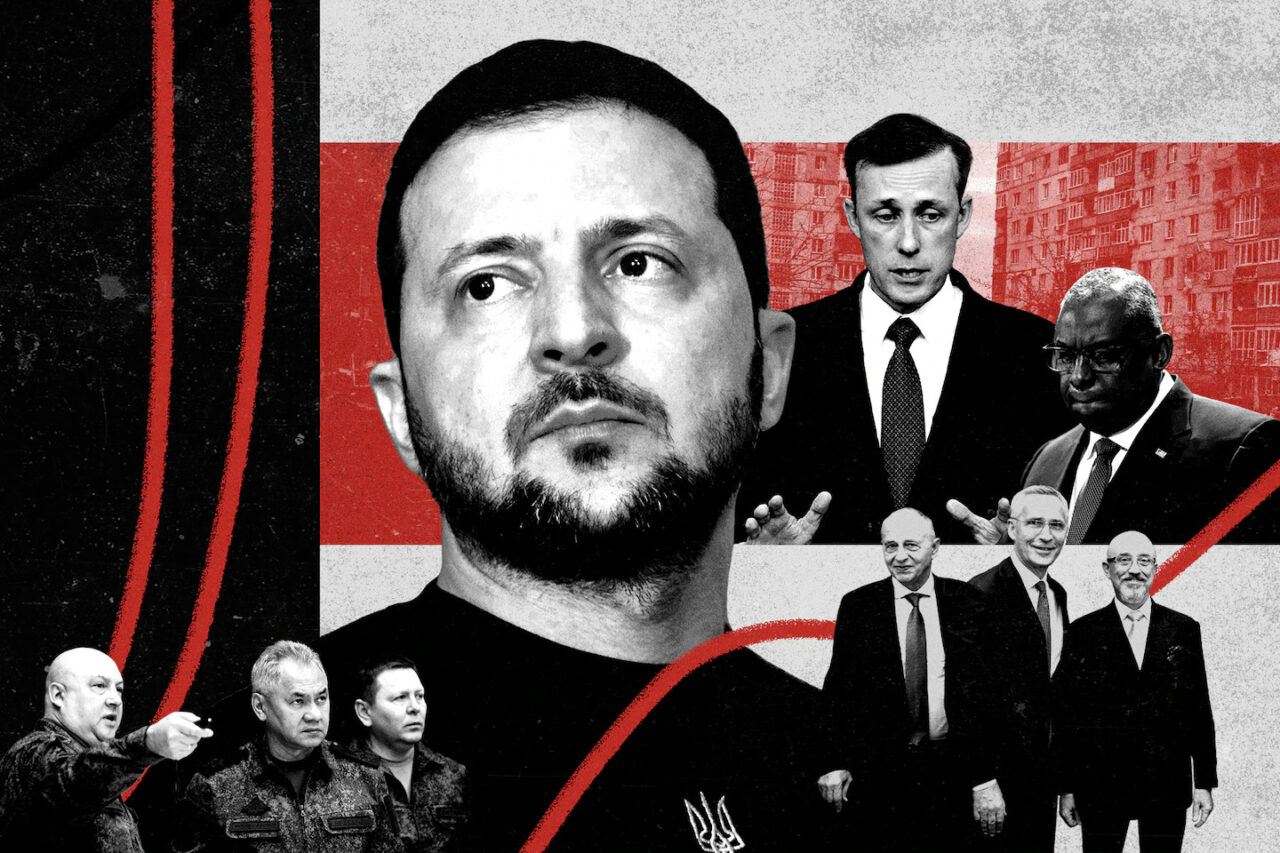
On June 15, in a conference room at NATO headquarters in Brussels, Defense Secretary Lloyd Austin, flanked by top U.S. commanders, sat around a table with his Ukrainian counterpart, who was joined by aides from Kyiv. The room was heavy with an air of frustration.
Austin, in his deliberate baritone, asked Ukrainian Defense Minister Oleksii Reznikov about Ukraine’s decision-making in the opening days of its long-awaited counteroffensive, pressing him on why his forces weren’t using Western-supplied mine-clearing equipment to enable a larger, mechanized assault, or using smoke to conceal their advances. Despite Russia’s thick defensive lines, Austin said, the Kremlin’s troops weren’t invincible.
Reznikov, a bald, bespectacled lawyer, said Ukraine’s military commanders were the ones making those decisions. But he noted that Ukraine’s armored vehicles were being destroyed by Russian helicopters, drones and artillery with every attempt to advance. Without air support, he said, the only option was to use artillery to shell Russian lines, dismount from the targeted vehicles and proceed on foot.
“We can’t maneuver because of the land-mine density and tank ambushes,” Reznikov said, according to an official who was present.
The meeting in Brussels, less than two weeks into the campaign, illustrates how a counteroffensive born in optimism has failed to deliver its expected punch, generating friction and second-guessing between Washington and Kyiv and raising deeper questions about Ukraine’s ability to retake decisive amounts of territory.
As winter approaches, and the front lines freeze into place, Ukraine’s most senior military officials acknowledge that the war has reached a stalemate.
This examination of the lead-up to Ukraine’s counteroffensive is based on interviews with more than 30 senior officials from Ukraine, the United States and European nations. It provides new insights and previously unreported details about America’s deep involvement in the military planning behind the counteroffensive and the factors that contributed to its disappointments. The second part of this two-part account examines how the battle unfolded on the ground over the summer and fall, and the widening fissures between Washington and Kyiv. Some of the officials spoke on the condition of anonymity to discuss sensitive deliberations.
Key elements that shaped the counteroffensive and the initial outcome include:
- Ukrainian, U.S. and British military officers held eight major tabletop war games to build a campaign plan. But Washington miscalculated the extent to which Ukraine’s forces could be transformed into a Western-style fighting force in a short period — especially without giving Kyiv air power integral to modern militaries.
- U.S. and Ukrainian officials sharply disagreed at times over strategy, tactics and timing. The Pentagon wanted the assault to begin in mid-April to prevent Russia from continuing to strengthen its lines. The Ukrainians hesitated, insisting they weren’t ready without additional weapons and training.
- U.S. military officials were confident that a mechanized frontal attack on Russian lines was feasible with the troops and weapons that Ukraine had. The simulations concluded that Kyiv’s forces, in the best case, could reach the Sea of Azov and cut off Russian troops in the south in 60 to 90 days.
- The United States advocated a focused assault along that southern axis, but Ukraine’s leadership believed its forces had to attack at three distinct points along the 600-mile front, southward toward both Melitopol and Berdyansk on the Sea of Azov and east toward the embattled city of Bakhmut.
- The U.S. intelligence community had a more downbeat view than the U.S. military, assessing that the offensive had only a 50-50 chance of success given the stout, multilayered defenses Russia had built up over the winter and spring.
- Many in Ukraine and the West underestimated Russia’s ability to rebound from battlefield disasters and exploit its perennial strengths: manpower, mines and a willingness to sacrifice lives on a scale that few other countries can countenance.
- As the expected launch of the offensive approached, Ukrainian military officials feared they would suffer catastrophic losses — while American officials believed the toll would ultimately be higher without a decisive assault.
The year began with Western resolve at its peak, Ukrainian forces highly confident and President Volodymyr Zelensky predicting a decisive victory. But now, there is uncertainty on all fronts. Morale in Ukraine is waning. International attention has been diverted to the Middle East. Even among Ukraine’s supporters, there is growing political reluctance to contribute more to a precarious cause. At almost every point along the front, expectations and results have diverged as Ukraine has shifted to a slow-moving dismounted slog that has retaken only slivers of territory.
“We wanted faster results,” Zelensky said in an interview with the Associated Press last week. “From that perspective, unfortunately, we did not achieve the desired results. And this is a fact.”
Together, all these factors make victory for Ukraine far less likely than years of war and destruction.
The campaign’s inconclusive and discouraging early months pose sobering questions for Kyiv’s Western backers about the future, as Zelensky — supported by an overwhelming majority of Ukrainians — vows to fight until Ukraine restores the borders established in its 1991 independence from the Soviet Union.
“That’s going to take years and a lot of blood,” a British security official said, if it’s even possible. “Is Ukraine up for that? What are the manpower implications? The economic implications? Implications for Western support?”
The year now stands to end with Russian President Vladimir Putin more certain than ever that he can wait out a fickle West and fully absorb the Ukrainian territory already seized by his troops…