The drumbeats of war have grown louder. The past few weeks have seen a slew of highly coordinated and non-accidental warnings about a major European war looming on the horizon.
Friends, unfortunate developments have required me to take my digital security more seriously, so I will be trialing some paid-only articles, particularly ones revolving around more ‘sensitive’ or provocative subject matter—while the regular SITREPs will remain open/free. As to what the mentioned developments are, I am planning to cover that in a detailed writeup soon—hopefully in the next few days—so stay tuned.
This article however is of such pressing matter I may consider making it public after a certain amount of time. But despite that I highly encourage all fence-sitters to go ahead and pull the trigger on a full paid subscription/membership to gain access to the many more indepth essays I have planned for what is shaping up to be a geopolitically explosive and unprecedented year.
It’s a long piece of which I will leave roughly 1/3 open, so free subscribers can read pretty much the central and most important exegesis. The larger portion after that will cover it in much finer detail, with more examples and implications for the future.
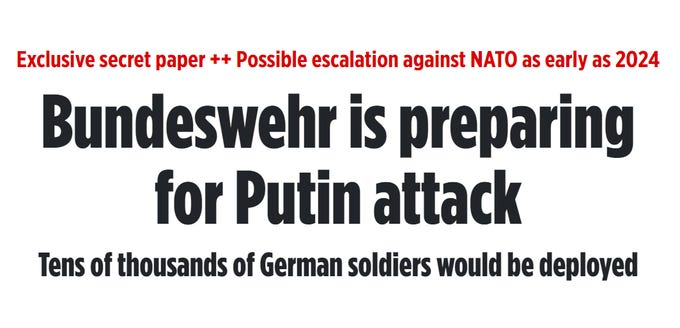
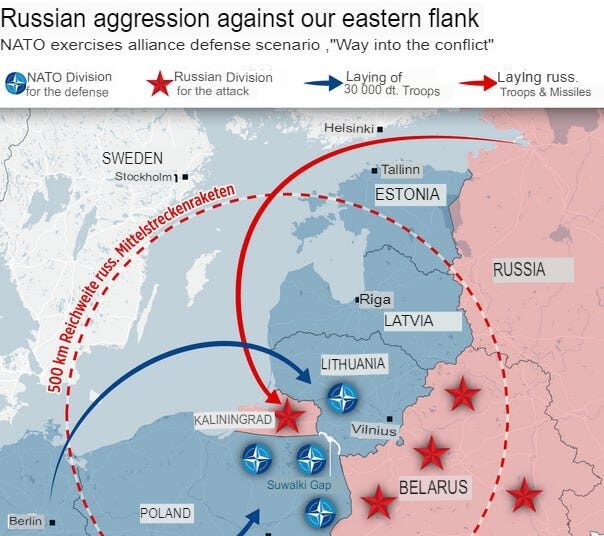
Here from Julian Roepcke at BILD:
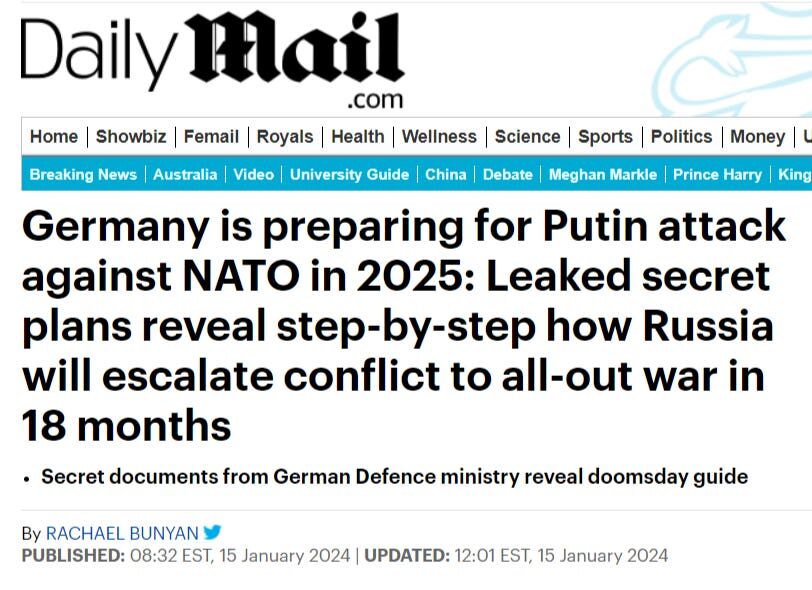
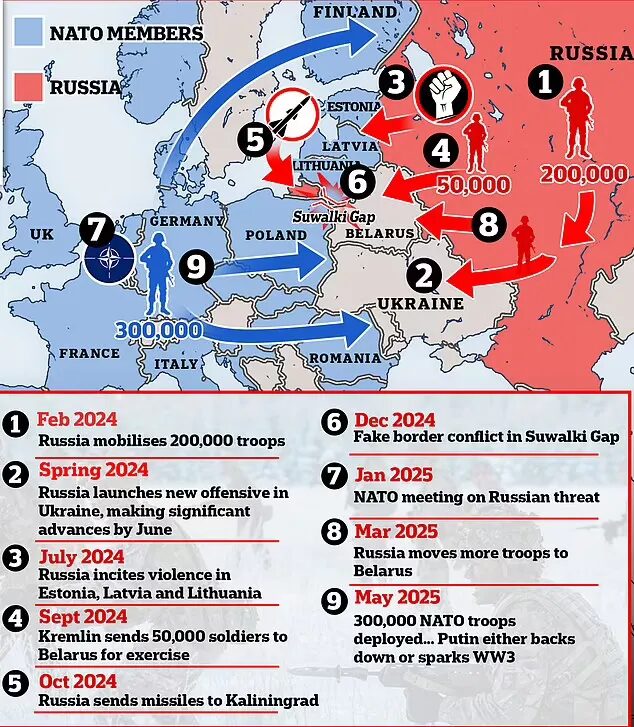
DailyMail’s map more succinctly breaks down the alleged “leaked plans” step by step:
First, on the surface this seems preposterous: weren’t these the people just telling us that Russia is weak; that the Russian army has been totally demolished; that—as per Lindsey Graham—Russia is being completely broken by “a tiny investment” of American funds in the hands of the heroic Ukrainian Armed Forces?
Recall the following which spread like wildfire only a couple weeks ago:
“U.S. intelligence officials estimate that #Russia has essentially lost its entire original invading army — originally estimated at around 200,000 — along with another 115,000 … So why are so many American politicians buying into #Putin’s narrative that Zelensky & his generals cannot decisively win the war?”
How is it possible an army which was entirely destroyed can reconstitute itself so fast as to engulf all of Europe like a tidal wave? One quickly begins to see how such stereotyped ‘legends’ about Russia are born, that were so rampant during WWII and beyond.
You will also note that the precise date outlines above are meant specifically to activate the fear-response in readers: it gives the illusion of authority and expert confidence, since all the dates are so accurately indexed, that it must be a scientifically-plotted done deal. A cheap psychological parlor trick.
To get back to the timeline: they elaborate on each development. But the most important thing to keep in mind, is that we know such projections are always the telegraphed intentions of the chief antagonist itself, which is the US/NATO empire. So for every action they list, they are ominously telegraphing precisely what they themselves intend to begin agitating for.
For instance:
In July, the first covert, and later increasingly open attack by Russia on the West begins the scenario.
▶︎ Severity of cyber-attacks and other forms of hybrid warfare, mainly in the Baltic States, leading to new crises. Russia begins with the incitement of ethnic Russian minorities in Estonia, Latvia and Lithuania.
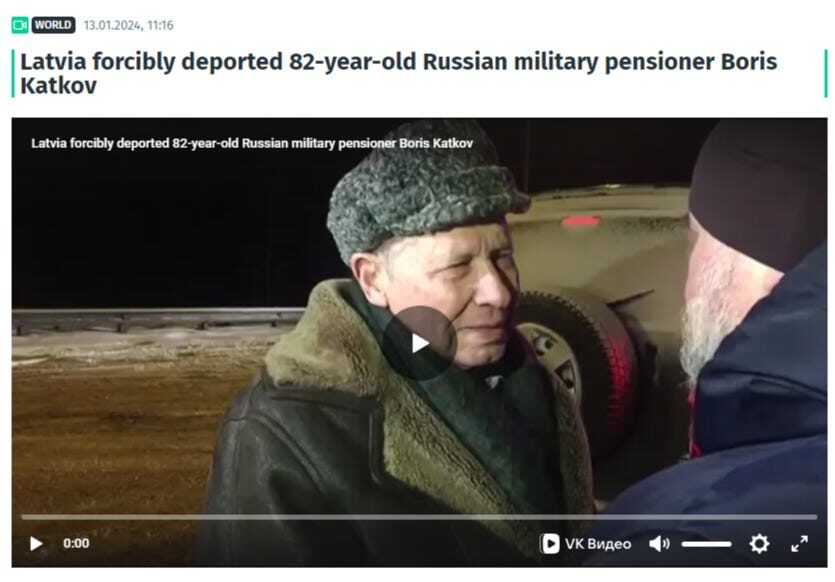
Just from the above we can see the open schema of the psychological operation. This week alone was rife with Western provocations in the Baltics, who are now openly persecuting ethnic Russians for every possible infraction. The biggest story of the week saw an 82 year old Russian man forcibly deported from Latvia:
Latvia forcibly deported 82-year-old Russian military pensioner Boris Katkov
By decision of the Ministry of Internal Affairs, an elderly man, who had a wife, children and grandchildren in Latvia, was recognized as a threat to national security and sentenced to deportation from the country with an indefinite ban on return.
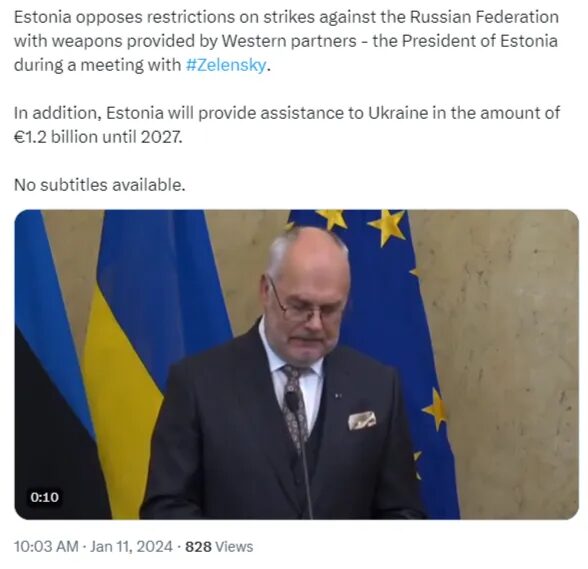
While Estonia saber-rattled and announced provocatively unfriendly measures as their own president openly condoned Ukraine striking targets in Russian territory:
You begin to understand how this works. The NATO war machine accuses Russia of something with which they themselves are already seeding the ground. They will continue pushing the escalations and provocations until Russia is forced to make even a small offhand warning—then they will pounce with a well-coordinated media blitz emblemizing Russia’s response as “proof” of hostility and major impending military action against the ‘Democratic’ Baltics.
The ‘leaked German report’ specifically outlines how Russia will begin “inciting ethnic Russians” in the Baltics: can you see how easily Russia’s defensive reaction to the ongoing provocations will be construed as “inciting” the ethnic population? Russia can release a mere statement warning ethnic Russians there to watch their backs and it will be immediately twisted and misconstrued as some type of subversive call or dogwhistle for an uprising.
Next, they comically predict that Russia will hold ‘threatening’ Zapad exercises in September 2024 in Belarus, which will be the final forewarning and staging operation before the ‘planned invasion of NATO’—except that Zapad is an annually recurring set of exercises which has already been auto-scheduled to happen later in the year. Another clear case of laughable spin to try and paint routine events as ‘dangerous provocations’.
So you see, they are playing the illusion of already predetermined events, some of which they themselves are catalyzing, and trying to sell them as ominous predictions. This is cheap hucksterism and warmongering of the highest order.
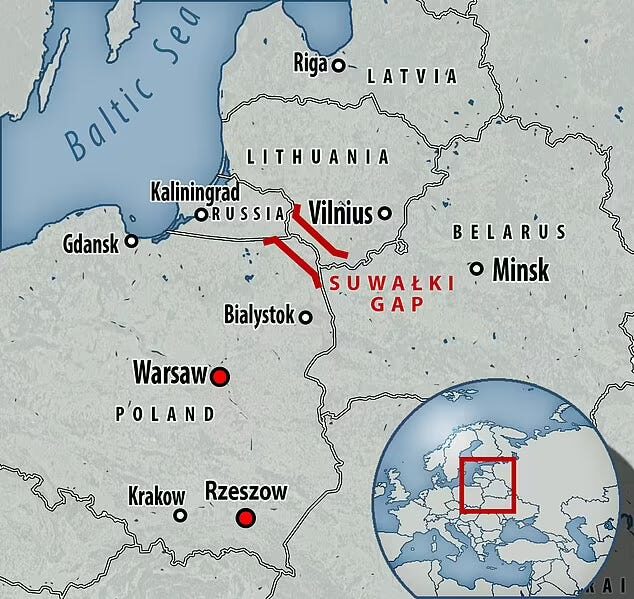
Naturally, the next “step” they envision is for Russia to begin agitating at the Suwalki gap in Kaliningrad:
But Putin’s main aim will be to attack a narrow strip of land known as the Suwalki Gap. Poland and Lithuania have fought for control of the area, but today it is part of Poland and is the only land border between mainland Europe and the Baltic States
But here’s the big kicker—beware the slightly wonky auto-translation of the BILD site:
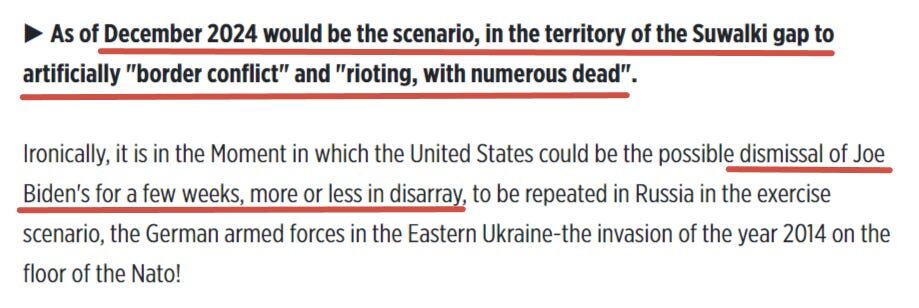
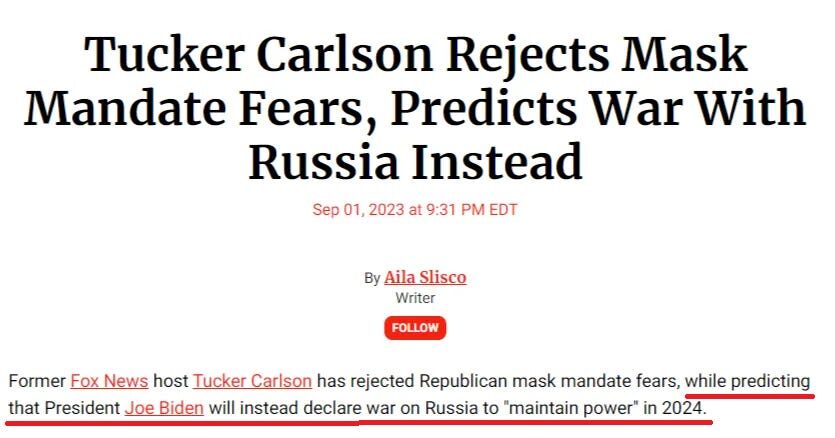
Do you notice how all of these plans just happen to culminate at precisely the time of the 2024 US presidential election? Do you recall how Tucker Carlson declared his firm belief that the big “October Surprise” of 2024 will be war with Russia, and the subsequent cancellation of the election?
Alex Jones and others likewise posited the same thing:
Not that I take this seriously, but given the circumstances, those reports months ago were ‘interesting’ where Amazon’s Alexa answered that the War Powers Act would be invoked and the 2024 election would be cancelled:
Of course, it’s only obligatory that at this point some people will likewise bring up the infamous Deagal 2025 depopulation forecast report. I’ve stated previously I don’t much buy into that, but everything is duly noted.
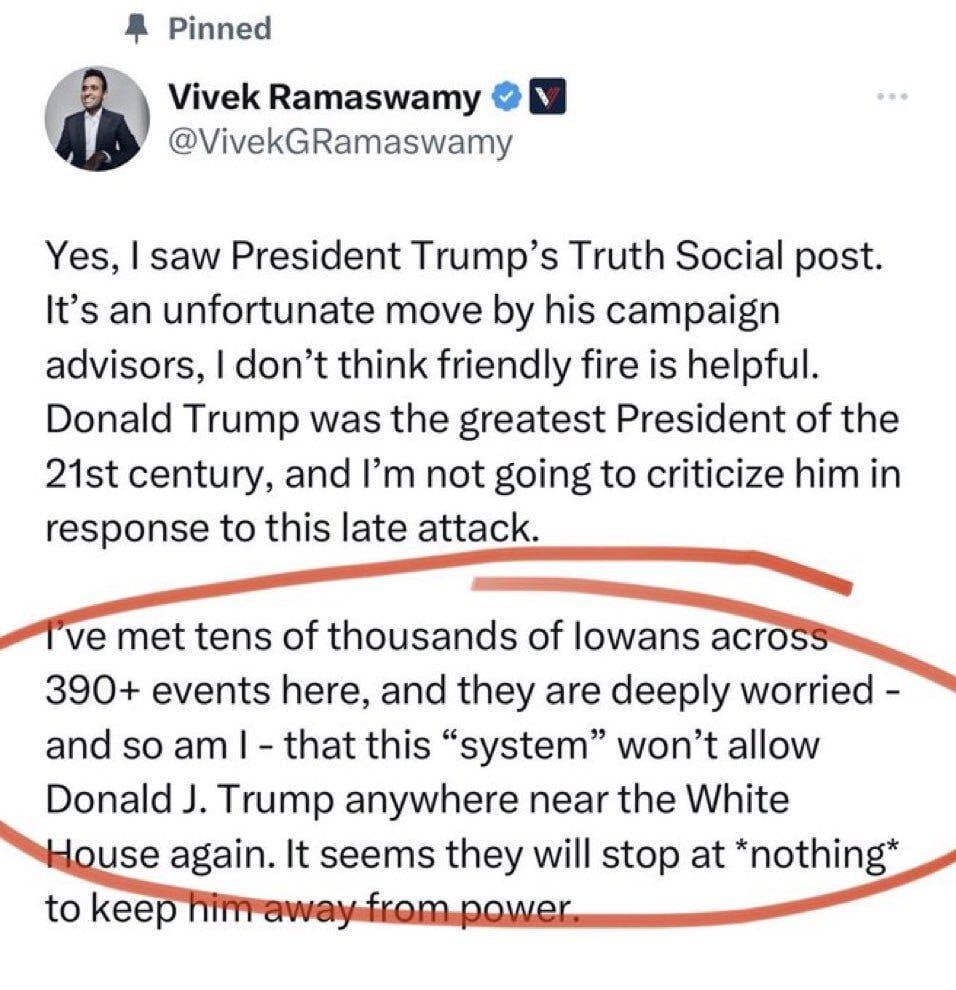
What’s inarguable though is the timing of the new German/NATO projections for potential war by end of 2024 or early 2025 is extremely suspicious and clearly appears part of a plan to potentially cancel the elections. They will of course keep it fluid in order to gauge how things are developing by then. There’s no need for drastic lengths if, for instance, Trump is already ‘taken care of’ by that time, one way or another:
We use necessary cookies to make our site work. We also set performance and functionality cookies that help us make improvements by measuring traffic on our site. For more detailed information about the cookies we use, please see our privacy policy.
Of course, it’s only obligatory that at this point some people will likewise bring up the infamous Deagal 2025 depopulation forecast report. I’ve stated previously I don’t much buy into that, but everything is duly noted.
What’s inarguable though is the timing of the new German/NATO projections for potential war by end of 2024 or early 2025 is extremely suspicious and clearly appears part of a plan to potentially cancel the elections. They will of course keep it fluid in order to gauge how things are developing by then. There’s no need for drastic lengths if, for instance, Trump is already ‘taken care of’ by that time, one way or another:
And Arestovich also had an interesting recent addendum to these thoughts:
He’s correct—just not in the way most Westerners would understand. It’s not that Russia intends to absorb all of its neighbors, per se. It’s simply that the US intends to use them all as vanguards to destroy Russia. And thus, in the ensuing conflicts, Russia will have no choice but to pacify and occupy these countries to keep them from becoming outposts or springboards for attacks against Russia.
As proof of my summation, just look at Georgia. Georgia was used as a springboard to attack and destabilize Russia. Russia went in, and within only a week, was on the outskirts of Tbilisi, the capital, threatening to entirely sack the country. Instead, Putin pulled back, having felt he accomplished the needed objective at the time of causing Georgia to back off, and proving that Russia is not merely mindlessly after the absorption of all neighbors. Russia could have easily conquered and absorbed Georgia at that very moment, if it truly wanted.
But countries which are particularly susceptible to habituating leaderships and movements that are existentially inimical to Russia—those countries will likely end up being absorbed in part or full, because the risk they pose cannot be brooked. Since Ukraine has historically incubated a highly viral and vicious strain of anti-Russian sentiment, it poses a particular form of danger to Russia, which means it cannot be allowed to fall under the control of the West.
Despite what feels like suffocating war paranoia, I still maintain that it will not come to that. As always—it’s not a binary, but a spectrum of probability. For me it’s still about 70/30 give or take that cooler heads will prevail, particularly if Russia exerts an overpoweringly decisive force on Ukraine this year, which will act as a deterrent in waking up the bureaucratic second echelon of Europe and militate against any fantasies of challenging Russia militarily. We see this fear already bearing out, given this week’s Sunday Times article which revealed—as per a Bundestag committee chairman—the real reason Scholz refused to provide Taurus missiles to Ukraine: he fears Russian retaliation:
The same article likewise asserts that Biden’s real reason for not providing powerful long range weaponry to Ukraine is that he too fears Russia’s nuclear hammer:
This is why I believe, despite the fervent agitation of the small neocon vanguard, when that critical culminating moment comes later this year or sometime in the next, there is good chance the West will fearfully back down and refuse to risk the total annihilation of their civilizations. At that point, French historian Emmanuel Todd’s earlier vision will have good chance of bearing out: the slow wane of America’s power in Europe as America itself is riven by internal strife and social upheaval in the almost certain post-2024 election chaos, followed by the eventual overwhelming tide of sensible political parties that could potentially capture Europe and reshape the continent, leading to an era of at least tense peace and cautiously pragmatic reconciliation with Russia.
Donald Trump Should Not Repeat Woodrow Wilson’s Failure
April 30th is an important date in American politics. This is the day 100 for the American President in the White House, and all attention will be on the reports of his achievements and failures. But nothing can be more critical than Peace…
○
6 mins read
A Holocaust perpetrator was just celebrated on US soil. I think I know why no one objected.
Russia’s invasion has made ordinarily outspoken critics of antisemitism wary of criticizing Ukrainian Nazi collaborators
○
1 min read
Qi Book Talk: The Culture of the Second Cold War by Richard Sakwa
Richard Sakwa has for many years been one of the most distinguished and insightful observers of relations between the West and Russia, and one of the leading critics of Western policy. In this talk with Anatol Lieven, director of the Eurasia program at the Quincy Institute, Sakwa discusses his book, The Culture of the Second Cold War (Anthem 2025). The book examines the cultural-political trends and inheritances that underlie the new version of a struggle that we thought we had put behind us in 1989. Sakwa describes both the continuities from the first Cold War and the ways in which new technologies have reshaped strategies and attitudes.