It is reported by a Ukrainian news source yesterday that Zelenskiy had asked his commander-in-chief Zaluzhnyi to resign, but that Zaluzhnyi had declined to do so, while recognizing that it was the President’s right to choose whomsoever he wanted to work with. Zaluzhnyi has been offered alternative positions, such as an ambassadorship, and the office of secretary of the national committee of defense. Today, reports appear to confirm that Zaluzhnyi had been told by Zelenskiy that if he did not resign he would be dismissed and that Zelenskiy had been about to implement a formal dismissal only to find that the supposed replacement for Zaluzhniy - the head of military intelligence, the SBU namely, Kryrlo Bodanov - has now said he does not want the job. So Zaluzhnyi’s dismissal has been postponed, presumably until a suitable relacement can be found.
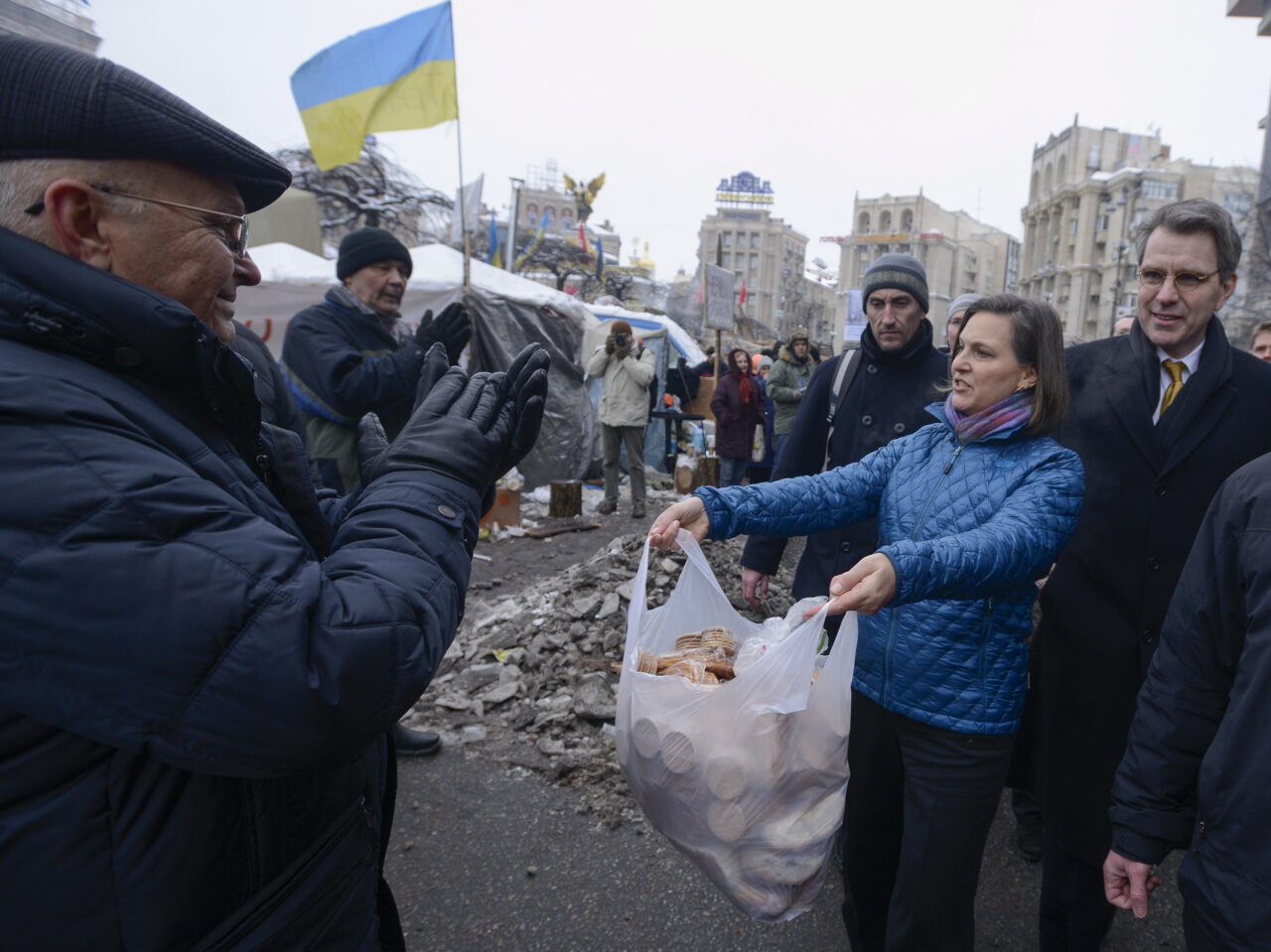
U.S. Assistant Secretary for European and Eurasian Affairs Victoria Nuland offered food to pro-European Union activists as she and U.S. Ambassador to Ukraine Geoffrey Pyatt, right, walked through Independence Square in Kiev, Ukraine, on Wednesday. She also offered food to some of the police nearby.
Zel vs Zal
It is reasonable to assume that Bodanov’s refusal is a new developoment: he was presumably canvassed in some way, in the past, so that Zelenksiy felt he was sufficiently on strong ground to proceed against Zaluzhnyi. Perhaps Bodanov felt that in view of his relative lack of direct military experience he was not suitable for the job or that there would be military resistance to his command, or even that were he to wait longer the pickings would be more attractive (the presidency even?).
Beginning of the End
Zelenskiy’s hold on power is looking fragile: he has until the end of March to hold on as president, at which time his legitimate presidency comes to an end. He might be able to extend it for a period of a few months if he declares a further period of military rule (to the end of May), but that is likely to be the farthest point Zelenskiy can go. On his daily broadcast this morning Alexander Mercouris speculates that the most likely replacement for Zelenskiy would be former President Poroskenko, who has been conspiring against Zelenskiy. Whether this is likely or not depends on whether Ukraine is going to restore normal democratic mechanisms and hold elections, in which case it could be that Zaluzhnyi would stand as candidate and that he might prove a good deal more popular than Poroshenko. Mercouris notes that the collective West may still prefer their man Zelenskiy who, on their behalf and in virtually nobody else’s real interest, dragged his country into war; also that Poroshenko would not be viewed favorably by Russia since Poroshenko is the one who committed Ukraine to the Minsky agreements and then defaulted on them. Russia would not therefore be able to trust Poroshenko (but then who in the current Kiev administration, or close to it, could Russia possible trust?), with baleful implications for the possibility of peace negotiations.
Nuland and the Three Goons
Into this state of tension and depression Victoria Nuland arrives in Kiev. She was the one who distributed cookies to Maidan protestors in 2013-2014 and, more critically of course, determined who should take over Ukraine following the US-backed and Banderite-executed coup d’etat of 2014. How and whom is she going to choose?
The main point in all this is that all three of the individuals who may most want the job (Zel, Zal and Poro) are toxic: they are failures; they have failed to protect and to defend their own country, their own people, at a sacrifice, according to figures today from the Russian MOD, of 414,000 Ukrainian lives of which 23,000 alone have been account for by events in the past month. These failures have not been able to secure what had been their main objective namely, that Ukraine should be a member of NATO. NATO has once again told Ukraine “No.”
These leaders have no identifiable plan as to how they could succeed without not just a continuation of western aid at a level equivalent to the former peak of such aid, but a further enhancement of such aid, since previous western aid over two years has not enabled Ukraine to win the war. No such aid is in sight. Biden’s proposed $61 billion package does not look likely to be revived, in the face of consolidating Republican opposition. Republicans are growing tired of Ukraine because they can see the mounting public skepticism about the flagrant waste of US wealth on a war which the Democrats, led by a man, Joe Biden, whose interests in a Ukraine victory are personal and financial, have betrayed their countery’s interests for the benefit of the military-industrial complex and nobody else’s.
The European Union is looking at a package worth $51 billion but, so far, Hungary, the only European country whose leader can articulate the obvious truth – that this is just throwing good money after bad – has witheld its consent. Further, that sum of $51 billion is intended for four years, with only $5 billion being available this year. $5 billion is what it takes to sustain Ukraine and its administration for about a month.
It is difficult to understand European determination to persist in their folly and to continue the war for as long as they can without presuming either that they are united behind their opposition to Trump, whose presidency might be their undoing anyway or, more likely, that a collapse in Ukraine must mean their own political collapse and possible exposure to actionable corruption. Perhaps like Joe Biden and, in a different context, Bibi Netanyahu. The same suspicions apply, with even more weight, in trying to understand why Zelenskiy is clinging to the presidency, why Zaluzhnyi is clinging to his job, and why Bodanov at this moment is steering clear of both.
Trump has signalled his opposition not just to Ukraine funding but to any Republican deal with the Democrats over the issue of the security of the Southern border.
No-Mob
Ukraine’s three identifiable contenders for presidential power have been on the verge, in at least two cases, of supporting a new mobilization that would impact 500,000 of which, assuming a continuation of the conflict, would surely mean a further loss of at least 100,000 more Ukrainian lives without gain. I say without gain because it is clear that Russia has the larger army overall: it may have only 600,000 men in the SMO area, but it has a large force of recent volunteers (signing 1,000 contracts a day), perhaps as many as 400,000 together with all of the rest of the Russian army that is currently stationed in Russia – we are probably talking about a total fighting force of at least one and a half to two million.
Ukraine has no comparable reserves to draw upon: Zelenskiy has at different times claimed a total fighting force of between 600,000 and 800,000. Were that to be enhanced with a further 500,000 (not much more than the Ukrainian lives that have already sacrified), it would be mobilized not all right away but over the course of an entire year, and the result would still be fewer than what Russia currently has without any further mobilizations than the one of 300,000 that it called in the summer of 2022, and the Russian army would be far better trained, with more and more relevant combat experience, and far better equipped, with production capability for further supplies of all categories of weapons that in almost all cases outstrips that of the entire NATO collective. If Ukraine is unable to pass its mobilization bill – it has now been held up for several weeks – then almost right away, Russian presence in the SMO area, including newly trained volunteers, could increase to something like 1 million while the size of Ukraine’s army would likely decrease at a rate of 20,000 a month.
The supply of new weapons, such as F16s by the Dutch (old, if refurbished, according to my understanding) or the supply of (how many? – a few hundred?) GLSDB guided bombs (150kms range) by the USA, are very unlikely game changers given, as Dima today on the Military Summary channel notes, that Russia on some days drops up to 150 such bombs. Russia meanwhile has just announced the completion and mass production of “Akatsia” artillery that has a range of 70kms. Many thousands of such systems will be constructed. It is a weapon that Dima describes as being perfectly suited for the implementation of a demilitarization zone in an area such as Kupyansk or Sumy or Kharkiv. In addition, in 2023, as Rostec figures show, 250 aircraft and helicopters were delivered to the Russian Aerospace forces. This could be indicative of new aerospace forces that could establish positions to the rear of Ukrainian defenses.
Battlefield
On the ground, Ukraine, the most important development has been Putin’s confirmation of intent to construct a large buffer or demilitarization zone in the north east (but possibly extending west and south). Russian shelling of Kharkiv and of other centers in this zone (but not only in this zone, of course) may suggest intent to prepare for a ground invasion.
Russia has begun to launch Lancet drones against Ukrainian positions in the Sumy area which may be a beginning of the destruction of Ukrainian artillery in this area and the launch of its demilitarization program. Ukraine has sent significant reinforcements to the Kupyansk area. In response, Russia Iskander missile attacks have hit a Ukrainian oil depot in Zmiiv, a town in which Ukrainian reinforcements were expected to concentrate. In Tabaivka, Russian forces have improved their positions around the village, taking the hills behind it, and have cut the main supply road from Pishchane northwards in the direction of Kyslivka and Kotliarivka (settlements that are now vulnerable to expansion of Russian-held territory). Other Russian forces are advancing on Berestove to the south. According to Dima at the Military Summary Channel recent Russian advances in the Krokhmaine-Tabaivka direction were helped by Russian intelligence showing that Ukrainian defenses in this area had been significantly weakened by corruption and misuse of funds intended for weaponry.
In Lyman area there are ongoing heavy clashes between Russian and Ukrainian forces near Terny. Russians are advancing in the direction of Yampolivka, south of Terny, and reportedly as many as 1,000 Ukrainian lives have been lost in this area over the past few days. There are attempted Russian advances north of Spirne. In Vesele, recently taken by Russia, Russian artillery is pounding Ukrainian positions and supply roads to the north preparing the way for an eventual attack on Siversk.
Near Bakhmut, Russia continues to bombard central and western Bohdanivka. Russians are also bombing positions on the route to Hryhorivka to the north of Bohdanivka. They are attacking the railways and the surrounding forest. A comparable situation unfolds around Invanivkse to the south, including Russian entry to the west of Klishchiivka. Russia appears to have advanced on the Papova forest area. In Avdiivka, Russian forces have penetrated from the east (seeking to cut off the eastern side of the city) and southeast, and have advanced towards the nearby settlement of Opytne on the M-30 road. Near Marinka to the south the primary targets of Russian fire are positions close to Heorivka. Russian forces are moving southwards from Marinka towards Konstanynivka and Novomykhailivka. Russian movements around Novomykhailivka lead Dima to claim that we are seeing the beginning of the end of Ukrainian control of this settlement. South of Novomykhailivka Russian forces have expanded the territory under Russian control considerably and are firing on positions closd to the T05-24 highway running north from Vuhledar. In the Vremevka ledge area, Russia has significantly added to Russian-controlled territory north of Pryiutne, and has launched tank convoys both northwards and eastwards in the direction of Staromaiorsk, which Russia lost in the Ukrainian counteroffensive a few months ago. Further southwest, Russian forces have started ground operations on Robotyne.
Middle East: Iran
The Biden Administration has confirmed its intention to retaliate against Iran for what it claims is Iranian responsibility for a missile or drone attack on an illegal US base in the south of Syria part of which stretches (legally) into the north of Jordan. The attack killed three and injured 34 Americans. The drone attack is one out of what the US claims to have been 160 attacks on bases since October 7 last year and which are doubtless motivated by an intent to bring about an end to Israel’s genocide in Gaza. This is in addition to a low intensity Israeli and settler war on Palestinians in the West Bank, complete with war crimes such as the murder of three hospital patients in one incident this week. While the US has pledged action against Iran, there is a shortage of actual evidence (something that, as previously noted, has rarely stopped the US taking retaliatory action – remember the invasion and twenty year occupation of Afghanistan). The claim that Iran supports certain militia financially may or may not be true, but finance is not the same as actual intent or culpability. US financial support to Israel is clearly not regarded by the US as implicating it in Israeli war crimes and genocide. In any case, Iran has signalled to the US that should the US target Iranian assets in Iran then Iran will take retaliatory measures. The militia that has claimed responsibility for the attack says that it has ordered a cessation of such attacks and insists that Iran had no responsibility. An Iranian retaliation, of course, woud represent a significant new movement up the escatatory escalator towards World War Three.
Middle East: ICJ
On the subject of genocide, analysts are still weighing and making sense of the judgment of the ICJ on South Africa’s charges against Israel (charges that it very likely coordinated with other BRICS countries). Many bemoan the court’s failure to insist on a ceasefire, and say that by entrusting the Netanyahu administration with responsibility for punishing the culprits of what the court deems was prima facie evidence of genocide, it was calling on the chief culprits to punish themselves and, in effect, mocking the Palestinians. And they are distrustful of the court’s president, Joan E. Donoghue, an American lawyer and former U.S. State Department official. Others welcome the fact that the hearings gave voice to extremely powerful evidence of Israeli crimes, and that it supported the view that genocide was the intent and the reality (even if western mainstream media tried their best to downplay it in favor of Israeli arguments). They are grateful that the court was not swayed by, nor even pareticularly interested in, Israeli attempts at procedural bluster and its claims of impunity on behalf of its right to self-defense. I note with great concern that, again without judicial evidence and on the basis of Israeli claims (claims, in other words from a deeply discredited source) that some of its employees may have had Hamas links, that many western nations have decided to enhance the pain of genocide by cutting financial aid to the UNRWA for Palestine.
The details of the peace deal presented today by US special envoy Steve Witkoff are consistent with the report in the Financial Times discussed in my previous article and with Larry Sparano in the posted interview. Putin will halt the Russian advance prior to driving Ukrainian soldiers out of all of the territory that has been reincorporated into Russia. It appears to be the case that the borders between Russia and Ukraine will be the current front line, so Putin is withdrawing Russia’s claim to the Russian territories still under Ukrainian occupation.
Russia and the US seem near a Ukraine peace deal. Kyiv’s role may be moot.
President Donald Trump’s hopes of securing a quick Ukraine peace deal hang in the balance after Washington’s envoy, Steve Witkoff, held his fourth Kremlin meeting with Russian President Vladimir Putin Friday.