Controversy over the marker resurfaced in the aftermath of veteran honored by Parliament
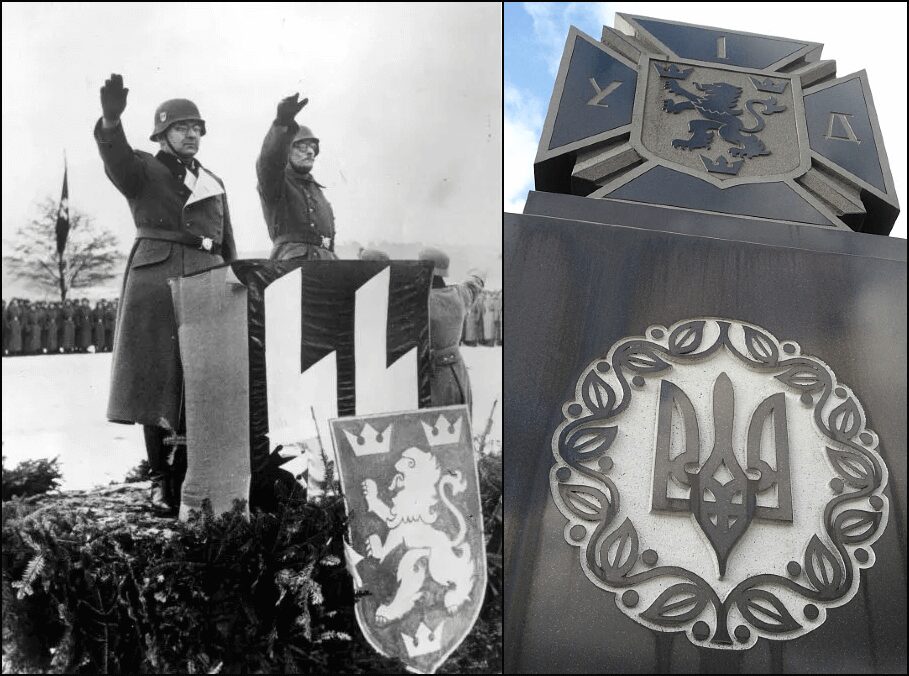
Left: Ceremony conducted by the 14th Waffen Grenadier Division of the SS (1st Galician). Right: SS Galichina monument at the St. Volodymyr Ukrainian Cemetery, Oakville. Image by Forward collage/Wikimedia Commons
A monument honoring Ukrainian soldiers who served in a Nazi division during World War II has been removed from a cemetery in Ontario after years of lobbying by Jewish leaders and others.
The monument to the 14 th Waffen Grenadier Division of the SS (1st Galician) was erected in 1988 at West Oak Memorial Gardens, which is owned by St. Volodymyr Ukrainian Cemetery, in Oakville, about 20 miles from Toronto. The marker bears the lion and crown insignia of the division, which is also known as SS Galizien and SS Galichina.
Efforts to have it removed gained steam last fall after the Forward reported that a 98-year-old Ukrainian-Canadian war veteran honored in Canada’s Parliament during a visit by Ukrainian Volodymyr Zelenskyy had served in a unit connected to the Third Reich. Prime Minister Justin Trudeau ended up apologizing for the incident and House Speaker Anthony Rota resigned over it, though both politicians said they were unaware of the details of the military service of the man they saluted, Yaroslav Hunka.
Rabbi Stephen Wise, who heads Oakville’s Shaarei-Beth El Synagogue and was among those pushing to remove the cenotaph, said fallout from Hunka’s appearance in Parliament helped “push the item to the top of the agenda.” Among other things, it was visited by neo-Nazis, which raised concerns of the cenotaph transforming into a shrine for white supremacists.
Memorials celebrating collaborators as freedom fighters have become a key feature of the modern surge of Holocaust revisionism, which seeks to recast perpetrators as heroes.
Who helped
Rabbi Wise said Friends of Simon Wiesenthal Center for Holocaust Studies, the Center for Israel Jewish Affairs, B’nai B’rith Canada, Oakville Mayor Rob Burton and Effie Triantofilopoulos, a member of the Provincial Parliament, all helped work toward the monument’s removal.
“We’re pleased that the decision has finally been made to take down a memorial that honored and glorified individuals who served in a Nazi military unit and were complicit in war crimes committed during the Holocaust, ultimately distorting Holocaust history,” the Friends group said in a statement. “To have such a monument in Canada was an affront to Holocaust survivors, the Jewish community, veterans and all Canadians who oppose Nazism.”
Wise also gave credit to “the Ukrainian community themselves who understood how problematic this was, and in fact, they’re the ones that met with the people who put this monument up and explained that it does not have a place here in Canada, and it was finally removed.”
Wise said he is not related to his namesake, the late American Jewish leader, Rabbi Stephen Wise, but he said the resolution of the controversy over the marker is a fitting way to honor the late Rabbi Wise’s legacy and his “vision for a peaceful world.”
A person answering the phone at the cemetery Friday said she could not hear or understand well enough to respond to a request for comment. The mayor’s office in Oakville declined to comment.
What’s next
The removal comes four years after the Oakville marker was spray-painted with the words “Nazi war monument.” Police were criticized for initially classifying the vandalism as a hate crime, suggesting that the Waffen-SS soldiers were somehow victims.
More recently, after Russia invaded Ukraine, the monument and others like it have been caught up in propaganda wars. The Russian Embassy in Ottawa bemoaned Canada’s monuments connected to Nazis, and some Ukrainians painted those calling for the Oakville stone’s removal as sympathizers with Moscow.
Now, the fate of the actual monument is unclear. Wise said he would like to see it go to the Museum of Tolerance in Winnipeg, with signage offering history and context, but said the people who erected the monument — descendants of soldiers who fought in the division — will ultimately decide. More than 45,000 Canadians died fighting in WWII.
At the cemetery, the spot where the marker was located now displays Canadian and Ukrainian flags. Wise said there is some talk of erecting a new monument there, to honor Canadians of Ukrainian descent who served in the Canadian army in the wars of the 20th and 21st centuries.
Wise said he was proud of the process that led to the monument’s removal: “People could have been coming into the cemetery and yelling and defacing things. Instead what we saw was people sitting together. They might not agree, but they talked it out and came up with a solution that was right with everyone.”
Beth Harpaz is a reporter for the Forward. She previously worked for The Associated Press, first covering breaking news and politics, then as AP Travel editor. Email: harpaz@forward.com.
Lev Golinkin is a regular contributor to the Forward whose work has also appeared in The New York Times, The Washington Post, the Los Angeles Times, CNN, NBC, The Boston Globe, Politico Europe, and Time.com. His memoir, A Backpack, a Bear, and Eight Crates of Vodka, chronicles his immigration from Ukraine.
The details of the peace deal presented today by US special envoy Steve Witkoff are consistent with the report in the Financial Times discussed in my previous article and with Larry Sparano in the posted interview. Putin will halt the Russian advance prior to driving Ukrainian soldiers out of all of the territory that has been reincorporated into Russia. It appears to be the case that the borders between Russia and Ukraine will be the current front line, so Putin is withdrawing Russia’s claim to the Russian territories still under Ukrainian occupation.
Russia and the US seem near a Ukraine peace deal. Kyiv’s role may be moot.
President Donald Trump’s hopes of securing a quick Ukraine peace deal hang in the balance after Washington’s envoy, Steve Witkoff, held his fourth Kremlin meeting with Russian President Vladimir Putin Friday.