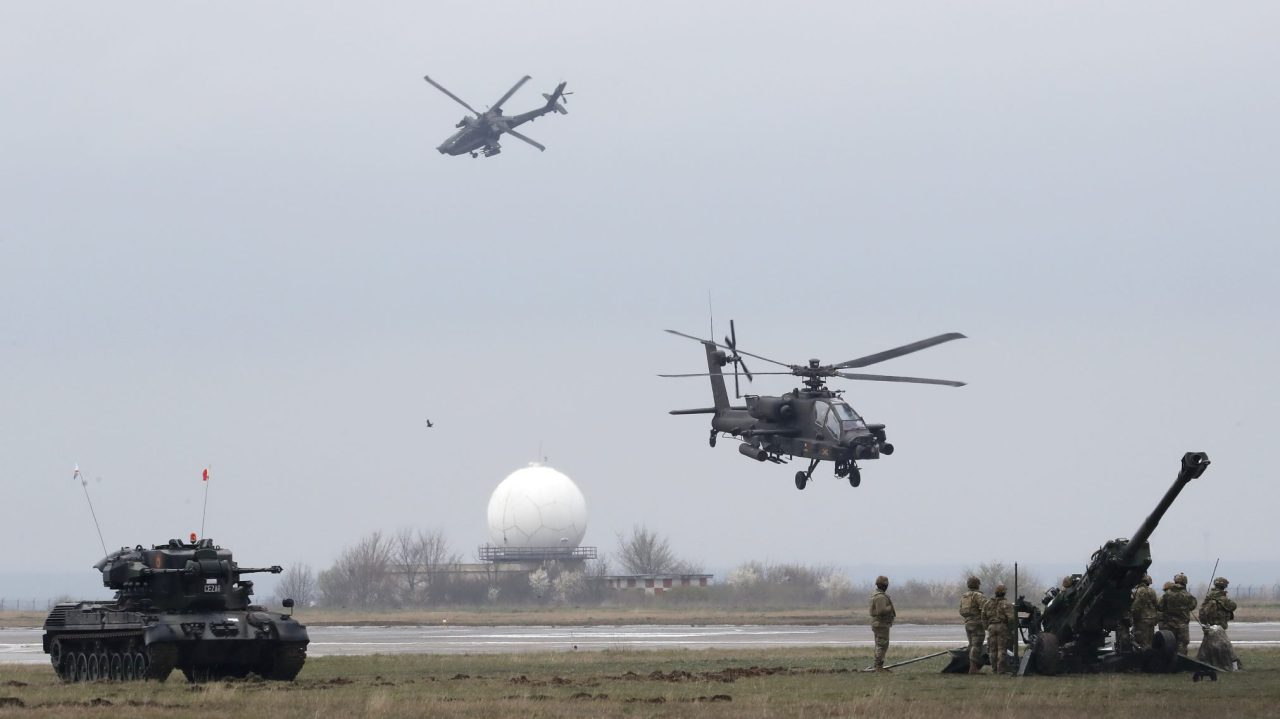
Work has begun on expanding the Mihail Kogalniceanu base in Romania, transforming it into the largest NATO military base in Europe.
Two Apache attack helicopters belonging to the US land forces from 101st American Airborne Division in action during a demonstrative exercise held at Mihail Kogalniceanu NATO air-base near Constanta city, Romania, March 31, 2023. Photo: EPA-EFE/Robert Ghement
The military base at Mihail Kogqlniceanu, Constanta, southeast Romania, on the Black Sea coast, will become the largest NATO military base in Europe and will surpass the US military base in Ramstein, Germany, in size.
The new base will give Romania an increased role in NATO’s security architecture and a position of greater strength in the Black Sea, which is militarily dominated by Russia. It will be able to host 10,000 soldiers and civilians by 2030.
NATO and the US will relocate some logistics and human resources from Ramstein to the Mihail Kogalniceanu base.
Expansion works will cost 2.7 billion US dollars and work on access roads and a high-capacity electrical network has already started. Romanian authorities have expropriated 2,400 hectares from the localities of Mihail Kogalniceanu and Lumina, paying 5,500 euros per hectare.
“Social housing will be built for individual personnel or families. There will be block-type housing, individual housing, nurseries, kindergartens, schools, pharmacies, everything that is needed,” the commander of Mihail Kogalniceanu, Nicolae Cretu, said.
Covering an area of almost 3,000 hectares, the base will be the largest in Europe. Ramstein in Germany covers about 2,000 hectares.
The airport’s current runway will be doubled and served by fuel depots and several hangars for various types of fighter jets and drones. NATO’s plans include the construction of one more runway for aircraft.
In addition to new military infrastructure, the Kogalniceanu base will include schools, kindergartens, shops and a hospital.
General Virgil Balaceanu, President of the Association of Reserve Officers and former representative of Romania at NATO Command in Brussels, told Radio Romania that Ukraine and the war there are not far from Romania.
With war on its borders, he said Romania must consider worst-case scenarios, and strengthening the country’s defence and deterrence position is essential.
In recent years, Romania has invested massively in defence. For 2024, the army will have a budget of over 20 billion euros, 45 per cent higher than in 2023. The money is intended primarily for the purchase of modern weaponry.
According to data made public, including the amount spent in 2023, over five years that include 2027, Romania will invest almost 320 billion lei in the military, or about 65 billion euros.
Donald Trump Should Not Repeat Woodrow Wilson’s Failure
April 30th is an important date in American politics. This is the day 100 for the American President in the White House, and all attention will be on the reports of his achievements and failures. But nothing can be more critical than Peace…
○
6 mins read
A Holocaust perpetrator was just celebrated on US soil. I think I know why no one objected.
Russia’s invasion has made ordinarily outspoken critics of antisemitism wary of criticizing Ukrainian Nazi collaborators
○
1 min read
Qi Book Talk: The Culture of the Second Cold War by Richard Sakwa
Richard Sakwa has for many years been one of the most distinguished and insightful observers of relations between the West and Russia, and one of the leading critics of Western policy. In this talk with Anatol Lieven, director of the Eurasia program at the Quincy Institute, Sakwa discusses his book, The Culture of the Second Cold War (Anthem 2025). The book examines the cultural-political trends and inheritances that underlie the new version of a struggle that we thought we had put behind us in 1989. Sakwa describes both the continuities from the first Cold War and the ways in which new technologies have reshaped strategies and attitudes.