The age-old debate – art for art’s sake or art in service to ideas and interests – has concluded not in discussions, but in real life. Society demands taking a stance in political struggles, does not recognize neutrality or standing aside, and artists willingly become party activists and propagandists. This is not a new phenomenon in times of profound social change and upheaval. But today, the connection between art and ideological and political struggle is more vivid and acute than ever before.
***
John Steinbeck’s novel “The Grapes of Wrath” published 85 years ago, remain an example of American realistic prose. The novel immediately gained worldwide fame. In 1940, it was published in large editions in the Soviet Union and held an important place in the ideological struggle during the Cold War for a long time.
In the same year, John Ford directed the film adaptation. Theatrical productions were created, along with abundant critical literature. Composer Ricky Gordon and librettist Michael Corey created an opera based on the novel’s plot. The opera consisted of three acts with a narrator. In subsequent years, new arrangements were made, including concert versions.
In America, many perceived “The Grapes of Wrath” as communist propaganda, and even farmers protested against the depiction of the inhumane conditions of their work and life. The California Farmers Association called the novel a collection of lies and Jewish propaganda. Contemporary antisemitism did not arise out of thin air.
The book was banned in schools and public libraries, the real reason was the realistic portrayal of the horrifying poverty and powerlessness of farmers and immigrants, juxtaposed with the wealth and lawlessness of bankers and landowners.
Steinbeck first visited the USSR with his wife in 1937 and was greeted with high honors. In 1947, he visited Moscow, Kiev, Tbilisi, Batumi, and Stalingrad and wrote about his trip in a quite benevolent “Russian Diary.” His positive impressions were not limited to the quality of Russian vodka, of which he was a great connoisseur and enthusiast.
In 1963, at the invitation of President Kennedy, he visited the USSR again, as well as Hungary and Czechoslovakia. Not only Soviet authorities used artistic intelligentsia for diplomatic purposes. With all his work, political stance, and personality, Steinbeck was suited to the role of mediator in the process of easing tensions between the two political systems. He shared leftist beliefs, was a member of the pro-communist American Writers’ League, maintained contacts with the Communist Party of the USA, the labor movement, and radical publications and journalists, opposed McCarthyism, supported singer Paul Robeson and playwright Arthur Miller, who were persecuted by the House Un-American Activities Committee. The FBI compiled a huge dossier on him.
In Soviet Union, Steinbeck was received as a critic of capitalism, a friend, and an ally in the common struggle. When he received the Nobel Prize, there were many critical assessments of this decision in the world press, especially in the USA; even the author himself expressed doubts about his worthiness. But in the USSR, the award was considered deserved, the reviews were enthusiastic, he was the most popular American author in the country, recognized not only by the authorities but also by the wide reading public of the most literate country in the world.
The relationship radically changed after the start of the Vietnam War. Yevgeny Yevtushenko published a poem titled “Letter to John Steinbeck” in the Literary Gazette, calling on him to condemn the barbaric attacks on peaceful cities: “You should bite, John.” Initially, Steinbeck did not approve of the war, but when his son was drafted into the army, he changed his attitude and did not publicly express his views on the war.
However, the letter from the Russian poet, who became a celebrity in America, caused irritation and protest from Steinbeck. Steinbeck’s reaction was not only due to political considerations. Yevtushenko, a Soviet dissident who knew how to build the right relations with the authorities, possessed political acumen not inferior to his poetic talent. He got acquainted and befriended Steinbeck, had the opportunity to appreciate his original and independent character, and must have understood that Steinbeck would not accept any instructions or appeals. Yevtushenko and the Soviet propagandists miscalculated. Steinbeck sharply rejected Yevtushenko’s position, defended American intervention, and accused the USSR of aiding Vietnamese revolutionaries.
The debate was received ambiguously in the American press, acknowledging that the appeal from the Russian poet was not groundless. Anti-war sentiments in America were strong at that time. And in the Soviet press, they immediately forgot about the previous friendship and accused Steinbeck of supporting imperialism and fascism.
Regardless of the criticism and the author’s views, Steinbeck’s novel became “the great American novel,” every author would want such public attention and discussion. The novel is listed among the “Greatest Books of the Century.” It stands alongside socially acute novels by Tolstoy, Dostoevsky, Balzac, Zola, Dickens – fighters for social justice and human dignity. Today, when social conflicts and contradictions tear apart a politicized, polarized society, great literature can serve as a criterion of truth and justice. And Steinbeck’s novel has not lost its relevance.
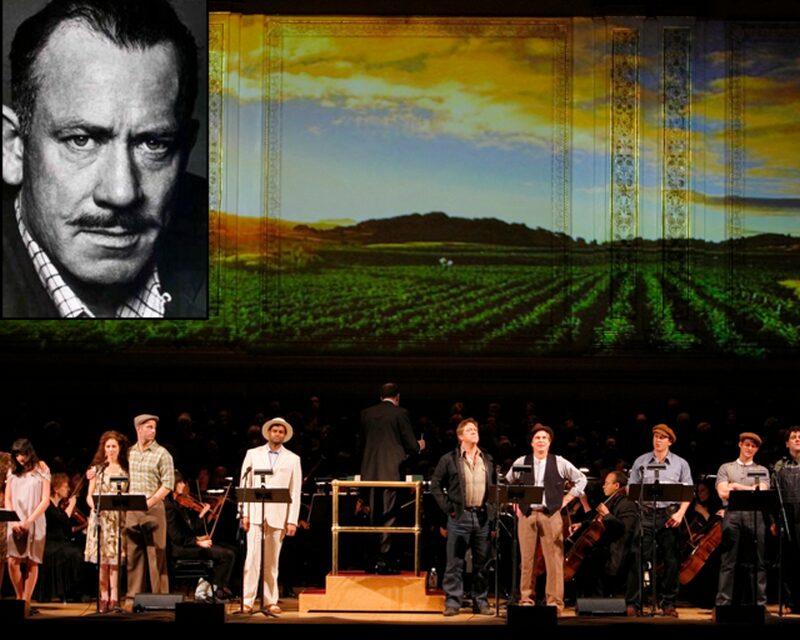
Just now, an opera adaptation of “The Grapes of Wrath” was performed at Carnegie Hall, with Ted Sterling conducting the American Symphony Orchestra and the Collegiate Chorale featuring stars of opera and Broadway. This is not the first performance of this opera on the stage of the famous concert hall. The same orchestra and choir performed here 10 years ago, also conducted by Ted Sterling, with Jane Fonda as the narrator.
The plot of the novel is well known to the American audience. It seems to me that combining musical and spoken genres is generally not very justified, and in this case, it was even less necessary. Although this was the intention of the creators of the opera, it underwent multiple rearrangements, and another one is quite possible considering the time and place.The audience received the performance with enthusiasm, which was well deserved.
***
Creators of art have never dwelled in ivory towers, atop mountains. Whether consciously or not, they reflect their time and the world in which they live. But in the past, there was often a dominant desire to say what others did not and will not say, to express one’s uniqueness. Today, on the contrary, the motives and goals of creativity are closely linked to societal attitudes and expectations; artists become megaphones for socio-political messages, aimed at mass approval. The highest criterion determining meaning and purpose is to be liked, to be in demand on the market.
This is evident even in academic genres, even in classical music – the most abstract of arts. Attending a concert hall, opera, or ballet with a full house can give the impression that high art is in demand, popular, and, if one sees a few young faces, has a future.
Undoubtedly, there is a category of listeners and viewers for whom high musical art is precious and irreplaceable. But speaking of societal influence, one should not overestimate these indications; the absolute majority of contemporaries are unaware, do not appreciate, and do not show interest in classical music, and no efforts will help revise tastes and preferences cultivated by environment and mass culture.
Pop culture actively uses political propaganda to expand its popularity. A politically correct position is the key to favorable treatment from authorities, media, and sponsors.
According to a two-column article in The New York Times, Beyoncé’s new album “makes her more than popular – a legend”; “Being black, a woman, breaking impregnable barriers… Beyoncé created a political album.” By today’s standards, the compliment sounds strange; today, in cultural promotion (not only in culture), it ismost difficult for a white heterosexual man, especially if he is not a liberal.
Beyoncé is undoubtedly talented, but her vocal mastery is not even mentioned; the main focus is on image and message. Most others have nothing except a shocking repertoire and appearance and adrenaline for mental attack.
Academic genres cannot compete with pop culture, which dominates the entertainment market. And when classical music becomes entertainment, and this is its fate, it loses its purpose.
Sales and audience of classical music account for just over one percent of musical genres overall. The royalties of pop stars are incomparable to the geniuses of classical art. Recently, I watched a TV program featuring a star of Russian ballet, successful in self-promotion as much as on the stages of the most famous halls in the world. But even he lamented that he wouldn’t earn as much in a year as a popular model would for one show. Not necessary to sympathize with him, but one can pity the listener and viewer, spending several days’ earnings for a concert of a fashionable rapper.
To avoid the invasion of pop music, especially its most aggressive genres, is impossible. It plays at all mass events, in restaurants, sports halls, from the phones and players of fellow passengers in transportation, during prolonged attempts to reach an institution, even while waiting in medical offices. Maximum volume, devoid of melody and harmony, a harsh assault on the ears and brain, senseless lyrics, most often performers without voice and professional training. Undoubtedly, such “art” contributes to the culture of violence, to universal wildness and aggression, to the decline of intellectual and emotional development, stimulates mental disorders. Overcoming the drug addiction that arises from childhood is possible for very few.
Music critic Mark Hogan complains in The New York Times that “financial cannibals… turn the musical ecosystem into a cultural desert.” If it was a desert, it wouldn’t be so bad; it would mean silence and solitude. Instead, we have dangerous jungles with roaring and howling.
***
For classical music, like any other form of art, there are no forbidden themes, and there are open possibilities for innovative exploration. Its creators not only convey the will of God and the music of the spheres but also their personal views and experiences. Beethoven, Chopin, Brahms, Glinka, Shostakovich, and many others have shown that it’s possible to address acute contemporary issues while maintaining the highest level of mastery. And the forms of composition can be revolutionary, transforming perceptions of genre boundaries.
Arnold Schoenberg, a great transformer of music, believed in the “historical obligation of musical style” and created a unique compositional system of radical modernism – dodecaphony, which adequately reflected the irrationality and incomprehensibility of the surrounding world during historical upheavals and changes.
The time of his creativity – before and after the First and Second World Wars – is marked by unprecedented cruelty, violence, militarism, aggressive nationalism, anti-Semitism, the collapse of social systems and regimes, which changed the face of existence and the worldview of humanity. Schoenberg’s music is often compared to the works of Franz Kafka, foreshadowing the impending catastrophe and hopelessness.
Most of Schoenberg’s works reflect his time, which resonates so much with the present, when the world is increasingly slipping into chaos and degradation. Schoenberg has never been as contemporary as today, when familiar conditions and norms are crumbling, and the world is full of tensions, threats, unpredictability, and anxiety.
On the 150th anniversary of the birth of Arnold Schoenberg, the American Symphony Orchestraand the Bard Festival Chorus, conducted by Leon Botstein, performed at Carnegie Hall the “grand cantata” “Gurre-Lieder” for soloists, chorus, and orchestra. This work is rarely performed and is not characteristic of Schoenberg’s radical aesthetics. The composer himself skeptically evaluated this work and was not pleased with its noisy success, unlike many of his other compositions, which were difficult for contemporaries to understand. As during the first performance over a hundred years ago, the audience at Carnegie Hall greeted the program with enthusiasm.
Schoenberg’s oeuvre confirms that it’s not good intentions, topical themes, or messages, but the talent of the creator that determines the merit of the work.
Schoenberg was exceptionally educated and broad-minded, but like many Jewish intellectuals in Europe, he believed that he had found a home and recognition in his country. After the start of World War I, caught up in patriotic enthusiasm, he wrote: “My eyes have been opened as to why I had so many feelings against foreigners… I could never find anything good in their music… Now… all these mediocre purveyors of kitsch… will have to extol the German spirit and pray to the German God.” In 1898, at the age of 24, Schoenberg converted to Protestantism, but with the rise of fascism, illusions were shattered, and he returned to Judaism. Five years later came Kristallnacht, truly opening the eyes of all Jews and others as well. But today, history repeats itself, eyes once again refuse to see the obvious, reason is captive to illusions and groundless hopes.
Donald Trump Should Not Repeat Woodrow Wilson’s Failure
April 30th is an important date in American politics. This is the day 100 for the American President in the White House, and all attention will be on the reports of his achievements and failures. But nothing can be more critical than Peace…
○
6 mins read
A Holocaust perpetrator was just celebrated on US soil. I think I know why no one objected.
Russia’s invasion has made ordinarily outspoken critics of antisemitism wary of criticizing Ukrainian Nazi collaborators
○
1 min read
Qi Book Talk: The Culture of the Second Cold War by Richard Sakwa
Richard Sakwa has for many years been one of the most distinguished and insightful observers of relations between the West and Russia, and one of the leading critics of Western policy. In this talk with Anatol Lieven, director of the Eurasia program at the Quincy Institute, Sakwa discusses his book, The Culture of the Second Cold War (Anthem 2025). The book examines the cultural-political trends and inheritances that underlie the new version of a struggle that we thought we had put behind us in 1989. Sakwa describes both the continuities from the first Cold War and the ways in which new technologies have reshaped strategies and attitudes.