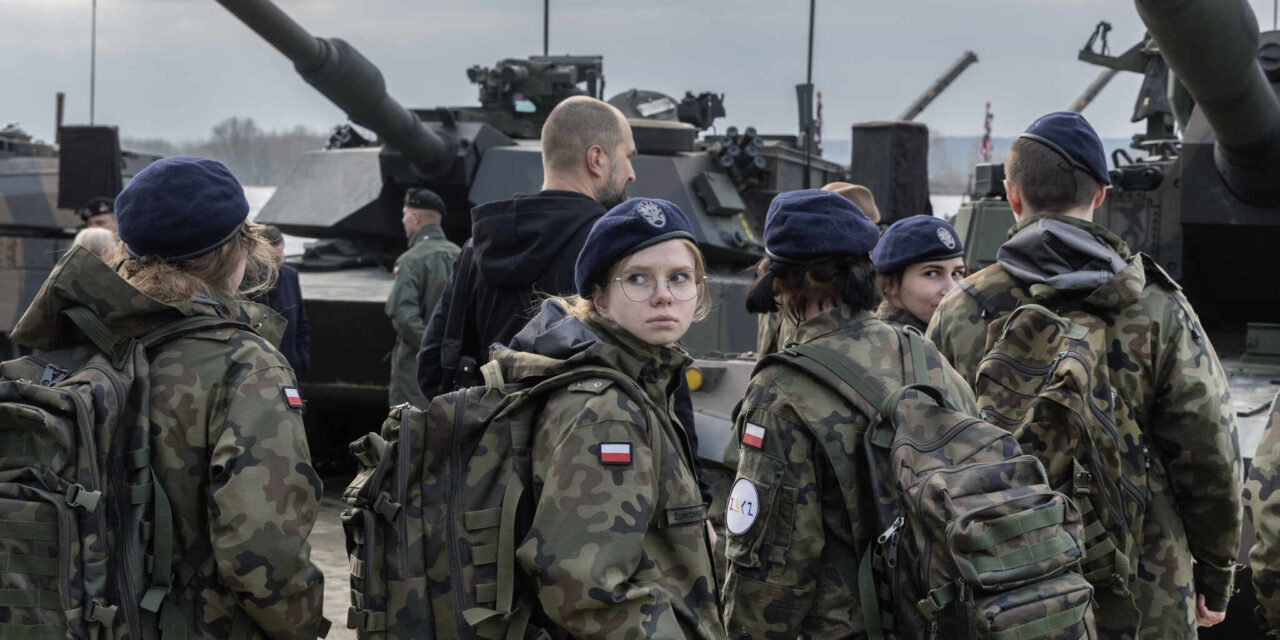
Russia's invasion of Ukraine in February 2022 accelerated the remilitarization of NATO's eastern flank. From troop reinforcements to the deployment of heavy military equipment, the Atlantic Alliance, which is celebrating its 75th anniversary in Washington, is preparing for a possible Russian attack.
LAURENT VAN DER STOCKT FOR LE MONDE
It’s a slow, gradual, but increasingly visible movement. Two years after the start of the war in Ukraine in February 2022, the military reinforcement of NATO’s eastern flank is now a more tangible reality, from the Arctic latitudes of Finland to the Black Sea shores in Bulgaria.
The height of the Cold War years, when several hundred thousand soldiers, particularly Americans, were stationed on Europe’s eastern borders, facing Soviet forces, is still a long way off. More than 350,000 American troops were deployed in Europe at that time, compared with 100,000 today.However, troop reinforcements, the construction of military bases and training grounds and the positioning of anti-aircraft defense systems have led to continuous activity along the 2,500 kilometers of borders between the Atlantic Alliance and Russia.
This military reinforcement of NATO’s eastern flank is nothing new. It began in 2014, following Russia’s annexation of Crimea. However, the acceleration of this process was formalized during NATO’s annual summit in Madrid in June 2022 and is expected to receive renewed impetus during the upcoming summit in Washington from July 9 to 11. As the Alliance celebrates its 75th anniversary, a new organization of the military high command is expected to be finalized, to coordinate all forces.
The belief that Russia will eventually seek to extend its expansionism westward of Ukraine is now widely held within NATO. “Currently, there’s no direct confrontation with the Russians. Almost all their ground forces are deployed in Ukraine,” said Joris Van Bladel, a specialist in Russian military matters and a senior associate at the Egmont Institute, the Royal Institute for International Relations, in Belgium. “But as soon as Moscow has the means to do so, possibly within the next two to five years, once its defense industry reorganizes, it will push the offensive. What we’re witnessing currently on the eastern flank is actually a race against time,” said Van Bladel.
Reset race
“A new era has begun: the pre-war era. I’m not exaggerating,” said Polish Prime Minister Donald Tusk in a March interview. In this rearmament race, Poland is the country where the process is most significant. In addition to a massive reinvestment in its defense capabilities – 4.1% of GDP by 2024, quadrupling expenditures since 2014 – Warsaw has authorized the deployment of NATO troops at no fewer than eight sites within its territory. From 2,800 NATO-deployable troops in March 2018, the country has risen to a total of 12,000 today, including a substantial number of Americans.
Read more Subscribers only Poland gives details on Eastern Shield to be deployed on Belarusian and Russian borders
Bemowo Piskie is a village in northeastern Poland, located 100 kilometers from Russia and 250 kilometers from the Suwalki Corridor – the narrow strip of land that separates the Russian enclave of Kaliningrad from Belarus. Today it is home to more than 1,000 soldiers for every 1,100 residents, according to a report by the news website Wirtualna Polska, published on June 19. American, British, Croatian and even Romanian soldiers are deployed there, with all possible heavy military equipment, such as tanks, howitzers and anti-aircraft systems.
In addition to the presence of NATO-led forces in Poland, there are also US military personnel in a dozen locations. They now number around 10,000, compared with 4,500 just before the start of the war in 2022, according to the Polish news agency PAP. Since summer 2022, the United States has effectively established its first permanent garrison in Poznan, central-west Poland, where the command of the US Army’s Fifth Corps, responsible for all US forces in Europe, is now based. At Redzikowo, 30 kilometers from the Baltic Sea shores, the Americans also operate a key site for NATO’s missile defense shield, which became operational in late 2023. Moreover, since May, US special forces have also established a base in Krakow with around 200 personnel.
The remilitarization of the eastern flank is also a major concern for new NATO members such as Sweden and Finland. However, unlike Poland, there are currently no Atlantic Alliance bases in either country, even though Finland shares a 1,300-kilometer border with Russia. The Finns remain divided on the potential creation of a permanent NATO “battle group,” as has been the case since 2022 in the eight other countries on the Eastern flank (Estonia, Latvia, Lithuania, Poland, Slovakia, Hungary, Romania and Bulgaria).
Over the past two years, however, Stockholm and Helsinki have benefited from an increase in maritime patrols, notably by French vessels, as well as a sharp rise in large-scale military exercises around their territory: almost 20 since February 2022, making the presence of NATO forces almost constant. “We saw a need to create a tailored model for Finland to ensure that allied troops can show their presence and defense capabilities here when we want to,” Defense Minister Antti Häkkänen cautiously stated on June 14.
In the Baltic states, where the level of concern over Russia is among the highest in Europe, militarization has largely involved expanding training grounds and fortifying existing bases over the past two years, along with the deployment of new equipment. Although reinforcements of a few hundred men have been observed here and there, the deployment of major allied contingents dates back primarily to 2014. Estonia, Lithuania and Latvia were the first countries to host permanent NATO battalions on their soil, consisting of 1,000 to 2,000 rotating military personnel.
The return of the bunkers
In Estonia, for example, where 1,500 allied soldiers – including several hundred French troops – are deployed, a fourth set of barracks is currently being built at the Tapa base, east of the capital Tallinn. Similarly, the runway at the country’s only military air base, located at Amari, southwest of Tallinn, where fighter jets patrol NATO’s airspace, is being renovated to accommodate F-35s sent by the Netherlands. Lastly, in the extreme southeast of the country, a vast training camp formerly used by the Soviet air force, called Nursipalu, will see its area triple in the coming months, to 9,000 hectares. The camp is located near Taara, a base reoccupied a year ago by several hundred American soldiers from the 101st Airborne Division, marking their first return to Europe since the Battle of Normandy in June 1944.
In Lithuania, the planned arrival of a brigade of 5,000 German soldiers by 2027 is leading to major construction work. The site chosen for these soldiers is, once again, a former Soviet base. Known as Rudninkai, it will eventually occupy an area of almost 25,000 hectares to the south of Vilnius, close to the Belarusian border. However, with everything yet to be built, costs are expected to be high. Lithuania will be responsible for the construction work, estimated at around €800 million, while Germany will cover maintenance and military equipment, with the total budget potentially reaching between €6-9 billion, according to the German authorities.
Latvia, on the other hand, is the first country in Europe to reintroduce compulsory military service for young people aged 18 to 27 since the outbreak of the war in Ukraine. The first cohort of conscripts completed their training in May.
Whether in the Baltic states, Finland and Poland, the reinforcement of borders with Russia and Belarus has been a major concern for several months. These borders are increasingly being manipulated by Moscow, which, according to authorities in these states, is redirecting some migrant flows toward their territories. All these countries have plans for anti-migrant barriers. They also fear a potential Russian ground military offensive in the short to medium term. In January, Estonia, Latvia and Lithuania announced their plans to build a “Baltic defense line” by 2025, with the construction of numerous bunkers – 600 in Estonia alone – along the Russian border. Since September 2023, nearly 20 for storing anti-crossing equipment – intended to impede potential Russian advances – have also been set up in Latvia. This project will be followed by the construction of some 3,000 anti-aircraft shelters in Latvia from 2025.
Hungary and Slovakia’s ambivalence
Several countries on the eastern flank, however, are well behind in this remilitarization process. These include Hungary and Slovakia, whose leaders regularly display pro-Russian positions. Hungary, where Viktor Orban has been in power since 2010, agreed to host a battalion of NATO troops right after the war in Ukraine began. Made up of Croatian, Italian, Turkish and American troops, it is by far the smallest in the Alliance, with 900 soldiers deployed.
In Slovakia, the government’s position is similarly ambivalent. Since autumn 2023, Prime Minister Robert Fico has abruptly stopped arms transfers to Ukraine, but several joint ventures between Slovak and Ukrainian arms industries have been created.
Meanwhile, Bulgaria, although more moderate in its foreign policy positions, is one of the countries in the Alliance that invests least in modernizing its defense apparatus. Sofia is hoping to limit confrontation with Russia.
The additional troops and military installations on the eastern flank run counter to the most recent treaties that aimed to maintain some semblance of arms control in Europe. This includes the Founding Act, signed by NATO and Russia in 1997. At the end of the Cold War, this text was designed as an initial gesture of cooperation between the two blocs. It aimed to prevent the reinforcement of “permanent” troops in Europe, limiting any military deployment to above brigade level – approximately 3,000 to 5,000 men. This agreement was respected until the annexation of Crimea in 2014.
Since then, Western nations have been slowly detaching themselves from it. “It took two years for a military response to emerge that was accepted by the allies as being in keeping with the spirit of the Founding Act,” said Elie Tenenbaum, a researcher at the Institut Français des Relations Internationales (French Institute of International Relations, IFRI) and author of a note on the defense of Europe’s eastern flank, published in early June. Everything fell apart with the Russian offensive launched on Ukraine in February 2022. “Today, no one is holding on too tightly to this treaty anymore, even though France is among the countries that have not officially declared it obsolete,” said Tenenbaum.
A mobilized France
Having long hesitated to engage in the East, notably because of the scale of its troops mobilized in the Sahel until November 2022 as part of Operation Barkhane (around 5,000 soldiers), France has finally become one of the most mobilized countries along the border with Russia. Present in Estonia since 2017, with about 300 soldiers in a mission called “Lynx,” it is also now particularly involved in Romania with a mission named “Aigle,” where militarization has been the strongest and fastest since 2022. The NATO battalion led by France comprises 1,500 soldiers – including 400 from Belgium and Luxembourg – and is due to be joined by a 250-strong detachment from Spain this fall.
Today, all these soldiers are grouped in Cincu, in the heart of the Romanian Carpathians. However, two years after their initial deployment, they are still living in a massive, constantly evolving construction site. Here, tanks and armored vehicles share the terrain with diggers and trucks, hard at work carrying out the essential improvements. At the beginning of June, several areas had only just been excavated, pending the construction of living quarters, hangars, storage areas and repair workshops, with the goal of accommodating up to 2,000 soldiers by the end of the year.
In Romania, France has been designated a “framework nation,” meaning it has been entrusted with the role of coordinating operations for all allies, a responsibility NATO assigns to the continent’s main armies. The British have this role in Estonia, the Germans in Lithuania and the Americans in Poland. This is an important responsibility for Paris, especially as Romania shares a vulnerable border with Moldova, affected by the Ukraine conflict. From Bucharest’s point of view, Moldova (which is not a NATO member) is the last bastion against Russian expansionism, while an unknown number of Russian soldiers are stationed in Transnistria, a separatist enclave bordering Ukraine. “Moscow continues to apply pressure on Moldova, including energy blackmail and disinformation,” said NATO Secretary General Jens Stoltenberg in October 2023.
Today, however, the Romanian army suffers from decades of underinvestment: It can’t face the threat without the support of powerful allies. “The air force, which has only one fleet of 17 F-16 aircraft purchased from Portugal [in 2016], not all operational, is unable to ensure airspace security,” said one observer. The army and navy are not much better off: The former is equipped with aging TR-85 tanks, while the latter has just three frigate warships moored in the port of Constanta. Significant investments, however, were restarted in 2018 to equip the forces with more than 200 state-of-the-art armored vehicles.
The US expands its network
Alongside NATO’s build-up, the Americans have bolstered their military presence on the Black Sea shores. “They have their land, their resources, their men and their plans,” said a French soldier. On this vast 3,000-hectare base called Mihail Kogalniceanu (MK), the American army has been developing, since 2022, the equivalent of its presence in Ramstein, Germany. Ramstein is currently the hub for all equipment sent to Ukraine and the largest US base in Europe, with over 10,000 personnel. In the coming months, MK will house a squadron of F-16s acquired by Romania from Norway, as well as combat drones.
More broadly, in response to Russian pressure, the Americans are increasing bilateral cooperation and defense agreements with countries on the eastern flank. In 2023, Estonia, Sweden, Finland and Denmark all signed agreements giving the US access to a vast network of military bases in these countries. The US military will be able to store equipment, weapons and ammunition there.
“Any NATO decision can take a long time, and eventually there is no guarantee that Article 5 will work. With this agreement, we should be able to quickly get reinforcements from the US in our region,” said Joakim Paasikivi, an expert at the Swedish Defense University, referring to the article in the NATO treaty that defines solidarity between allies in the event of an attack against one of them. “The Americans are building a rapid deployment force, to leave themselves the option of intervening on their own,” said Tenenbaum of IFRI, pointing out that the commander of the United States European Command (EUCOM) also leads NATO forces in Europe (SACEUR).
A logistical conundrum
This remilitarization of the eastern flank remains a conundrum for the Allies. Armies face numerous technical or administrative constraints. “There is no Schengen area for the military,” said a French officer. “For every train that leaves, dozens of permits are required and, at every border, reams of documentation have to be provided before the equipment can pass through.” The same applies to the movement of soldiers, who are not officially deployed as part of an external operation and have to comply with numerous formalities.
Most Romanian bridges, for example, cannot bear the weight of French tank carriers. In Germany, in the autumn of 2022, these same tank carriers were similarly denied access to freeways due to weight restrictions, forcing the army to transport them by train. Recently, the French also had to contend with the shortage of military cargo planes, which had been urgently dispatched to New Caledonia. Shipping the equipment by sea offers little more certainty, as neighboring Greek ports are already heavily utilized by the allies.
“Redeployment on NATO’s eastern flank is a monumental task,” a former American Alliance diplomat told Le Monde recently. In January, the European Commission finally released €807 million to finance some 40 “military mobility” projects, including the renovation of rail facilities. Similarly, at the end of January, Germany, the Netherlands and Poland signed an agreement to create a “military corridor” to facilitate the movement of troops and equipment from deep-water North Sea ports to Europe’s eastern borders. This topic is expected to be discussed further at the NATO summit in Washington.
To circumvent this obstacle, some allied countries have undertaken to pre-position vehicles and stocks further west, in Central Europe. In France, this avenue is currently being explored by the new military high command responsible for European operations, based in Lille. Like other Western governments, Paris has opted to limit the number of troops deployed in the east, but has made a commitment to NATO to send up to 4,000 soldiers there at very short notice, if needed.
To achieve this “brigade” level, France plans to leverage a Romanian logistics outpost at Lugoj, a three-and-a-half-hour drive to the west of Cincu, close to the Hungarian road network. The same applies to Caslav, in the Czech Republic, which serves today as an aerial logistics hub for reassurance missions towards the eastern flank, including operations like “Lynx” and “Aigle.” “France has pledged to be able to quickly step up should the need arise, but does not wish to concentrate its forces in one single location,” said Tenenbaum.
Extensive sea and air operations
However, the most advanced in this area are the Americans. Their army already has logistics hubs in Germany, Poland, Belgium and the Netherlands, while their navy has bases in Norway. Other sites are being built or extended in Poland, with new deliveries of tanks, armored vehicles, artillery and other equipment for soldiers. The goal for the United States is to be able to deploy, without delay if necessary, two complete brigades on European soil. For the year 2023 alone, nearly $1.3 billion was allocated to this effort.
To safeguard its borders, however, the alliance does not rely solely on this increasingly visible land presence. It has also expanded its maritime patrols, with four permanent groups: two in the North Atlantic and Baltic, and two in the Mediterranean. Each consists of several frigates and destroyers from various European navies. NATO has also bolstered its aerial patrols along the Russian border. Whereas before the war in Ukraine, allies did not always rush to take their turn at guard duty, the rotation is now methodically organized.
Despite these military reinforcements, Russia has been intensifying a form of hybrid warfare against Western countries for several months. This includes targeted fires against commercial sites and warehouses used for military purposes, as well as disinformation operations aimed at stirring patriotic feelings among the Russian-speaking population or pro-Russian sentiments within Europe. “These operations reflect weaknesses in conventional warfare, allowing Moscow to maintain presence while focusing efforts on Ukraine,” said Van Bladel. “It’s not yet a war of destruction, but it’s very clearly a preparation phase for it.”
Donald Trump Should Not Repeat Woodrow Wilson’s Failure
April 30th is an important date in American politics. This is the day 100 for the American President in the White House, and all attention will be on the reports of his achievements and failures. But nothing can be more critical than Peace…
○
6 mins read
A Holocaust perpetrator was just celebrated on US soil. I think I know why no one objected.
Russia’s invasion has made ordinarily outspoken critics of antisemitism wary of criticizing Ukrainian Nazi collaborators
○
1 min read
Qi Book Talk: The Culture of the Second Cold War by Richard Sakwa
Richard Sakwa has for many years been one of the most distinguished and insightful observers of relations between the West and Russia, and one of the leading critics of Western policy. In this talk with Anatol Lieven, director of the Eurasia program at the Quincy Institute, Sakwa discusses his book, The Culture of the Second Cold War (Anthem 2025). The book examines the cultural-political trends and inheritances that underlie the new version of a struggle that we thought we had put behind us in 1989. Sakwa describes both the continuities from the first Cold War and the ways in which new technologies have reshaped strategies and attitudes.