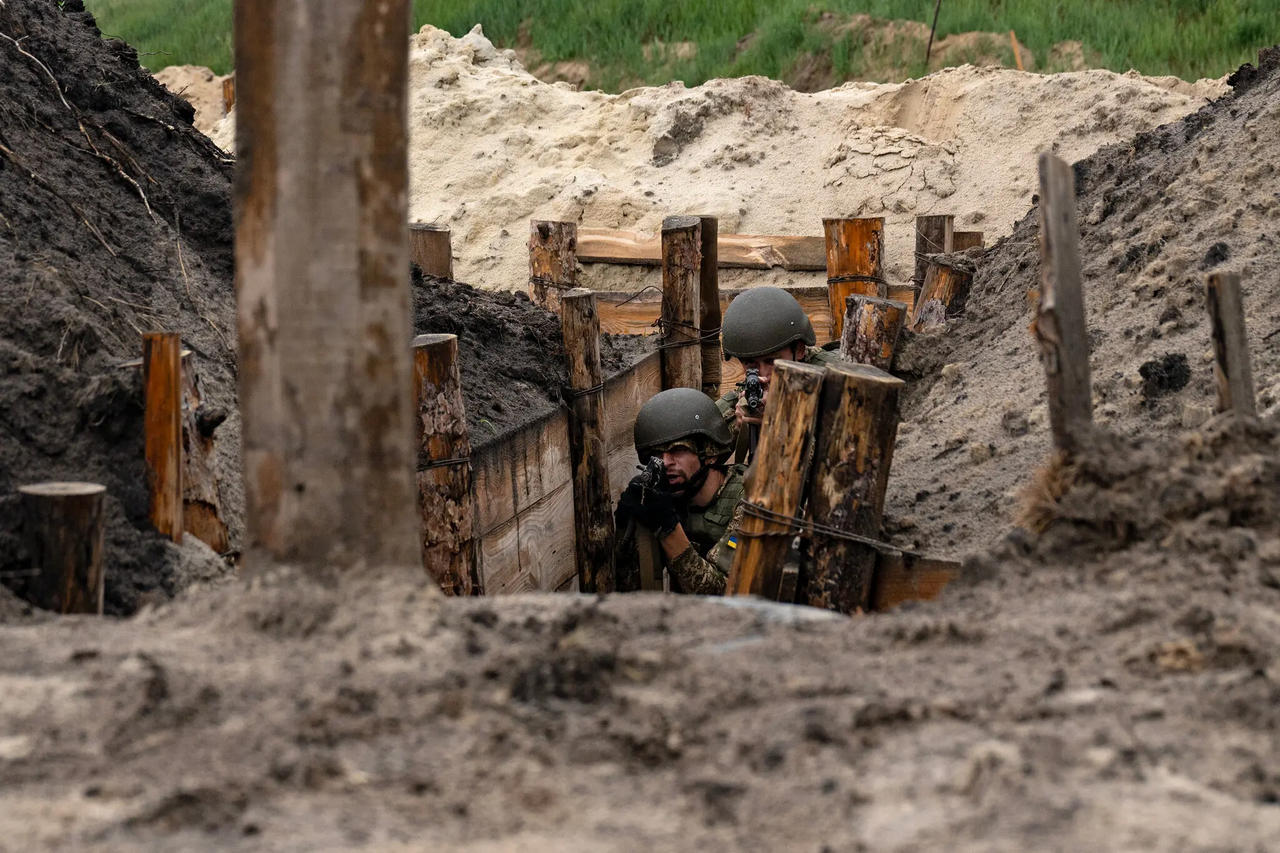
Large numbers of recruits will arrive at the front in the coming weeks, soldiers and military analysts said, but some are poorly trained or out of shape.
Training in June. Personnel shortages have been one of Ukraine’s biggest problems on the battlefield for the past year. Lynsey Addario for The New York Times
Ukraine’s campaign to replenish its war-weary troops is ramping up and should help fill personnel gaps on the front line in the coming weeks, according to Ukrainian officials, soldiers and military analysts.
The mobilization push has so far not significantly bolstered Ukraine’s forces on the battlefield, those people say. Many conscripts are still completing the weekslong training process and have yet to reach the front. And some recruits who have arrived are not physically fit for combat, members of Ukrainian units have noted.
But several brigades deployed on the battlefield have reported an increase in the number of conscripts they have received in recent weeks. They said they were hoping that the influx of soldiers would help Ukraine to stabilize the front line this summer.
Nazar Voytenkov, press officer for the 33rd Mechanized Brigade, said on Friday that his unit had “received more newbies this month” than they had at the beginning of the year. “And today I was told that more are coming to us,” he added.
The Ukrainian authorities have declined to share conscription figures, arguing that the information is confidential. Three military experts with knowledge of the figures said that Kyiv had been drafting up to 30,000 people a month since May, when a new conscription law took effect. That is two to three times more than during the last winter months, they said, and about the same number that the Russian Army is recruiting each month. That figure could not be independently confirmed.
The experts spoke on condition of anonymity to discuss the confidential numbers.
Lt. Serhiy Skibchyk, press officer of the 65th Brigade, which is fighting in southern Ukraine, said, “The situation is slightly improving compared to the end of 2023, when there was a severe shortage of people.” Small groups of conscripts are now trickling into his unit every week, he noted, “But our needs still exceed the number of people we’re getting.”
Troop shortages have been one of Ukraine’s biggest problems on the battlefield for the past year. Russian forces have managed to break through weakened Ukrainian lines by overwhelming them with waves of ground assaults. And the Ukrainian Army has not had enough soldiers to mount large-scale counterattacks.
Gen. Yurii Sodol, a former commander of the Ukrainian forces, told Parliament in April that in certain sections of the front, Russians outnumbered Ukrainians by more than seven to one.
The law offers a mix of financial incentives for those taking up arms and penalties on those trying to evade service, such as suspending the driver’s licenses of those who fail to register.
Yehor Chernev, deputy chairman of the parliamentary defense and intelligence committee, said in a text message that “the situation with mobilization has improved significantly,” although he declined to give any precise figures.
In addition to the conscripts, Ukraine has released some 3,800 prisoners to serve in exchange for the possibility of parole at the end of their fighting duties, according to Denys Maliuska, the justice minister.
A medic fighting near the eastern Ukrainian town of Toretsk, one of the hottest points on the front line, said that her brigade had received 2,000 conscripts and prisoners in the past two months. The medic spoke on condition of anonymity to avoid giving information to Russian forces.
Franz-Stefan Gady, a Vienna-based military analyst who recently returned from a field study in Ukraine, said that large numbers of conscripts would arrive on the battlefield in the coming weeks. Before that happens, he said he expected Russian forces to “make another big push” and try to break through Ukrainian lines.
“They have a vested interest in trying to make as many gains as they can right now,” Mr. Gady said.
A member of an artillery unit after firing at a Russian target near Kreminna in the Donbas region of Ukraine this month. Credit: Tyler Hicks/The New York Times
Mobilizing soldiers is just one part of a larger equation for Ukraine. Ensuring that troops are properly trained and supplied with enough weapons and ammunition is equally important, soldiers and experts said.
President Volodymyr Zelensky of Ukraine acknowledged this month that there were not enough facilities to train conscripts, and he complained that more than a dozen brigades were underequipped because of delays in deliveries of Western weapons.
Mr. Voytenkov, the press officer for the 33rd, said his brigade gave one week of additional training to conscripts to show them the weapons and armored vehicles that they would be using. After just the basic training, he said, “they are not ready to fight, honestly.”
Daria Mitiuk contributed reporting.
Constant Méheut reports on the war in Ukraine, including battlefield developments, attacks on civilian centers and how the war is affecting its people.
The details of the peace deal presented today by US special envoy Steve Witkoff are consistent with the report in the Financial Times discussed in my previous article and with Larry Sparano in the posted interview. Putin will halt the Russian advance prior to driving Ukrainian soldiers out of all of the territory that has been reincorporated into Russia. It appears to be the case that the borders between Russia and Ukraine will be the current front line, so Putin is withdrawing Russia’s claim to the Russian territories still under Ukrainian occupation.
Russia and the US seem near a Ukraine peace deal. Kyiv’s role may be moot.
President Donald Trump’s hopes of securing a quick Ukraine peace deal hang in the balance after Washington’s envoy, Steve Witkoff, held his fourth Kremlin meeting with Russian President Vladimir Putin Friday.