Since the fairly spectacular but also hyped Cold War-style prisoner exchange between Russia and the US, some observers have wondered if this could be a harbinger of a general return to diplomacy, especially with regard to ending the needless and catastrophic war in and over Ukraine. Optimists have gone as far as to even allow themselves not only a question but some hope.
Don’t get me wrong. While, by temperament, I am no optimist, I recognize that, in principle, even optimists can get it right, occasionally. And I certainly agree with the underlying assumption, namely that we should return to diplomacy and at long last abandon our moronic repetition of that thing that has never worked, that is, our patented Western snake oil consisting of (proxy) war, sanctions, and endless hypocritical gibberish about how superior we and our so-called “rules” and “values” are.
Yet a return to diplomacy (and a minimum of reason) takes two. In this case, that means, of course, that Moscow has to agree. Yesterday it told us – and all Russians, by the way – that it will not, except we, the West, make fundamental changes to our behavior. Moscow is right. But, while I have no crystal ball, I believe that this means that a general return to diplomacy is still a far way off. Except for one but faint chance, about which more below.
Yet a return to diplomacy (and a minimum of reason) takes two. In this case, that means, of course, that Moscow has to agree. Yesterday it told us – and all Russians, by the way – that it will not, except we, the West, make fundamental changes to our behavior. Moscow is right. But, while I have no crystal ball, I believe that this means that a general return to diplomacy is still a far way off. Except for one but faint chance, about which more below.
First things first: To understand how important yesterday’s signal was, recall a key fact of Russia’s mainstream media landscape: There is no news format more important than the Sunday edition of Vesti on Russia. As far as TV – still crucial in Russia, as in many other countries, including, of course, the US – goes, this is the news source. Almost always presented by rock star anchors – such as Dmitry Kiseliov or Evgeny Popov (as was the case yesterday), Vesti’s Sunday edition is two hours long and consists of a mix of the most important news of the preceding week and fresh material.
Yesterday, on 4 August, one of those items was a 13-minute interview – an eternity by general news standards and long even for the Vesti Sunday edition – with Sergei Ryabkov, a long-serving (since 2008) deputy foreign minister. Ryabkov may not be a household name and his boss Sergei Lavrov is, of course, more prominent, especially in our short-attention-span West. But make no mistake: Ryabkov is a very important – as well as smart, competent, and tough – Russian diplomat. Also important to note: Ryabkov was a key figure when Russia presented its last warning and offer to negotiate to the West in the winter of 2021/22, which the West answered with empty talk and a de facto no. Last exit ramp very deliberately not taken by Washington and its vassals, that’s how we got to the transition to large-scale war in Ukraine in February 2022. Ryabkov can by no means be reduced to a caricature of a fierce enforcer, but it is true that speaking unpleasant truths to the West is part of his portfolio. And it is also true that when Ryabkov delivers a warning, we know empirically that Moscow means it.
The interview was conducted by Olga Skabeeva, a topnotch heavy hitter in the Russian talk show universe, too. Together with Evgeny Popov (the same one who also served as anchor for yesterday’s Sunday Vesti; he’s also a Duma deputy), she runs the daily primetime political show “60 Minutes,” not to be confused with the American format, of course. Popov who is Skabeeva’s husband as well, introduced her interview with Ryabkov as “sensational.” And, in all fairness, he can’t be accused of merely flattering his wife there. This was a remarkable interview indeed, even if most – though not all – of the things Ryabkov had to say were not new. What mattered was the overall message and the straight-shooting, hard-as-nails manner in which it was delivered.
Ryabkov started by locating our current global situation on the famous Doomsday, used since the first days of the first Cold War in 1947 to visualize the expert opinion of the Bulletin of Atomic Scientists about how close (usually, too close) we – that is, humanity –are at any given moment to wiping ourselves out, a point symbolized by Midnight. It won’t surprise you that, at this moment, we are as close as never before – at 90 seconds to midnight. While, originally the clock was all about big mushroom clouds and fallout, recently it has included other risks of species suicide as well, such as climate change. Nonetheless, it is safe to say that the risk of World War III with nuclear weapons is a main factor now as well.
Ryabkov, actually, feels we are at two minutes to midnight. But it would be foolish to mistake that for optimism on his part. Most likely, he is simply not up to date on the latest assessment of the Bulletin experts and his meaning is exactly the same as theirs: too damn close. The Russian “military must keep their powder dry,” was his way of putting it, because “all kinds of scenarios are possible,” and a “moment” may come for nuclear weapons.
For those in the West who believe mainstream media disinformation, the interview and its framing within yesterday’s Vesti Sunday edition will also come as a surprise, in that it was not soft on US presidential candidate Donald Trump. Instead, the show underlined his responsibility – not unshared, but substantial – in dismantling the 1987 abolition of land-based intermediate-range missiles between Russia (then the Soviet Union) and the West. Asked about, in essence, what Russia has learned from the 1987 agreement and its sorry fate, Ryabkov went to great lengths to hammer home one simple point: Moscow will never again make concessions in advance or excess of Western ones or based on nothing but trust in Western good faith. Russia’s approach will be hardheaded and aiming at concrete and fair quid-pro-quos. Even in the case of a great improvement in the relationship with the West – which Ryabkov correctly considers unlikely – there will be no return to what Russia plausibly perceives as the gullibility of the Gorbachev years. “There will be no presents, concessions, some sort of gestures to mollify Washinton,” as he put it with visible signs of disgust. “If they” – that is the West – “once again try to achieve agreements that are advantageous only for them, then there won’t be any agreements. That is the only way.”
Yet the Russian leadership sees a change in attitude not only on its own side. Ryabkov acknowledged that in the past “it was possible to reach agreements with Washington on the basis of healthy common sense.” But those days are gone. “Some things still work, for instance, on the humanitarian level,” he also recognized in a clear allusion to the recent prisoner exchange. Yet what is more important is his clear statement that “all of this does not change the overall picture,” which is that only hard, equal give-and-takes will work, an approach that “the Americans understand well.” In essence, Moscow has concluded that the rather savage US elite understands only one language, and it’s one of harsh trade-offs without any misplaced good faith.
This, Ryabkov, also made clear, will apply as well to current US – and European, especially German – plans to again station intermediate-range missiles in Europe. “We will provide for our security, and there will be one-sided advantages for our opponent, the collective West. We will not allow them to achieve such advantages.” And while, Ryabkov added, taking the initiative in escalation should be avoided, scenarios in which Russia would have to take a “de facto escalatory step are under review.”
While may sound convoluted, once translated from the harsh dialect of diplomatese Ryabkov employed, its meaning is quite clear: Russia will not “merely” be a follower, always only responding to Western measures. Instead, Moscow reserves for itself the freedom to take a step back, assess things more comprehensively, and escalate as well, if that is considered necessary for containing or answering Western strategies. And a point not to be missed, what dealing with the West will take is not only “signals” but “action,” Ryabkov underlined, because without it Moscow would lose credibility.
For the history buffs, this is quite close to what George Kennan initially laid out as the West’s strategy in his “Sources of Soviet Conduct” at the beginning of the first Cold War, writing of “the adroit and vigilant application of counterforce at a series of constantly shifting geographical and political points.” In general, history has come full circle in some way: much of Ryabkov’s interview – and of Russian elite discourse in general now – sounds like Moscow developing an all too plausible theory of the sources of Western conduct and how to counter and contain it.
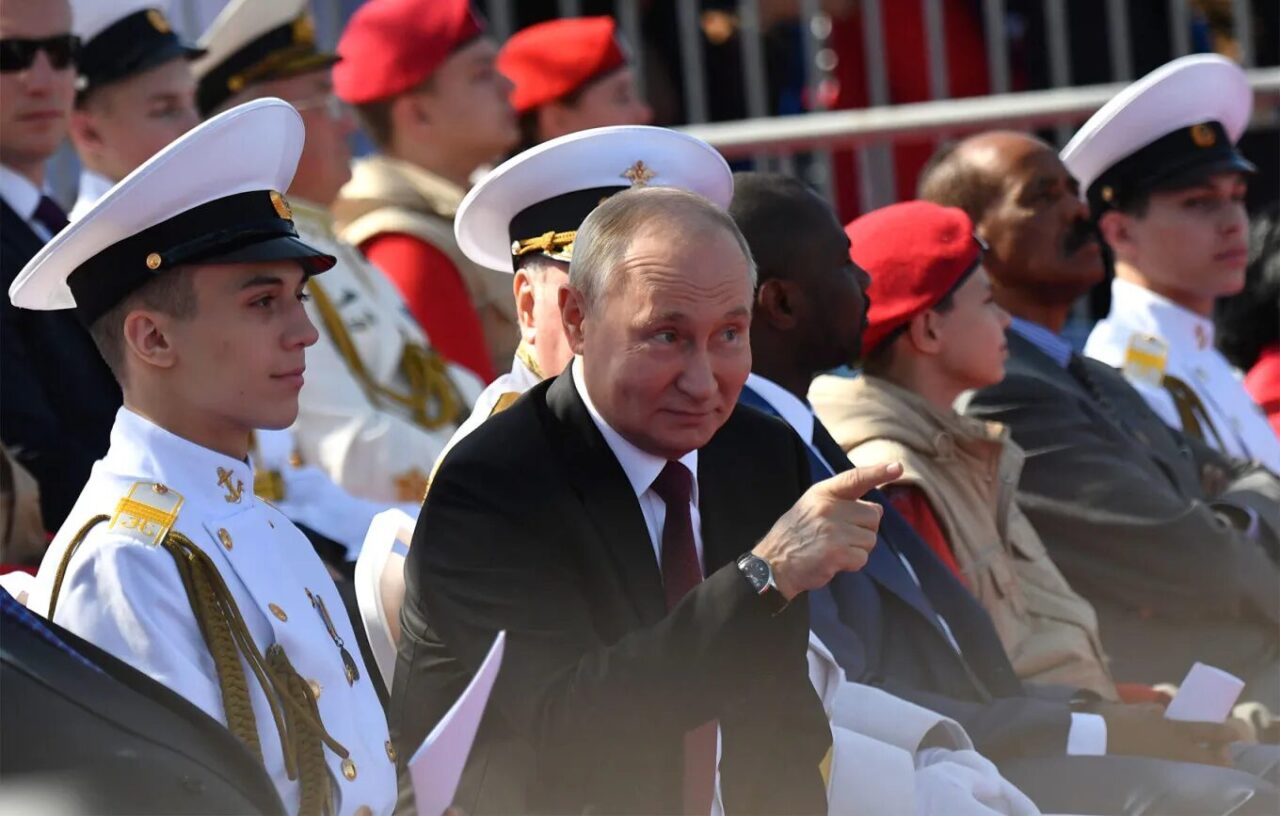
Vesti, Skabeeva, and Ryabkov had an immediate example to offer of the kind of hardheaded approach the West needs. He never said it outright, but the message still came through loud and clear: Two important things have recently happened. Ukraine planned an attack – not specified in detail – on the recent large parade to celebrate Russia’s Navy Day in St. Petersburg, and Russia, via direct contacts between its defense ministry and the US Pentagon, headed off that attack by making the Americans to tell the Ukrainians to drop their crazy scheme, for once. Considering that Russia’s president Vladimir Putin was at the parade, the implication, forcefully if tacitly conveyed, that Kiev was preparing not “merely” some kind of mass casualty event but to assassinate Putin.
Obviously, we cannot verify this story. It may be true, partly true, or simply untrue. One thing we can say, on the basis of the verifiable record of Ukraine’s special services, in particular HRU military intelligence and the general-purpose SBU, is that Kiev is perfectly capable of such a scheme. A fact many Westerners fail to grasp in the is regard is that The likelihood that such an attack would escalate the Ukraine War to World War III does not deter but attract the Ukrainian regime. Because escalating is its only way to avoid defeat. That that is a suicidal as well as deeply evil strategy is another matter. Do not overestimate the rationality or morality of Zelensky, Budanov, and co.
Another point to take note of was Ryabkov’s assessment of Berlin’s position (which Vesti mordantly accompanied with footage of Germany’s foreign minister Annalena Baerbock bouncing around on a trampoline). For Ryabkov, there is no “professionalism” there in the conduct of foreign policy. Importantly, he generalized that observation for, at least, most of the West, namely its submissive clients and vassals. He believes that they have been reduced to “an attempt to solve those geopolitical tasks” set for them in a very small number of actual decision-making centers. What can one say? I’d say: Where is the lie?
What counts here is that Russia is telling us that it is realistic about the West and knows that most Western governments are hardly worth talking to, because they are mere followers. Europeans beware: This also implies that Washington remains worth talking to, and one day its uber-docile European vassals might find themselves cruelly cut out of a deal reached between Russia and the US. Impossible? Be my guest if you want to base your policies on that guest.
Finally, the F-16 and Ukraine. Expectably and plausibly Ryabkov denied that they can make a difference. Instead, he predicted, their burned-out wrecks will be added to Moscow’s trophy exhibitions, currently already featuring such other Western quick fixes as Bradleys, Leopard IIs, and Abrams, to name only a few. The real problem, he warned, is in the escalation, in the fact that no limits are left standing. Challenged by Skabeeva whether Russian forces would strike airfields in NATO states, such as Romania or Poland, if the F-16 should use them for operations in the Ukraine War, Ryabkov, again, was perfectly clear even while not being fully explicit: Yes, they would.
And on that note, the interview ended. Now, take a step back and look at it as a whole, as the message Gesamtkunstwerk was certainly meant to be: Not everything in it was new. Indeed, much of it consisted of reiterations of known Russian positions. But what matters is the timing and the combination. What Ryabkov delivered, just after the big prisoner exchange between Washington and Moscow, was, in essence, a broadside or maybe a massive Kalibr strike of disillusionment. Moscow will not let itself be drawn into a “Gorbachevian” trajectory of trusting the West, not one inch. Instead, it will only be ready for larger deals once the West is ready to make true concessions, which the Russian leadership can recognize as at least the equivalent of what Moscow itself might be prepared to do in the future. The prisoner exchange was not a thaw. Winter is continuing, and if anything, things will get even frostier.
One specific addressee of this cold shower is, I believe, Donald Trump. And that brings me to something mentioned above: There might, just might be a way toward a more diplomatic, negotiated relationship again, if – a big if – Trump both wins the election (don’t get me wrong: I’d never vote for him because every politician not speaking up against Israel’s Gaza Genocide is a non-starter for me) and then does what he has occasionally said, namely end the war in Ukraine by pressuring Kiev into, in essence, giving up. In that case, the relationship between Moscow and Washington could potentially return to some form of making deals. But – and this is what the Ryabkov interview signals in this context – it would be what Trump is so proud of: hardheaded dealmaking, no frills, no feelings, and nothing for free for the US ever again.