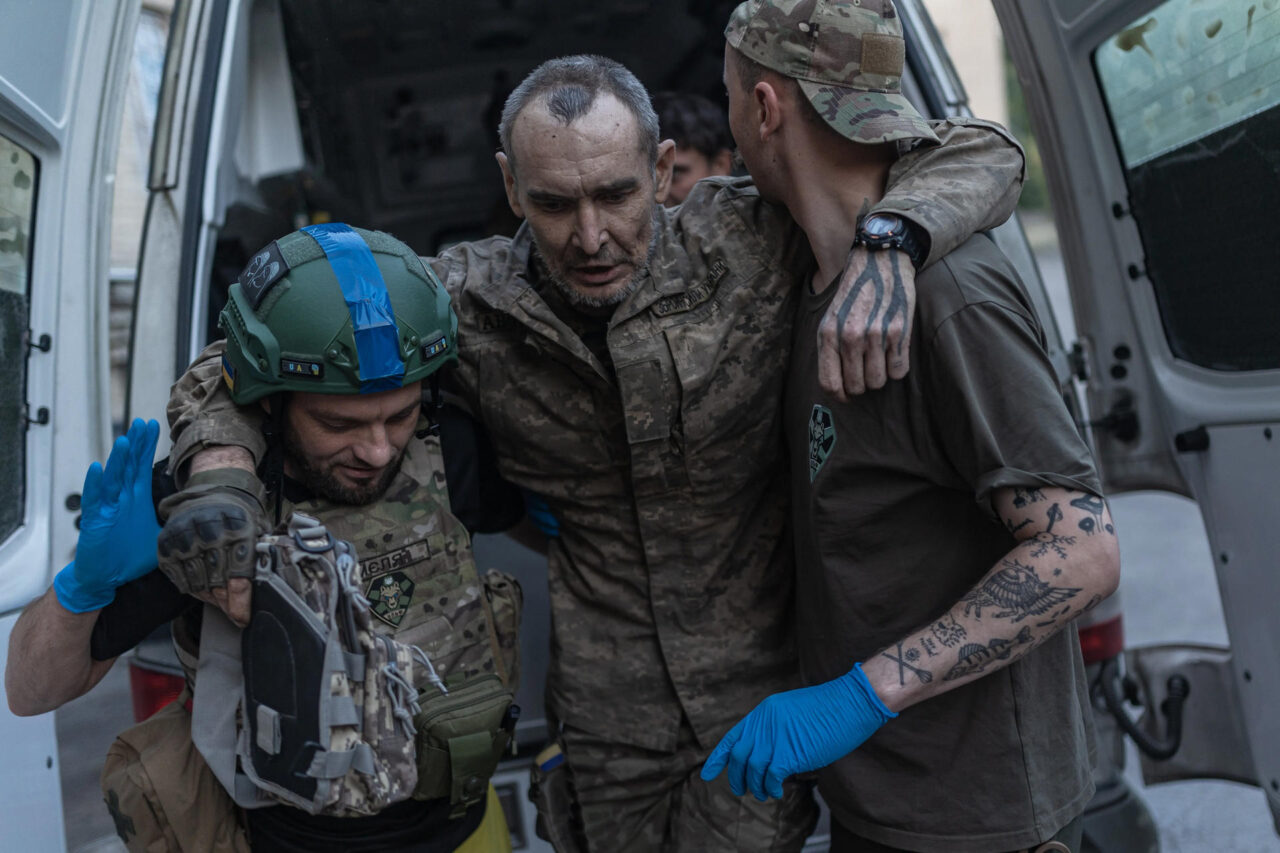
The key city of Pokrovsk is being evacuated as heavily outnumbered Ukrainian soldiers find their comrades’ success across the border is doing nothing to relieve the strain
To escape the advancing enemy army last week, Maria Priazhnykova, an elderly widow, had to endure an exhausting 20-hour journey across Ukraine in a stuffy railway carriage packed with dozens of other refugees, their children and pets.
It left her spoiling for a fight with the Russian president.
“Give me a pistol and I’ll happily shoot Putin,” she said, after stepping onto the platform in a strange city more than 500 miles from the home she had left behind in the east of the country. “F***ing Russians!” she added as she was helped into a wheelchair.
The 88-year-old former decorator had been through this once before. In 1941, as a five-year-old, she was evacuated by train from Leningrad at the start of the Nazi siege of the Soviet city. “That time we were put in a cattle wagon,” she said.
On Friday, Priazhnykova was one of 257 refugees who arrived in the western Ukrainian city of Rivne. In scenes reminiscent of the early days of the war, when hundreds of thousands of Ukrainians fled west, they were met by humanitarian aid workers and volunteers who handed out water and sandwiches — and colouring crayons for children — before sending them off on buses to shelters nearby.
The flow of refugees from the Donbas industrial rust belt is set to increase in the coming days.
Russia’s advance on the crucial logistics hub of Pokrovsk, for so long in its crosshairs, has gained momentum. The government in Kyiv ordered the forcible evacuation of the city last week. Priazhnykova said she had not wanted to leave her home in nearby Myrnohrad: “My boyfriend’s still there,” she said, her eyes twinkling. “I’d have preferred to sit it out in my basement.”
But Kateryna Golentovska, 35, who reached Rivne on another train earlier in the week, said she knew it was time to leave her home near Pokrovsk with Angelina, her seven-year-old daughter, when a friend was hit by shrapnel as she walked home from work.
“She had to have her leg amputated — she has three small children,” said Golentovska. “We stayed as long as we could, but I wanted my daughter to be safe.” After packing a few clothes and Angelina’s favourite cuddly toy, a panda, they closed up their home and departed.
In phone calls with The Sunday Times, Ukrainian military commanders were at pains to explain the apparent collapse around Pokrovsk, some blaming a lack of artillery shells, others new Russian tactics or the use of glide bombs and electronic warfare. They agreed, however, that one of the biggest problems they face is being greatly outnumbered.
“The situation is difficult, we are losing positions, the enemy is pushing us back,” said Captain Dzvenyslava Rymar of the 47th brigade, which is involved in combat near Pokrovsk.
“People are exhausted,” she added. “We need fresh people. No matter how well-trained our fighters are, the Russians still manage to crush us with their numbers. It’s not possible to hold the line when there are just two or three of you and ten to 20 of them coming at you.”
Ukraine had hoped its recent cross-border invasion of Russia’s Kursk region, 200 miles to the northwest, might relieve the strain on its troops in the Donbas region, where Moscow’s forces have been held at bay for most of the war, but are now applying almost intolerable pressure.
It did not. “It has had no effect on our part of the front line,” said Rymar. “Russian assaults are continuing permanently.”
If Pokrovsk falls, it will be the largest population centre taken by the enemy since the Russians seized Bakhmut in May last year. The local administration has left and its 53,000 inhabitants are preparing for the worst.
Besides the evacuation trains, families are departing in cars with roof racks piled high with chairs, sofas and fridges. Banks are dismantling their cash machines.
Svitlana Lastovchenko, 42, another of the refugees, knew it was time to leave her home in Myrnohrad, near Pokrovsk, when she saw a block of flats down the road turn into rubble.
“It was in the middle of the day, out of the blue,” she said. “I saw glass flying. I heard people screaming. Two days later the bodies of two people, an elderly couple, were dug out of the rubble. There were many injured too.” She and her husband, Yuri, 42, and three children, fled west.
Liudmyla Bayura, 51, a nurse who left Myrnohrad with her 13-year-old son, Stanyslav, witnessed the same missile attack. She knew the couple who had been killed. “They had already left the town,” she said, in a hostel in Rivne. “But they returned to see if they could retrieve any more belongings.” She sighed. “At that moment they were killed.”
Bayura’s husband, Serhii, a locksmith, has yet to join the evacuation, and she fears for his safety: “When I speak to him on phone video, I can see the curtains trembling in the explosive waves.”
Lt Mykhailo Luzhetsky, 36, of the 109th brigade, which is fighting near the city, spoke of a “depressingly sad atmosphere in Pokrovsk”, adding: “We hope everything will be all right, but we understand that the situation is not good.”
Even so, the Kursk operation to the northwest had “greatly lifted the spirits” of Ukrainian soldiers and civilians alike, he said. Ukraine has captured almost 500 square miles of Russian land and hundreds of Russian soldiers. It has blown up three bridges with western-supplied rocket systems, to prevent the enemy’s retreat or resupply.
“Here in the east we are jealous,” added Luzhetsky: “While they are moving and advancing in the Kursk region, we are stuck in these trenches like in the First World War.”
The invasion of Russian territory — the first since the Second World War — embarrassed Putin and raised questions about apparent failings in his military chain of command and intelligence services. Almost three weeks after an estimated 10,000 Ukrainian troops stormed the border, Russia has yet to respond.
Putin has already absorbed numerous humiliations during the war, from the bungled beginning of his invasion to the sinking of the Black Sea Fleet’s flagship and the unopposed march on Moscow last summer by Yevgeny Prigozhin and his Wagner mercenaries.
“But Russia keeps going,” said Matthew Savill of the Royal United Services Institute (RUSI), a military and security think tank in London. “The Russian mindset seems to be, ‘We took tens of millions of casualties in the Second World War and we can keep going’.”
He sees Ukraine’s invasion of Russia as “either an act of genius or an act of desperation”, adding: “Rather than lose ground slowly in the east with nothing to show for it, Ukraine needed to change the narrative — to say ‘yes, we’ve lost ground in the east, but we can still manoeuvre and make things difficult for the enemy’.”
The final verdict, Savill predicted, would depend on the “cost Ukraine has to pay” for its lightning cross-border assault. If the operation forces Russia to “thin out” its front line and “creates a sea change in international support, with renewed equipment for Ukraine and a change in the caveats about its use of western long-range weapons in Russia, that would also be a win”, he said.
While congratulating his troops for their efforts last week, Ukraine’s president, Volodymyr Zelensky, told the US, Britain and France: “There is a need for faster delivery of supplies from our partners. We strongly ask for this. There are no vacations in war.”
Zelensky described the territory occupied by his troops in the Kursk region as a “buffer zone”, and gave every sign of wanting to hold onto it, suggesting it might be used as a bargaining chip in negotiations with Russia. Moscow, however, has remained focused on the Donbas.
“There seems an understanding that Putin is ready to sacrifice Kursk so as not to lose any pace in the Donetsk region. This is the only part of the front line where they are succeeding,” said Captain Ivan Sekach of the 110th Mechanised Brigade, which is trying to block Russia’s advance from positions near Pokrovsk.
He believed that Russia would not deviate from the brutal tactics it has used throughout the war in Ukraine, as well as on other battlefields from Chechnya to Syria, predicting Putin’s soldiers would “bomb Pokrovsk to pieces”.
“They will completely destroy it,” he said. “That’s the pattern here, they are already doing it, another school has been destroyed today. They cannot break through the front line, so they advance by flattening everything in their path.”
He believed salvation from the Russians might come with autumn. “When the leaves start to fall and the rain comes, they will get bogged down. We just have to hold on until then.”