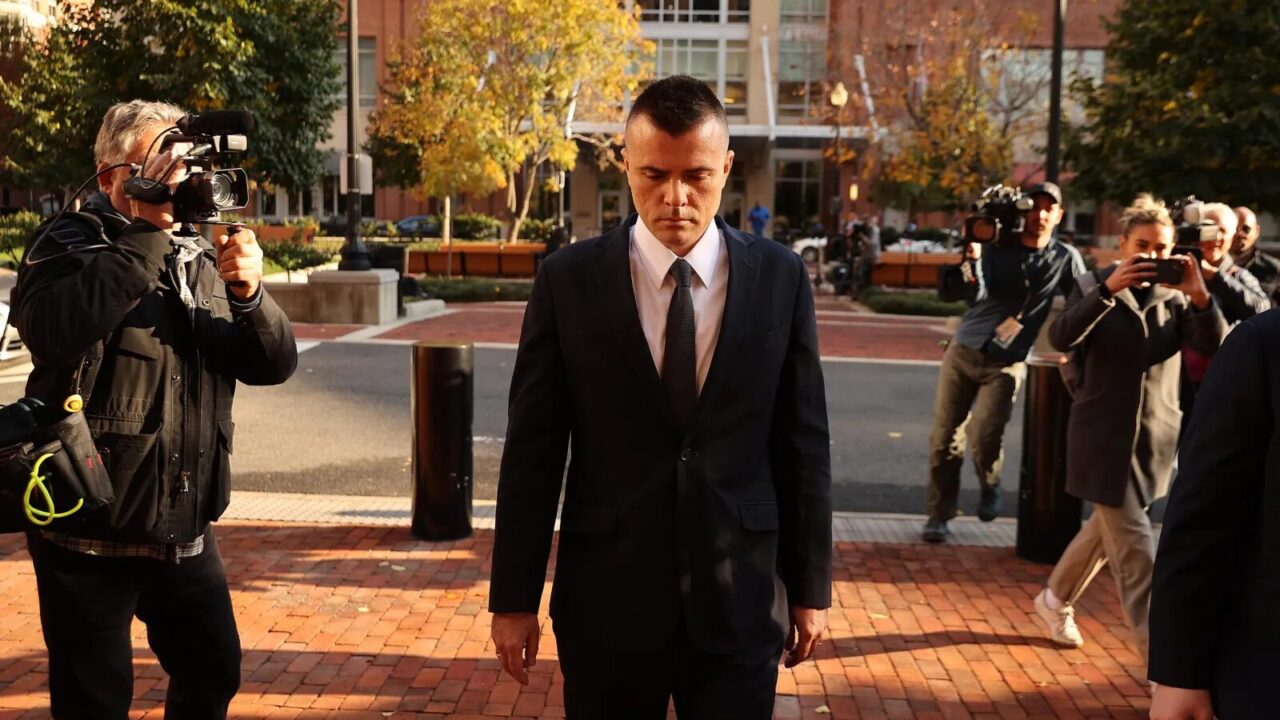
The right calls Igor Danchenko a Russian spy. The left blames him for the still-unverified information he collected. His own mother thinks he’s a double agent. Now, he's telling his side
On the day Igor Danchenko believes he was betrayed by the U.S. government — when the federal government’s chief law-enforcement officer effectively outed the Russian émigré, then a confidential FBI informant, as the architect of one of the most explosive and controversial documents in American political history — Danchenko was on vacation.
The wiry, voluble man had just arrived at his family’s one-bedroom condo in Ocean City, Maryland, right by the beach and a few hours from their home in northern Virginia. It was shortly after sunset on July 17, 2020, a steamy evening during one of the hottest and most heated U.S. summers ever: Covid, protests, an ugly presidential campaign. Danchenko unpacked. His daughter and stepdaughter, not yet teenagers at the time, headed to sleep. His wife, Kristina, reclined on the bed and opened Twitter. She saw the news they’d dreaded the entirety of their relationship. Her heart jumped.
“Oh, my God,” she said. “The 302 transcript is out.”
An FD-302 form is how FBI agents summarize an interview. In this case, it was Danchenko’s initial interview with the FBI. The FBI had learned of Danchenko after BuzzFeed News published the so-called Steele Dossier, a 35-page collection of memos — “unverified, and potentially unverifiable” allegations about President-elect Donald Trump’s worrisome ties to Russia — only 10 days before Trump was to take office in 2017. Danchenko was the dossier’s primary subsource.
For three days in January 2017, Danchenko had volunteered to sit down with FBI representatives from Washington, D.C., to break down what he’d learned during a half-dozen trips to Russia the previous year. For the next three years, Danchenko was a paid confidential human informant for the FBI, contributing to dozens of investigations on things like Russian malign-influence efforts and compiling raw reports that were disseminated to the intelligence community.
But until this evening in 2020, his affiliations had remained sealed from the public eye. He’d never been identified as the man who’d provided the majority of the intelligence in the dossier. He hadn’t even known his boss at Orbis Business Intelligence, Christopher Steele, the former head of the Russia desk for the British foreign-intelligence agency, had compiled his reports into a dossier. Danchenko had thought his work would remain in the shadows — like it had throughout his career. He assumed it would get passed on to the intelligence community, and perhaps they would investigate it further. But, he says, he was as stunned as anyone when he saw it published on BuzzFeed News.
“That’s the nature of this business, of intelligence work,” Danchenko tells me. “This whole world is built on trust — trust that this is strictly confidential.”
The Steele Dossier has left a permanent imprint on American politics and on the intelligence community. When Danchenko was in Russia digging up rumors on Trump, he says, he didn’t know his work was financed by the Democratic National Committee. He didn’t know it would be compiled into a document that after publication would take on a life of its own. And he certainly didn’t know that document’s afterlife would last years: fueling conspiracy theories on the left and right, feeding Americans’ growing suspicion of opposing political parties, leading to his own indictment and a trial that felt like a proxy trial for America’s intelligence community.
Yet as the Steele Dossier continues to ripple through American politics in another election year, the man at its center sits at home, his life crumbled around him.
As Danchenko and his family settled in for a beach weekend on that July 2020 day, Attorney General Bill Barr, saying it was in the public interest, ordered the FBI to declassify a redacted report from Danchenko’s 2017 interview and hand it over to Sen. Lindsey Graham. Within an hour of the release, the report was made public, despite the ranking Democrat on the intelligence committee saying its public release was a gift to Russians and decrying it as the Department of Justice becoming “weaponized.”
The transcript was redacted, but you could tell the number of letters in Danchenko’s blacked-out name: four in his first name, nine in his surname. There were plenty more details for internet sleuths: That the subsource had studied in Russia and the United States, that his Russian hometown had four letters, that he’d participated in a program affiliated with the Library of Congress for emerging leaders from the former Soviet Union.
“All these years, I wasn’t hiding,” Danchenko says. “My social media was all open for people to see. So many open records. It was impossible to shield myself from this. I couldn’t undo my whole life. These details were so particular, so specific — of course it was Igor.”
Senate Committee on the Judiciary Chairman Lindsey Graham holds a copy of the Steele Dossier during a 2019 committee hearing on Capitol Hill. Saul Loeb/AFP/Getty Images
Danchenko says he texted his FBI handler: “I think this is it.”
The FBI said they shouldn’t park in their normal spot; they moved their SUV a few blocks away. Danchenko and his wife covered the condo’s windows with blankets. They called his ex-wife so their kids could stay with her.
They were terrified for their safety: “I’ve been served on a silver platter to Russian intelligence,” Danchenko recalls. “How often do you get betrayed by the attorney general of the United States, personally? How often does that happen?”
He pulled out his pack of unfiltered Lucky Strike cigarettes and chain-smoked while deleting his digital past. He feared for his sources in Russia — at least a dozen of them, he calculated, could be in serious danger if linked to him. He deleted friends from LinkedIn. He severed ties with a network of hundreds.
Two days later, his name was posted on a blog titled I Found the Primary Subsource. Online sleuths had connected that unredacted report to the Steele Dossier. Immediately, his Foursquare account was hacked. He deleted other accounts, like eBay and Expedia, and cleaned up his social media, deleting hundreds of friends. One of his best friends from his hometown of Perm, a formerly closed-off mining city not far from Siberia, texted that he was in the news. RT, formerly known as Russia Today, had blasted out Danchenko’s photograph.
“You can see life crashing down and everything collapsing,” he recalls.
“I’ve been served on a silver platter to Russian intelligence. How often do you get betrayed by the attorney general of the United States, personally? How often does that happen?”
Soon, it would get worse. He’d be overwhelmed with online death threats — “The Gulag is calling for you” — and people speculating that he would kill himself. He’d be called a Russian spy. Trump name-checked Danchenko at rallies as an example of political corruption. His drinking, long an issue, devolved. The FBI severed ties. Eventually, he’d be indicted for lying to the FBI. His trial would end in acquittal — a semi-redemption that would cost more than $350,000 in legal bills. Without irony, Danchenko refers to his trial with the same words Trump uses when talking of allegations of Russian collusion: “a witch hunt.” He became virtually unemployable in his world of business intelligence and geopolitical analysis.
For the next few days, Danchenko and his wife hunkered down in Ocean City, contemplating their next move. They went for a walk on the beach. The skies darkened. Winds gusted above 20 mph. People rushed away from the sea, beach gear in hand, but Danchenko and Kristina decided on a quick swim before the storm.
Just before they got in the water, they paused, seeing an odd shape on the beach. They walked closer, and it came into focus: a dead shark.
ON A SPRING DAY EARLIER this year, I stride up to Danchenko’s home in a leafy neighborhood in Arlington, Virginia. I pass the American flag out front and dozens of seashells on display and knock on the door.
Danchenko answers. I extend my hand.
“It’s a bad omen to shake hands before entering the door,” he warns me.
From the outside, all seems well in the 46-year-old’s life. He was acquitted in 2022 at his trial for lying to the FBI, an embarrassing loss for special counsel John Durham, especially after Trump had said the special counsel was exposing the “crime of the century.” (Durham had been appointed late in the Trump administration to probe the origins of the Trump-Russia investigation; Durham’s final report criticized the FBI for relying on raw, unconfirmed intelligence when it opened the Trump-Russia investigation.) During the trial, doubt was cast on Danchenko’s competence in gathering information used in the Steele Dossier, but FBI witnesses testified that Danchenko told the truth during his time as a confidential informant.
After his acquittal, Danchenko figured his family’s yearslong drama was over. They went on a family vacation to Puerto Rico. He finally became a U.S. citizen. He started a book; his ghostwriter told him he might get a seven-figure advance. His wife focused on her high-paying job as an attorney.
And they moved from their old 1,500-square-foot house, where Danchenko and Kristina slept in a basement with one egress window, to this beauty: more than 6,000 square feet, separate bedrooms for his daughter, stepson, and stepdaughter, a downstairs in-law suite for Kristina’s parents, a music room, a well-appointed kitchen, and a shaded backyard with a gazebo and hammock.
Who is this man to worry? He could have been in jail. He could have been targeted by Russian operatives. Instead, he sits catlike, curled up on a brown leather couch from their favorite thrift shop, temples starting to gray on his close-cropped hair, sipping one of the dozen coffees he drinks this day.
But all is not well.
“It ruined him,” says his 13-year-old daughter, Isabella. “It’s what he’s known for. That’s always going to be there for him. And for me, too.”
He and his wife are in marriage counseling. Kristina can no longer talk about the Steele Dossier: “I can’t be your therapist anymore,” she told him after the acquittal. “I feel like I’m being swallowed by all of it.” Consumed by stress, he missed vast parts of his daughter’s childhood. He’s lost 40 pounds off a frame with little to spare; his face looks gaunt. He and his wife lost friends. Viewed as a traitor in his home country, he believes he’ll never be able to return to Russia to visit his aging parents; he missed his grandmother’s funeral last year. (“I’ll never be able to go back there, even if there’s a liberal president,” Danchenko says. “Treason is treason. I’ve committed treason.”) He has often contemplated suicide. He refuses to go on antidepressants because he feels Americans are overmedicated and that they wouldn’t solve his problems, anyway. Trump sued him, though the lawsuit was thrown out of court and Trump was ordered to pay $20,000 in legal fees. (He has yet to pay, Danchenko says. A representative for Trump didn’t respond to a request for comment.) He zeroed out his finances, cashing out his IRA from his time at the Brookings Institution, spending his and Kristina’s savings and their kids’ college funds, selling his flat in Saint Petersburg, Russia. He still owes his attorney $60,000.
Steele tells me he views Danchenko as a “figure of historical importance,” but that can feel hollow to a man who has been out of work since his outing, except for a few small freelance jobs. His confidential sources in Russia and elsewhere dried up. He’s applied for 100 jobs since his acquittal. The job market for a Russian and Eurasian energy analyst is small: research, academia, counterintelligence. Those jobs often require some level of security clearance; to get security clearance, he’d need an employer to sponsor him. “I can’t get someone to sponsor me because of the stigma,” he says. A dozen times in the past year, he estimates, he felt optimistic about a job before the institution simply went dark on him, not even returning emails.
He sees deep irony in this: With Russia’s war in Ukraine and its increasingly menacing stance toward the West, his expertise may be more valuable than ever before.
“Igor doesn’t deserve any of this,” says Fiona Hill, one of Danchenko’s mentors and a Russia specialist who served on the U.S. National Security Council, and who was a key figure in Trump’s first impeachment. “He would have been a really good political-risk analyst.”
Kristina and Danchenko peer at each other from opposite ends of the couch. Money isn’t their biggest problem, they agree, thanks to Kristina’s job. It’s that he’s lost himself.
“Russia, this work, it’s part of his identity,” his wife says.
“I’m chained to this dossier, to Trump,” he says. “And I can’t unlink myself from it.”
“I can’t be your therapist anymore,” his wife, Kristina, told him after the acquittal. “I feel like I’m being swallowed by all of it.”
His book, Danchenko hoped, could be redemption. But it never sold. Again and again, publishers asked his ghostwriter: Where’s the new dirt on Trump? Another election was coming; his story was rooted in two elections past.
“Igor,” says an old friend, Baron Bustin, an American petroleum engineer who worked with him in Russia two decades ago, “has been a pawn in this whole thing.”
Back in 2016, when he visited Russia to investigate Trump’s Russia connections, Danchenko had already done scores of jobs for Steele, and the MO was almost always that business intelligence work, governed by nondisclosure agreements, would never become public….