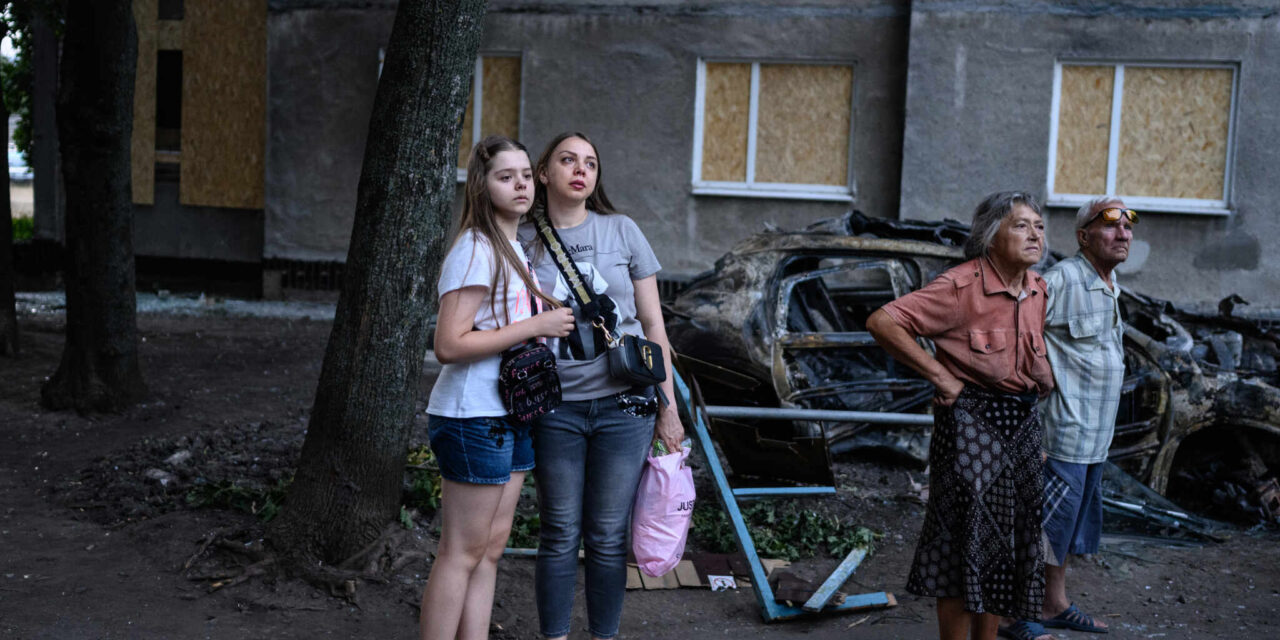
Many residents of Kharkiv, where a Russian strike killed five people on August 30, have relatives on the other side of the border, just a few dozen kilometers away. Some are estranged, others are still in touch, but the wounds run deep and families are being torn apart.
GUILLAUME HERBAUT/AGENCE VU’ FOR LE MONDE
Their minds didn’t falter for a second, pointing their index fingers without any hesitation. “That way,” “Behind the trees there,” “Over there.”… When it comes to showing where Russia is, no one in this apartment block courtyard has any problems orienting themselves. It was 3:10 pm on Friday, August 30, when a “guided bomb” exploded on building 2D in the Industrialnyi district of Kharkiv, Ukraine’s second-largest city. When asked where this device, far more accurate than an air-to-ground missile, came from, everyone in the 2D courtyard pointed in the same direction: East. The border is 35kilometers away as the crow flies, as the missileflies.
When the strike pierced the afternoon sun and destroyed an entire building a few blocks from where they live, Tetyana was in the“courtyard,” as squares surrounded by residential buildings are called here. Her husband, Mykola, was not far away. “Our building shook,” said the 50-year-old high school janitor, his palm over one of his ears, still buzzing from the blast. “I thought about my mother, who lives with us upstairs, and I ran up the stairs to make sure she was alright.” That day, only building 2D, 150 meters from their own, was in flames. Tetyana, an employee working at the book depot of Vivat, one of Kharkiv’s biggest publishing houses, made sure to quickly reassure her family before the news broke on social media. She told everyone except her cousin Angelina, who lives in Moscow.
Angelina grew up in the same neighborhood as her; she also attended the same school, the “119,” before moving to neighboring Russia with her husband. But in the spring of 2022, whenPutin’s army tried to “take” Kharviv, missiles rained down on this urban areaof 1.5 million residents, and when Tetyana sent Angelina photos of tanks and destruction, she laughed: These were obviously “fake” pictures. “She wrote to me: ‘We’ll protect you,'” continued Tetyana. “Since then, it’s all over for me. I stopped texting her on WhatsApp and Viber. Russian TV and Telegram channels rotted her brain in no time.” The couple noted with a hint of irony that the apartment kept by this same cousin in the northern districts, the most exposed, was never damaged in two and a half years of conflict.
“Everyone here has a cousin in Russia,” said her husband, Mykola. Kharkiv is the largest Russian-speaking city outside Russia’s borders, as evidenced by the courtyard of building 2D, like so many others in the post-Soviet space. This courtyard is also Eastern Ukraine in miniature, a snapshot of those regions where the stories of families living on both sides of the front lines create even more complex situations than elsewhere in Ukraine – rifts, heartbreaks, peculiar solidarities. Some continue to talk to each other while steering clear of sensitive issues, or else exchanging banalities filled with innuendo: “Say hi to those around you,” “Kiss the family,” “How’s your health?” “Take care of yourselves.” Others have ruptured all bonds.
Blanketing Russia’s strikes
Building 2D on Second Five-Year Plan Street, now “decommunized” and renamed Valentyn-Biblyk Street after a local engineer, was exactly 50 years old. It was one of a series of buildings constructed in the early 1970s to create “residential complexes,” as people still call them. In their faded, peeling-paint lobbies are varnished wooden letterboxes lined with numbers, never names – perhaps this was the state’s way of saying, “You are mere usufructuaries.” In those days, everything was designed for the community, from communal heating to the elevator. The one in 2D went up 12 floors, others around it went up to 16, and you sometimes wonder if the one you’re riding in will make it all the way. Yet these machines are indestructible, and with the war, what their users actually fear are power cuts.
At the block’s entrance are a mini-market, a butcher’s shop, a drug store, a cash dispenser and the water tanks where everyone fills up their jerry cans since running water is not drinkable in Ukraine. Of course, there’s also a children’s playground in the center of the courtyard. Ping-pong table, swings, a slide… The former Soviet Union is filled with them. Not much in 2D’s courtyard could still be called young, but the neighborhood has been one of the city’s most peaceful since the 2022 Russian invasion. On that same August 30, the last Friday of the holidays, neighbors were almost enjoying a kind of tranquility under the birch trees of the sandbox repainted in blue and yellow – fresh brushstrokes that were often made after 2014 and the Maidan revolution, when they hadn’t left to join their dachas, makeshift houses populating the countryside, to bottle fruit and vegetables.
What fell on them was a “FAB-500 glide bomb,” explained a very young blonde reporter wearing glasses and a plain green blazer, evidently used to reporting live disasters from Kharkiv on channel Kyiv 24. The final death toll was quickly published: Five dead in the building, as well as a 14-year-old teenager who was in a square. Later, the journalist repeated, “Let me remind you that it was the Russians who attacked.”
Things move fast in Ukraine after a drone strike, missile or rocket attack. It’s as if blanketing Russia’s strikes as soon as possible was a way of responding to them. The very next day, when Le Monde visited the area, the courtyard was once again full of children set on pedaling their bikes at full speed. Swings were flying skywards, and pensioners were back on their benches. Alexandre, a 73-year-old construction engineer, started explaining that a relative living in Elista, in southern Russia, had reached out because he was worried about him, before cautiously stopping in his track. You don’t talk about your Russian family in front of just anyone.
Banished from the phone book
Sitting in front of their truck at the foot of the sandpit, a team of rescuers had returned to inspect the scene of the tragedy in the waning daylight. “Our job is to do everything that firemen don’t,” explained Dmitriy L., a tall, smiling man in a khaki T-shirt. He showed off his hands, impressive, gigantic, as if belatedly, at the age of 36, they had grown with the scale of the crimes that needed healing. He sighed: “The Russians only bring misery.”
And yet things had been so quiet when he had left to do his military service at Hoptivka, the border crossing with Russia, just 40 kilometers from Kharkiv. “It was the most important crossing point in Ukraine,” said Dmitriy. In 2012, before the war in the Donbas and the Kremlin’s annexation of Crimea, 45,000 people came to Hoptivka to go in and out every day. He worked there until 2019. “Everything was going well.” Residents of Belgorod, the Russian city closest to the border, but also of other towns like Kursk and Orel, flocked on Sundays or in the summer to buy fabrics, clothes, fake Louis Vuitton bags, wedding dresses and wholesale jeans at Kharkiv’s large Barabashovo market. Buses even shuttled back and forth across the border – for Kursk, it was number 692 and number 2306. “They came here to eat, to party, to hang out in nightclubs during the weekend or at Gorki Park. You could recognize them by their accent.” Dmitriy has an uncle on the other side of the border, Sacha.
Sasha and his wife had come from Moscow to Ukraine for Dmitriy’s wedding. The couple then went on vacation together to Kherson. It also became a habit for them to meet up once or twice a year. Then came 2022… Since then, they’ve been separated by a wall. The rupture began with the bombing of Mariupol’s maternity hospital on March 9. “I was talking about it on the phone with my uncle’s wife. She said, ‘Sergei Lavrov told us it was fake,'” quoting the foreign minister of the Russian Federation. That day, Dmitriy, the rescue worker, deleted their entire conversation thread on WhatsApp.
Pavel I., 34, who was also dispatched by the Interior Ministry to the foot of building 2D, simply “removed” the number of his mother’s cousin and his “whore of a wife,” as he said with a blank stare, from his contacts. A silence fell. Two years earlier, he explained, he had been digging graves in Izium, a martyred town a hundred kilometers away that fell into Russian hands in the spring of 2022 before being liberated the following September. “I’ve seen women and children executed from behind, with holes in their heads; I have too much anger and hatred,” the rescuer said tersely, his jaw clenched. On his torso, his carabiners and fireproof gloves look like a suit of armor. “We can no longer talk to each other.”…
The details of the peace deal presented today by US special envoy Steve Witkoff are consistent with the report in the Financial Times discussed in my previous article and with Larry Sparano in the posted interview. Putin will halt the Russian advance prior to driving Ukrainian soldiers out of all of the territory that has been reincorporated into Russia. It appears to be the case that the borders between Russia and Ukraine will be the current front line, so Putin is withdrawing Russia’s claim to the Russian territories still under Ukrainian occupation.
Russia and the US seem near a Ukraine peace deal. Kyiv’s role may be moot.
President Donald Trump’s hopes of securing a quick Ukraine peace deal hang in the balance after Washington’s envoy, Steve Witkoff, held his fourth Kremlin meeting with Russian President Vladimir Putin Friday.