Russia remains a formidable power. The West should not assume it is a depleted military force.
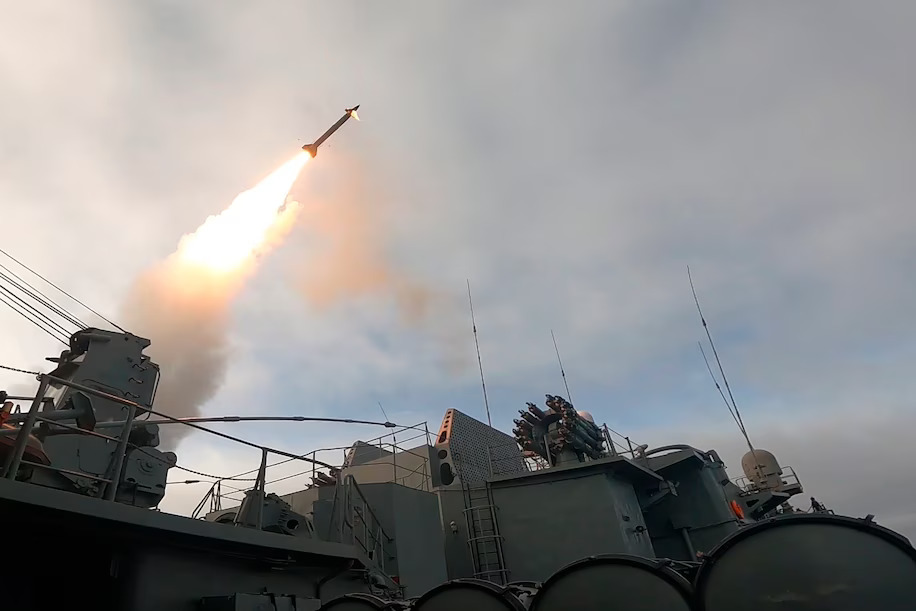
The Russian destroyer Vice-Admiral Kulakov launches a missile during the Ocean 2024 exercises in the Arctic Ocean. (Russian Defense Ministry Press Service via AP)
Aboard a NATO surveillance flight above the Norwegian Sea last week, just two of the 19 military personnel were as old as the plane, a 45-year-old modified Boeing 707 jammed with electronics and monitoring devices, its fuselage crowned with an enormous radar dome.
But the young crew on the lumbering AWACS — the acronym stands for Airborne Warning and Control System — was on the lookout for an enduring threat: Russia’s Northern Fleet, on maneuvers near Iceland as part of a massive worldwide naval exercise.
That exercise, dubbed Ocean 2024, involved some 400 Russianwarships, submarines and support vessels in the North Atlantic and Pacific, as well as the Mediterranean, Caspian and Baltic seas, along with some 90,000 military personnel, according to the Russian Defense Ministry. Chinese vessels also participated.
Even if Russia’sfigures are inflated, the operation was a muscle-flexing reminder that Moscow remains plenty equipped to project power across the globe.
That sobering fact often gets lost amid China’s rising threat and Washington’s pivot to the Indo-Pacific. It shouldn’t, because it would be a mistake once again to underestimate the Kremlin’s resolve to challenge the U.S.-led global order, or Moscow’s staying power in Ukraine.
The outset of Vladimir Putin’s full-scale war in Ukraine exposed Russia’s ground forces as incompetently led and beholden to a tyrant in thrall to his own arrogance and neoimperial ambitions. The ensuing stalemate, now well into its third year, has been a strategic calamity for Moscow.
That sobering fact often gets lost amid China’s rising threat and Washington’s pivot to the Indo-Pacific. It shouldn’t, because it would be a mistake once again to underestimate the Kremlin’s resolve to challenge the U.S.-led global order, or Moscow’s staying power in Ukraine.
The outset of Vladimir Putin’s full-scale war in Ukraine exposed Russia’s ground forces as incompetently led and beholden to a tyrant in thrall to his own arrogance and neoimperial ambitions. The ensuing stalemate, now well into its third year, has been a strategic calamity for Moscow.
Reminders of that threat have been plentiful in recent months. On the AWACS flights that patrolled the Norwegian Sea east of Iceland last week, Russian ships, presumed to be part of the Ocean 2024 exercise, were detected on nearly every mission, a NATO spokesman said.
On the flight I was on, the tactical director, a French air force major, told me: “We didn’t used to encounter the Russian navy very often. Now we know they are out there.”
Much has been made of Ukraine’s impressive success in sinking or crippling a chunk of Putin’s Black Sea Fleet. But with a couple of exceptions, the Chatham House study said, the ships destroyed or disabled were “very old or limited” vessels. The Russian navy “has lost none of its blue-water combat capability,” the paper concluded, and Moscow’s “global power projection capabilities are undiminished.”
To underline that capability, three Russian warships and a submarine cruised into Cuban waters in June and remained just off Havana for several days. They posed no specific threat to the United States; unlike other ships and submarines in Moscow’s arsenal, they were not equipped with nuclear weapons. But they did carry hypersonic precision missiles with a range of several hundred miles.
That is not to say Putin intends to launch a nuclear war, or that he believes Russia’s fleet could go toe-to-toe with the U.S. Navy. But the longer the war in Ukraine grinds on, the more credence the West should give his bedrock assumption — that Moscow can outlast Washington and its allies through the sheer mass of Russian forces and resources, and by keeping the West off balance with threats of escalation.
Putin’s strategy seems increasingly sound, as public support for Ukraine has softened in the United States and parts of Europe. There, hopes have receded that Russia can be defeated on the battlefield, or that its economy will crumble under the weight of U.S.-led sanctions.
The wishful view of Russia as a paper tiger has been discredited by the failure of Ukraine’s counteroffensive last year, and by Putin’s ability to shrug off an attempted mutiny last year and repeated military setbacks.
Granted, Ukraine’s invasion of the Russian region of Kursk this summer was a propaganda triumph. But it has given Kyiv control of just .006 percent of Russia’s landmass. By contrast, Moscow’s forces occupy nearly 20 percent of Ukrainian territory — despite the infusion of $200 billion of Western military and other aid.
The West has been right to help Kyiv retain its independence. It needs now to formulate a muscular long-term strategy that deters future Russian aggression in Ukraine and elsewhere — without starry-eyed assumptions that Moscow is a depleted force.
Lee Hockstader has been The Post’s European Affairs columnist, based in Paris, since 2023. Previously he was a member of the Post editorial board; a national correspondent, a foreign correspondent, and a local reporter. He was awarded The Post’s Eugene Meyer Award for lifetime achievement in 2014
Donald Trump Should Not Repeat Woodrow Wilson’s Failure
April 30th is an important date in American politics. This is the day 100 for the American President in the White House, and all attention will be on the reports of his achievements and failures. But nothing can be more critical than Peace…
○
6 mins read
A Holocaust perpetrator was just celebrated on US soil. I think I know why no one objected.
Russia’s invasion has made ordinarily outspoken critics of antisemitism wary of criticizing Ukrainian Nazi collaborators
○
1 min read
Qi Book Talk: The Culture of the Second Cold War by Richard Sakwa
Richard Sakwa has for many years been one of the most distinguished and insightful observers of relations between the West and Russia, and one of the leading critics of Western policy. In this talk with Anatol Lieven, director of the Eurasia program at the Quincy Institute, Sakwa discusses his book, The Culture of the Second Cold War (Anthem 2025). The book examines the cultural-political trends and inheritances that underlie the new version of a struggle that we thought we had put behind us in 1989. Sakwa describes both the continuities from the first Cold War and the ways in which new technologies have reshaped strategies and attitudes.