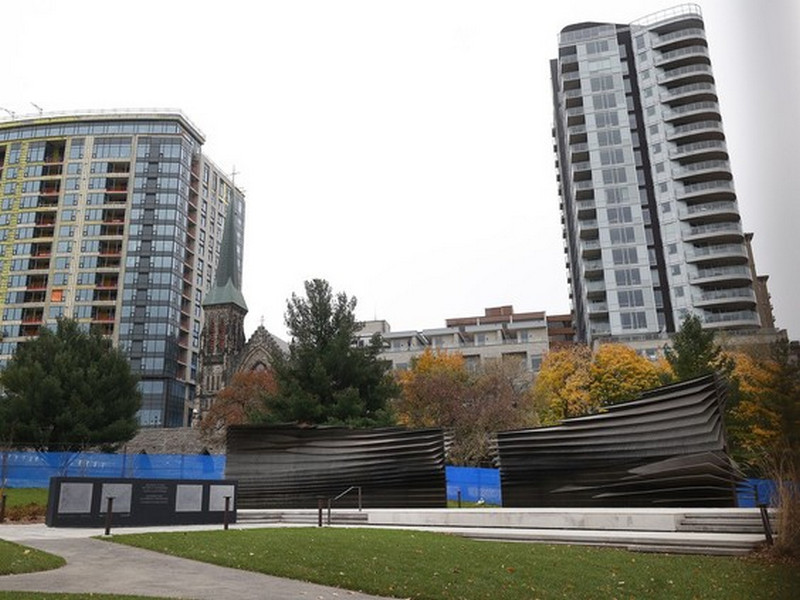
The memorial was supposed to be unveiled in November 2023 but that was put on hold after questions surfaced about many of the names listed.
The opening of the Memorial to the Victims of Communism has been put on hold. Photo by Tony Caldwell /POSTMEDIA
The Department of Canadian Heritage is being told that more than half of the 550 names on the Memorial to the Victims of Communism should be removed because of potential links to the Nazis or questions about affiliations with fascist groups, according to government records.
As originally planned, there were to be 553 entries on the Ottawa memorial’s Wall of Remembrance.
The department had determined that 50 to 60 of the names or organizations were likely directly linked to the Nazis, according to the documents obtained by the Ottawa Citizen through an access to information request.
A 2023 report for Canadian Heritage recommended more than 330 names be excluded to be on the safe side, the records noted. The exclusions were recommended because of the lack of information about the individuals or organizations and whether they might have links to fascist organizations or the Nazis. Some of the entries could also be removed because they have no direct link to Canada.
The memorial, which is located near the corner of Wellington and Bay streets, is supposed to honour those who suffered under communism.
But concerns have been raised over the years by Jewish organizations and historians that names of eastern Europeans who collaborated with the Nazis in the Holocaust have been put forward in an attempt to whitewash their past.
The memorial was supposed to be unveiled in November 2023 but that was put on hold after members of Parliament honoured Yaroslav Hunka, a Ukrainian soldier with the Waffen-SS Galicia Division, a voluntary unit that was under the command of the Nazis. That incident became an international embarrassment for Canada.
Canadian Heritage spokesperson Caroline Czajkowski told the Ottawa Citizen that a new date for the memorial unveiling has not yet been set. Asked whether the more than 330 entries on the Wall of Remembrance will be removed, Czajkowski replied “the review of the commemorative elements is ongoing.”
The main spokesperson for Tribute to Liberty, the organization which advocated for the memorial, did not respond to a request for comment.
Jaime Kirzner-Roberts, a senior director at the Friends of Simon Wiesenthal Centre, said her Holocaust education organization has been raising concerns for years with Canadian Heritage regarding the potential inclusion of Nazi war criminals in the memorial.
“In 2021, we discovered that one particular Nazi leader was being honoured by the Memorial and it took us more than a year of very active advocacy efforts before his name was finally removed,” she said. “We told officials repeatedly that we believed there could be a great number of Nazis being commemorated but sadly this problem did not appear to be a priority for the department.”
Kirzner-Roberts said the recent report commissioned by the department confirmed her organization’s worst fears. “It finds that more half of the individuals commemorated in the memorial may have been Nazis or Nazi collaborators,” she said. “It is totally unacceptable for Nazis and collaborators to be honoured by a Canadian public memorial, especially one meant to recognize victims of state violence and tyranny.”
Federal officials in other departments have continued to warn Canadian Heritage that the inclusion of Nazi collaborators on the memorial will cause international embarrassment.
“It is important to note that many anti-communist and anti-Soviet advocates and fighters were also active Nazi collaborators, who committed documented massacres,” Global Affairs Canada officials warned their counterparts at Canadian Heritage in 2021.
Private donations had already been made to the monument in the names of Nazi collaborators, the CBC reported in July 2021. Those included Roman Shukhevych, a Ukrainian nationalist and Nazi collaborator, as well as Ante Pavelić who ran a Nazi puppet regime in Croatia and is considered a chief perpetrator of the Holocaust in the Balkans, the CBC reported.
Canadian Heritage officials were also voicing their own concerns in internal messages.
“It has come to our attention that a number of entries that have been put forward for recognition may have been affiliated in some capacity to fascist and Nazi organizations,” wrote Tristan-E. Landry, a deputy director at the department. “For example, some of proposed individuals were linked to the Organization of Ukrainian Nationalists and its military, the Ukrainian Insurgent Army….and to a lesser extent with Baltic nationalist groups (i.e. members of the Latvian SS).”
Kirzner-Roberts said the Friends of Simon Wiesenthal Centre is urging the federal government to implement new, rigorous vetting procedures so this type of situation does not happen again.
The Memorial to the Victims of Communism has already been the focus of multiple controversies over its exact purpose, location, size and cost over the last 15 years. The price tag for the project has ballooned to an estimated $7.5 million — including $6 million in public funds — from an original budget of $1.5 million that was supposed to be funded entirely through private donations from Tribute to Liberty.
David Pugliese is an award-winning journalist covering Canadian Forces and military issues in Canada. To support his work, including exclusive content for subscribers only, sign up here: ottawacitizen.com/subscribe
Donald Trump Should Not Repeat Woodrow Wilson’s Failure
April 30th is an important date in American politics. This is the day 100 for the American President in the White House, and all attention will be on the reports of his achievements and failures. But nothing can be more critical than Peace…
○
6 mins read
A Holocaust perpetrator was just celebrated on US soil. I think I know why no one objected.
Russia’s invasion has made ordinarily outspoken critics of antisemitism wary of criticizing Ukrainian Nazi collaborators
○
1 min read
Qi Book Talk: The Culture of the Second Cold War by Richard Sakwa
Richard Sakwa has for many years been one of the most distinguished and insightful observers of relations between the West and Russia, and one of the leading critics of Western policy. In this talk with Anatol Lieven, director of the Eurasia program at the Quincy Institute, Sakwa discusses his book, The Culture of the Second Cold War (Anthem 2025). The book examines the cultural-political trends and inheritances that underlie the new version of a struggle that we thought we had put behind us in 1989. Sakwa describes both the continuities from the first Cold War and the ways in which new technologies have reshaped strategies and attitudes.