Report says settlements with tokens could save billions. Russia has sought to lower reliance on dollar after sanctions
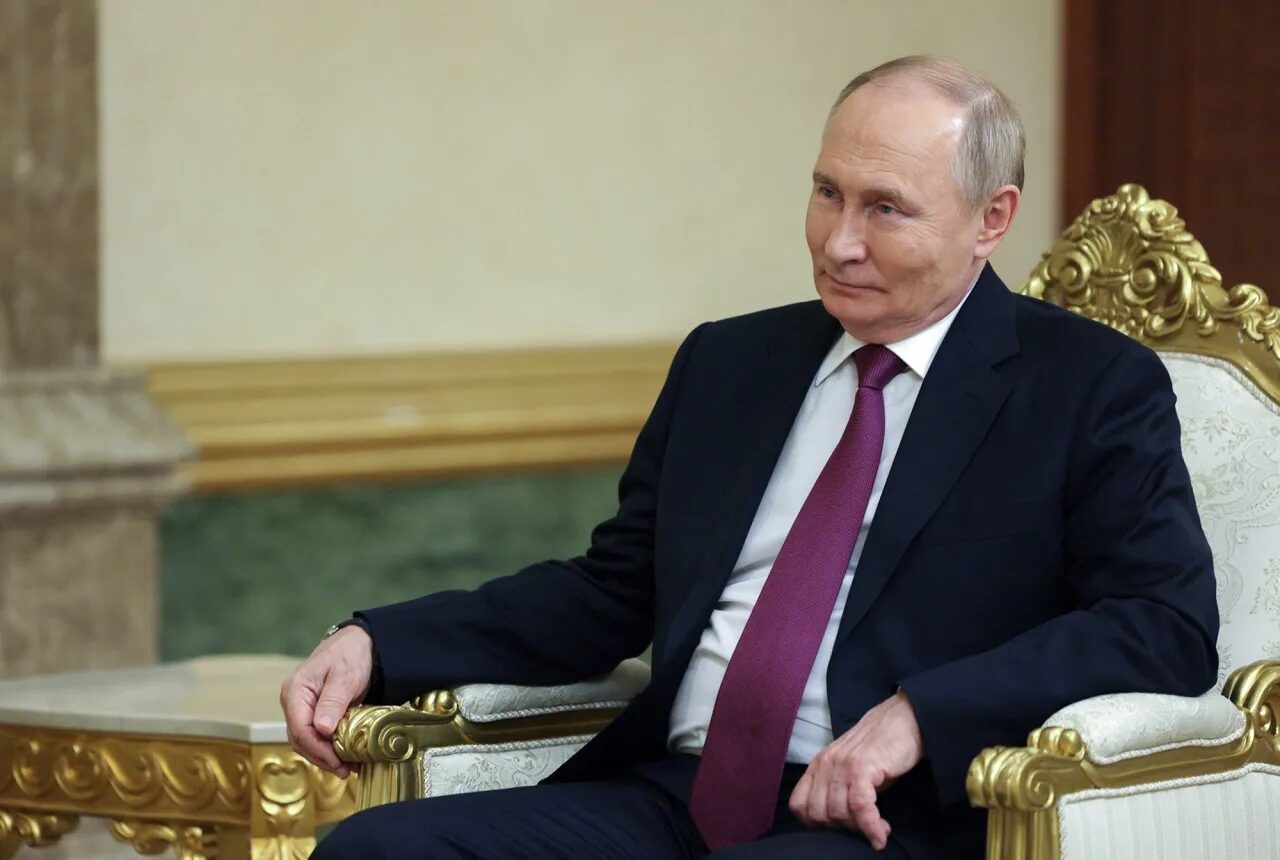
In this pool photograph distributed by the Russian state agency Sputnik, Vladimir Putin attends a meeting in Ashgabat, Turkmenistan.Photographer: Gavriil Grigorov/AFP/Getty Images
Russia is proposing changes to cross-border payments conducted among BRICS countries aimed at circumventing the global financial system, as the heavily penalized country seeks to sanctions-proof its own economy.
The alternatives include developing a network of commercial banks that can conduct such transactions in local currencies as well as establishing direct links between central banks, according to a report prepared by the Russian Finance Ministry, the Bank of Russia and Moscow-based consultancy Yakov & Partners.
The “multicurrency system” will need to “ring-fence its participants from any external pressures such as extraterritorial sanctions,” said the report, which also argued that US interests “are not always aligned with the interests of other participants” of the global financial network.
The plan also includes the creation of centers for mutual trade in commodities such as oil, natural gas, grain and gold.
The US and its allies imposed sweeping penalties on Russia after President Vladimir Putin ordered the February 2022 full-scale invasion of Ukraine. They froze Russia’s foreign assets and kicked major Russian lenders off the SWIFT financial messaging system. In response, Russia has sought to decrease its dependence on the dollar.
Still, other BRICS countries not facing the same complications from sanctions have continued to prioritize access to the dollar-based financial system. Globally, 58% of international payments, excluding those within the euro area, involve the greenback, while the dollar is used in 54% of foreign trade invoices as of 2022, according to the Brookings Institution.
The report was published as Putin prepares to host leaders for the annual BRICS summit, in Kazan from Oct. 22-24. The BRICS group comprising Brazil, Russia, India, China and South Africa expanded in January to include Iran, the United Arab Emirates, Ethiopia and Egypt.
Among the proposals, Russia is pitching the use of distributed ledger technology (DLT) or a new multinational platform to allow settlements with tokens.
“The key advantage of utilizing DLT settlement model is the elimination of the credit risk” accompanying the conventional banking set-up, the report said.
DLT could also reduce processing times and costs because correspondent entities and compliance checks will be absent, saving BRICS countries as much as $15 billion annually if half of all cross-border transfers used such transactions, the report’s authors argued.
Donald Trump Should Not Repeat Woodrow Wilson’s Failure
April 30th is an important date in American politics. This is the day 100 for the American President in the White House, and all attention will be on the reports of his achievements and failures. But nothing can be more critical than Peace…
○
6 mins read
A Holocaust perpetrator was just celebrated on US soil. I think I know why no one objected.
Russia’s invasion has made ordinarily outspoken critics of antisemitism wary of criticizing Ukrainian Nazi collaborators
○
1 min read
Qi Book Talk: The Culture of the Second Cold War by Richard Sakwa
Richard Sakwa has for many years been one of the most distinguished and insightful observers of relations between the West and Russia, and one of the leading critics of Western policy. In this talk with Anatol Lieven, director of the Eurasia program at the Quincy Institute, Sakwa discusses his book, The Culture of the Second Cold War (Anthem 2025). The book examines the cultural-political trends and inheritances that underlie the new version of a struggle that we thought we had put behind us in 1989. Sakwa describes both the continuities from the first Cold War and the ways in which new technologies have reshaped strategies and attitudes.