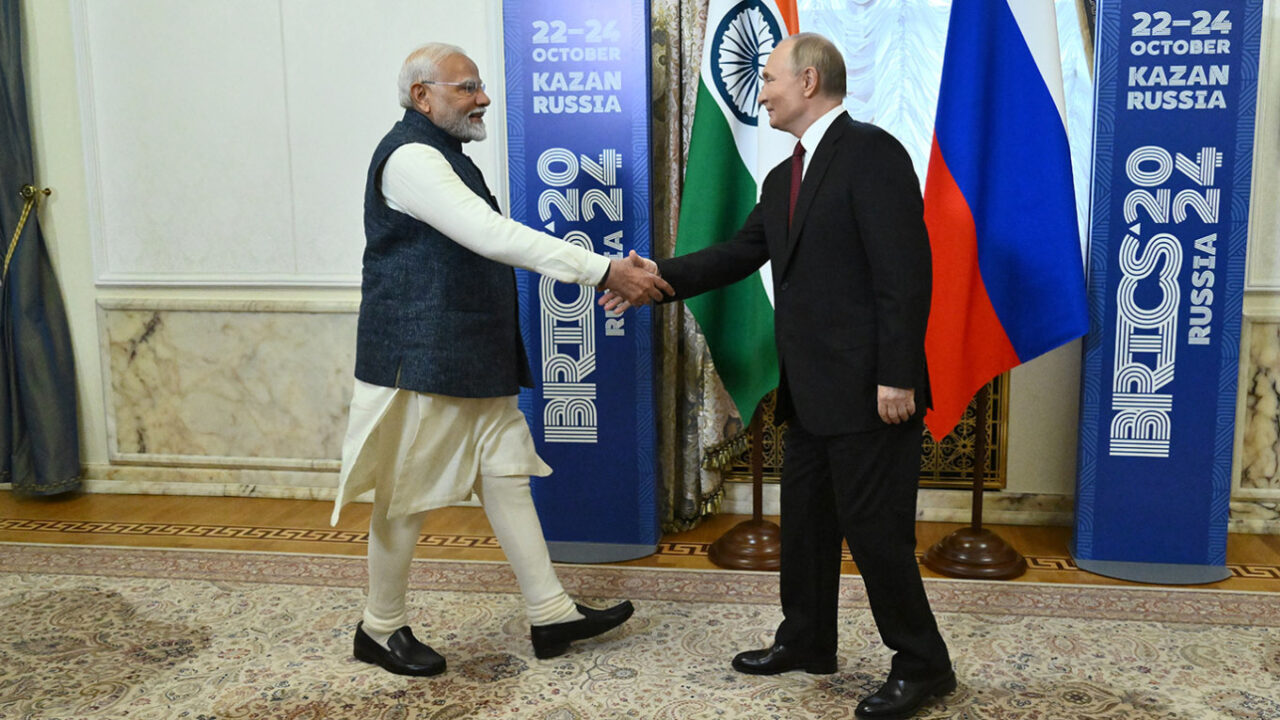
More than thirty world leaders, including Chinese President Xi Jinping and Indian Prime Minister Narendra Modi, have arrived in Kazan, Russia, for the 16th BRICS summit.
Russian President Vladimir Putin welcomes India's Prime Minister Narendra Modi to Kazan. / Kremlin.ru
The meeting, the first since BRICS expanded from five countries to nine, is critical for Russian President Vladimir Putin, who seeks to use the gathering to demonstrate that Moscow is not isolated. Alongside the BRICS leaders, numerous other observers have arrived in Kazan, many of whom aspire to join the group.
The Kremlin has promoted the event as a showcase of Russia’s enduring global alliances, despite efforts to isolate it from the international community. The summit occurs against the backdrop of intensifying sanctions on Russia due to its invasion of Ukraine. Putin is increasingly isolated, facing an arrest warrant from the International Criminal Court for war crimes related to Russia’s actions in Ukraine. Moscow is portraying the gathering — featuring countries like China, India, Iran and other emerging economies — as proof of its continued relevance on the global stage.
Leaders such as Modi and Xi arrived in Kazan on October 22, just in time for the three-day summit. Xi’s plane was escorted by a Russian fighter jet and greeted on the tarmac by Rustam Minnikhanov, the head of the Republic of Tatarstan. Kazan is the capital of Tatarstan, one of Russia’s most important regions.
The summit also underscores the challenges facing the international community’s stance on Russia, especially regarding the potential involvement of UN Secretary-General António Guterres, whose attendance remains uncertain. Moscow has suggested that Guterres might participate, but the UN has not yet confirmed his presence.
A key focus of the summit’s agenda is the future trajectory of BRICS, which has welcomed new members such as Egypt, the UAE and Iran, with countries like Turkey and Saudi Arabia showing interest in joining.
Speaking to The New York Times, Alexander Gabuev, director of the Carnegie Russia Eurasia Centre in Berlin, described the summit as an opportunity for Putin to “punch back”.
“Standing next to all of these leaders, shaking hands and taking pictures, Vladimir Putin will be trying to tell the world that Russia is not isolated,” Gabuev said, noting that the Russian president aims to portray Moscow as part of the global majority.
In addition to its symbolic significance for Putin, the summit serves as a platform to promote a shift away from the dominance of the US dollar in international trade. Many BRICS members aim to establish a counterbalance to Western economic influence, a likely central topic of discussion at the meeting. With sanctions hindering Russia’s cross-border trade and payments, Putin seeks to persuade BRICS members to adopt an alternative global payment system that bypasses the dollar and other G7 currencies. This approach would help Russia and its allies mitigate the impact of Western financial sanctions, potentially loosening the economic grip held by the US and Europe through their control of global financial systems.
However, as BRICS expands, concerns about maintaining ideological coherence have arisen. While countries like Russia, China and Iran strongly advocate a departure from the dollar and Western financial systems, others, including Brazil and India, adopt a more cautious approach. Brazil’s President, Luiz Inácio Lula da Silva, who is not attending in person, has stated that BRICS is “not against anyone”, emphasising that it is a forum for economic cooperation rather than geopolitical confrontation. This lack of consensus may complicate the group’s long-term objectives, even as it seeks to bolster economic and technological frameworks less influenced by the US.
There are other potential stumbling blocks. Countries such as India and South Africa, though part of the bloc, have interests that may not always align with those of Moscow or Beijing. Meanwhile, new members like Egypt and Ethiopia bring their own regional conflicts. Critics argue that these divisions could hinder meaningful economic cooperation within BRICS. Nevertheless, for Putin, the Kazan summit is less about resolving these differences and more about presenting strength and unity to both domestic and international audiences, signalling that Russia remains far from isolated despite Western hostility.
Donald Trump Should Not Repeat Woodrow Wilson’s Failure
April 30th is an important date in American politics. This is the day 100 for the American President in the White House, and all attention will be on the reports of his achievements and failures. But nothing can be more critical than Peace…
○
6 mins read
A Holocaust perpetrator was just celebrated on US soil. I think I know why no one objected.
Russia’s invasion has made ordinarily outspoken critics of antisemitism wary of criticizing Ukrainian Nazi collaborators
○
1 min read
Qi Book Talk: The Culture of the Second Cold War by Richard Sakwa
Richard Sakwa has for many years been one of the most distinguished and insightful observers of relations between the West and Russia, and one of the leading critics of Western policy. In this talk with Anatol Lieven, director of the Eurasia program at the Quincy Institute, Sakwa discusses his book, The Culture of the Second Cold War (Anthem 2025). The book examines the cultural-political trends and inheritances that underlie the new version of a struggle that we thought we had put behind us in 1989. Sakwa describes both the continuities from the first Cold War and the ways in which new technologies have reshaped strategies and attitudes.