The West is no longer capable of waging a real war, says French historian Emmanuel Todd. In an interview, he predicts that Putin is seeking regime change in Kiev. He does not believe that Russia will attack other countries.
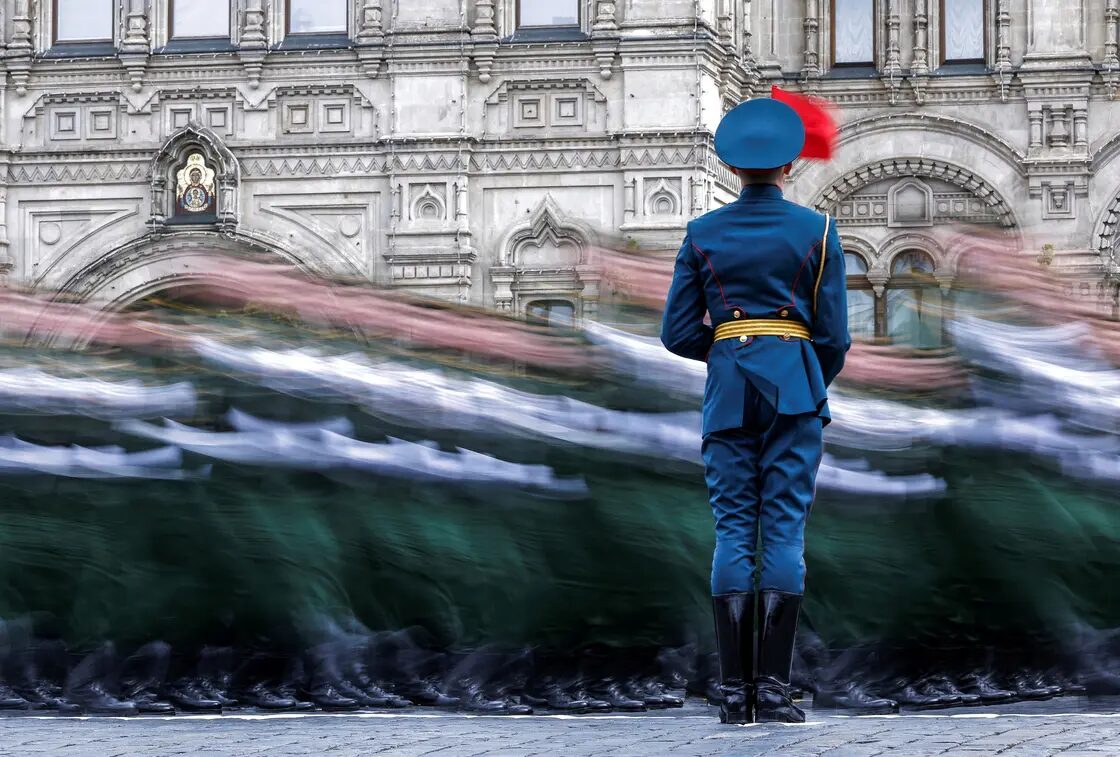
On May 9, 2024, Russian troops will parade on Red Square in Moscow. Maxim Shemetov / Reuters
The controversial French historian Emmanuel Todd, born in 1951, predicted the collapse of the Soviet Union in 1976 with his book “La Chute finale”, causing a great stir. Since the turn of the millennium, he has made a name for himself as an unconventional thinker and historian who likes to argue against the mainstream. In 2002, he wrote an obituary for the USA. And a few weeks ago, his latest work was published under the title “The West in Decline”. In it, he defends Russia’s attack on Ukraine, which the West provoked without being able or willing to do anything to counter it.
Mr. Todd, recently Ukrainian President Volodymyr Zelensky presented a victory plan. What do you think of it?
Nothing. The name alone evokes the Orwellian method of completely reinterpreting reality. The Russian army is on the advance. One wonders how many more months the regime in Kiev can hold out. The Russians will win this war. And in the West, people turn a blind eye and talk about peace.
What makes you so sure that the Russians will win?
European politicians and thinkers are no longer capable of waging war. And when they are confronted with a real war, they immediately and without thinking begin to accuse the person who started the war, assuming that the person who started the war is necessarily the guilty party.
There is a broad consensus about who the aggressor is in this war. You seem to think Putin is the victim?
Putin is waging a defensive war of aggression. Of course I disapprove of the war. But here it was the Americans who took on the Ukrainian army. Ukraine was de facto integrated into NATO. I am a historian, I am simply trying to understand what happened.
There was never any serious discussion about Ukraine joining NATO.
That is exactly the point. They were well on their way to tacitly integrating the Ukrainians into NATO. In concrete terms, this meant that the Ukrainian army was being reorganized by the Americans and British. With an offensive goal, a project to reconquer the Donbass. Unfortunately, Ukraine was not a member of NATO in the legal sense and was therefore not protected by the obligation to provide assistance in the event of a so-called alliance. So they had all the risks of membership in NATO, without its protective shield.
You are not only a historian, you also seem to know a lot about the future. In 1976 you predicted the end of the Soviet Union, and now in your new book you predict that Russia’s victory will also mean the downfall of the West. You seem to enjoy the role of Cassandra?
Yes, I look to the future. But in my methods I am a conformist. I look at history in the long term, I am interested in economic forces, religion and education. This is productive for understanding the present and recognizing a tiny piece of the future. As a historian, I have to look at this war as I study Caesar’s wars. I am not primarily concerned with moral judgment. And if you now tell me that I am too much of a futurologist, then all I can say is: I want to know what will happen now.
Tell me.
The Ukrainians have lost, the Americans have lost. But how will the Americans and the Europeans accept their defeat?
What is your prognosis?
The Russians will never pursue further war aims because they have neither the means nor the desire or interest. And that is peace. Or the West will continue the war by firing long-range missiles at Russia and risking a nuclear escalation.
In your book you list the three war aims of the Russians as if you had a direct connection to the Kremlin.
These goals can be derived from the security needs of the Russians: occupation of the eastern bank of the Dnieper, occupation of the Odessa Oblast to secure the ports on the Black Sea and a Russia-friendly government in Kiev.
However, this would mean the total subjugation of Ukraine.
That’s right, it’s the destruction of Ukraine. That shows that I’m an honest and serious researcher. I’m accused of being a Russophile, they say I understand Putin. If you want to make a joke in your interview, you can write that it’s finally obvious that I’m not a Kremlin agent, but that I give Putin advice.
I have the impression that it gives you satisfaction to predict the defeat of the West and the subjugation of Ukraine.
I think you are confusing my intellectual satisfaction as a historian with a supposed pleasure in the tragic events. It is not the pleasure in the historical facts, but that of the historian who writes his chef d’oeuvre.
Does this also include the satisfaction that your historical research and the forecasts derived from it stand out from the mainstream?
In fact, many people in France think that I enjoy contradicting everyone.
In any case, you obviously don’t seem to mind.
On the contrary, it makes me physically ill. Contradiction in itself does not give me any pleasure. However, I believe that I am an outsider. I have developed a historical model that regularly contradicts the views of other researchers. The interesting thing is that it is always other people who attack and insult me. Nevertheless, I believe that I am a likeable guy.
Is it important to you to be likeable?
Extreme, I’m not argumentative. But I can stand debates. On the other hand, I suffer when I’m despised.
How come you are constantly being attacked so violently from very different sides?
I am a historian to the core. In a society that no longer has any historical awareness, I am bound to come into conflict with the intellectuals of today.
You are despised. But don’t you also despise the media?
Absolutely, I have acquired this disdain through long experience. I come from a journalistic tradition. My grandfather Paul Nizan was a writer, communist and journalist, he died at the front in 1940. My father, who is now 95 years old, is an important journalist for the Nouvel Obs. This has shaped my own intellectual formation.
Can you describe it in more detail?
I saw my father travel the world, even to dangerous places like Vietnam and Biafra. He wrote great reports, but hardly understood the historical background. My obsession with books – apart from the fact that I don’t travel much and am afraid of flying – has to do with my father, who traveled a lot and didn’t understand a lot of things. I have my own theory about the demise of journalism.
And that is?
In the beginning there was a pluralistic system with a variety of positions, which in turn guaranteed the plurality of information. Then all ideologies disappeared and journalism with lowercase letters turned into JOURNALISM with uppercase letters, which considered itself more important than political positions. Newspapers became interchangeable. Journalism contributes greatly to the inability of the West to look at the Ukraine war soberly.
Journalists claim for themselves what you claim as historians: they collect facts and interpret them.
Journalists without a sense of history, like my father, no longer have any idea how history should be interpreted, so all journalists have become similar with their few simple ideas. It is not surprising that journalism in the West calls for war in capital letters. Journalism has become a warmongering force. A warmongering force does not bode well for humanity.
There are a few things in your book that I find very bizarre.
Just a few?
You write several times in your book that Putin is pursuing a slow strategy out of consideration for his soldiers. From everything we know, the lives of his soldiers are not worth much to him.
To say that he wants to protect them is too strong a statement. That is not what he means. I am basing my argument on the Western discourse. In the West, people do not want to think soberly about Putin and Russia. They think of everything in terms of Putin equals Stalin. That is why they think Putin is waging war like Stalin. Stalin waged war using the Soviet Union’s demographic resources, which were inexhaustible. Putin’s approach is completely different. The human losses are significant. He does not want to risk too many deaths and is therefore waging a very slow campaign.
I am not saying that either. These are not the standards that can be applied to a head of state. Putin wants to avoid a general mobilization that would be poorly received by the people. It would completely unbalance Russia’s economy and society. Does Biden have respect for human life?
You just said that these are not the standards by which heads of state are judged. I am surprised that in your book you emphasize so obsessively that Putin supposedly spares the soldiers.
I am just trying to mention a fact that Western observers consistently ignore. Because it is the prerequisite for the stability of the Russian regime. I am not specifically pointing out the Russian government’s excesses of violence because that is common knowledge.
Is it not intellectually dishonest to present the situation in such a one-sided way?
I did not want to repeat what is already obvious. You cannot accuse me of wanting to keep quiet about something. Specifically, I am pointing out the difference between an oligarchic democracy in the West and the authoritarian democracy in the East.
In doing so, you are turning reality on its head, using Orwellian methods. You call Putin’s regime a democracy, while the opposition is either murdered, imprisoned or forced into exile. That is cynical.
But no, this is very serious. In the West, we are guided by liberal democracy. It is a democracy in which the majority of the population expresses itself and the minority is protected. And that is why I call Russian democracy authoritarian, because the majority of the population expresses itself in it, but the minorities are not protected.
What is the deal with oligarchic democracy in the West?
Although democratic institutions still exist, people vote, there is freedom of the press, the spirit has been lost because the population has become fragmented and the upper class despises the workers. That is why I call it a liberal oligarchy. The controversies I have triggered with this show that the comparison must be fruitful.
Who are the oligarchs in the USA?
Trump, Musk, Bezos, Gates, there are a lot of people who are extremely rich and whose wealth allows them to exert direct influence on the political system of their country. But the majority of American billionaires are on the side of the Democrats. At least there is a pluralism of oligarchs in the USA.
Your book has been translated into many languages, including Russian, but it has not yet been published in the USA. Does that surprise you?
I was actually very surprised because my previous books were very well received in the United States. It makes me very proud. I thought I must have written a really good book if it is considered so dangerous and all the American publishers are afraid to publish it.
Couldn’t it be the other way round? Your assessments are considered inaccurate.
I’m more wondering whether there was a central authority in the USA that banned the book.
The details of the peace deal presented today by US special envoy Steve Witkoff are consistent with the report in the Financial Times discussed in my previous article and with Larry Sparano in the posted interview. Putin will halt the Russian advance prior to driving Ukrainian soldiers out of all of the territory that has been reincorporated into Russia. It appears to be the case that the borders between Russia and Ukraine will be the current front line, so Putin is withdrawing Russia’s claim to the Russian territories still under Ukrainian occupation.
Russia and the US seem near a Ukraine peace deal. Kyiv’s role may be moot.
President Donald Trump’s hopes of securing a quick Ukraine peace deal hang in the balance after Washington’s envoy, Steve Witkoff, held his fourth Kremlin meeting with Russian President Vladimir Putin Friday.