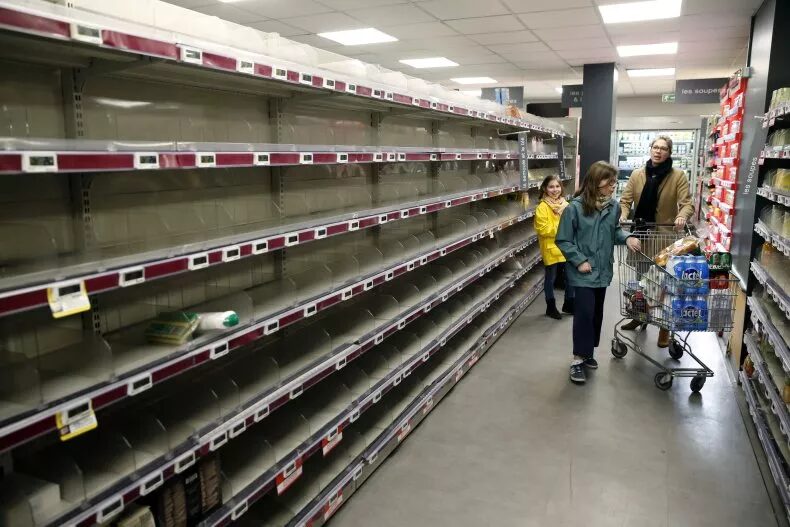
People living in the European Union should stockpile emergency supplies in the event of war breaking out or another major emergency, a new report has advised.
Empty shelves at a Monoprix supermarket in Paris during the COVID-19 pandemic in 2020. A new report suggests EU citizens should keep a stockpile of key supplies in case of emergency. Chesnot/Getty Images
The report on Europe’s civilian and military preparedness, published on Wednesday, was written by former Finnish President Sauli Niinistö in his capacity as Special Adviser to the President of the European Commission.
The report notes that the EU was not prepared for either the COVID-19 pandemic or Russia’s aggression against Ukraine, and that it needs to move “from reaction to proactive preparedness.”
As part of this strategy, the EU should advise households to be prepared to be self-sufficient for a minimum of 72 hours in the event of an emergency, the report says.
It advises member states to provide its citizens with guidelines on stockpiling, evacuations, and how to access emergency services, among other things.
A survey cited in the report outlines various essential supplies for households to have in case of an emergency, including stockpiles of food, drinks and medicine, a flashlight and battery-powered radio.
The advice aims to prepare EU citizens for emergencies ranging from another pandemic to extreme weather or armed aggression.
The COVID-19 pandemic prompted people around the world to suddenly start buying up goods to stockpile, leading to shortages of certain items.
While the report does not cite Russian aggression as the only possible threat, it cites it as a major one.
“We do not have a clear plan on what the EU will do in the event of armed aggression against a Member State. The threat of war posed by Russia to European security forces us to address this as a centerpiece of our preparedness, without undermining the work to prepare for other major threats,” the report said.
The report notes that while the threat of Russian aggression is felt most by its immediate neighbors, any action by Russia against an EU member state would impact all of the bloc’s 27 countries.
“The territorial integrity and political independence of every Member State is inextricably linked with that of other Member States, and the EU as a whole,” the report says.
The report states that empowering citizens should be at the “core” of a comprehensive preparedness strategy, and that the bloc should raise awareness and encourage self-reliance among its population.
It also proposes other EU-wide measures, at least 20 percent of the bloc’s overall budget being allocated to enhancing security and crisis readiness. It also suggests a plan of greater intelligence sharing among EU countries.
The 165-page report was presented to EU Commission President Ursula von der Leyen on Wednesday.
Donald Trump Should Not Repeat Woodrow Wilson’s Failure
April 30th is an important date in American politics. This is the day 100 for the American President in the White House, and all attention will be on the reports of his achievements and failures. But nothing can be more critical than Peace…
○
6 mins read
A Holocaust perpetrator was just celebrated on US soil. I think I know why no one objected.
Russia’s invasion has made ordinarily outspoken critics of antisemitism wary of criticizing Ukrainian Nazi collaborators
○
1 min read
Qi Book Talk: The Culture of the Second Cold War by Richard Sakwa
Richard Sakwa has for many years been one of the most distinguished and insightful observers of relations between the West and Russia, and one of the leading critics of Western policy. In this talk with Anatol Lieven, director of the Eurasia program at the Quincy Institute, Sakwa discusses his book, The Culture of the Second Cold War (Anthem 2025). The book examines the cultural-political trends and inheritances that underlie the new version of a struggle that we thought we had put behind us in 1989. Sakwa describes both the continuities from the first Cold War and the ways in which new technologies have reshaped strategies and attitudes.