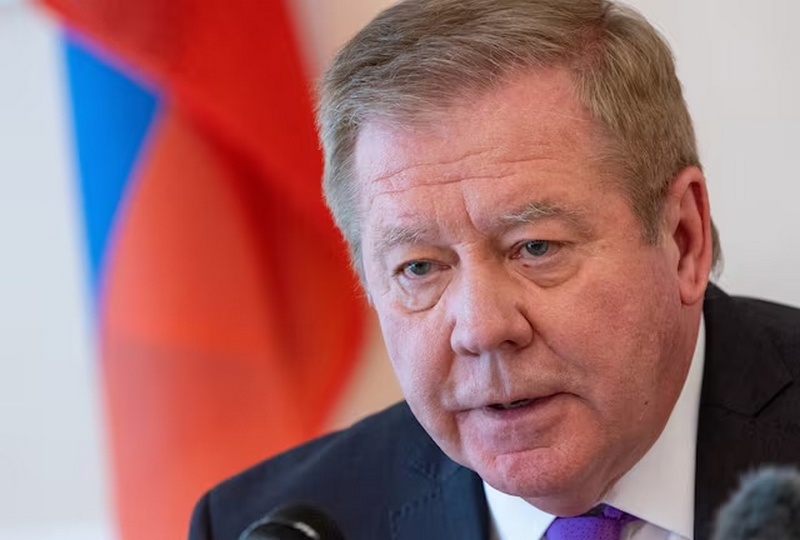
GENEVA, Nov 14 (Reuters) - Russia is open to negotiations on an end to the Ukraine war if initiated by U.S. President-elect Donald Trump, but any talks need to be based on the realities of Russian advances, Moscow's ambassador to the U.N. in Geneva told reporters on Thursday.
Russian ambassador to the United Nations Gennady Gatilov attends an ACANU briefing in Geneva, Switzerland, March 26, 2024. REUTERS/Denis Balibouse/File Photo
Summary
Envoy says talks must acknowledge recent Russian advances
Sees limited scope for reset in Russia-US relations
But more dialogue with Washington possible under Trump
Trump has repeatedly criticised the scale of Western aid to Kyiv and has promised to end the conflict swiftly, without explaining how. His victory in the Nov. 5 presidential election has spurred concerns in Kyiv and other European capitals about the degree of future U.S. commitment to helping Ukraine.
“Trump promised to settle the Ukrainian crisis overnight. OK, let him try. But we are realistic people of course we understand that this will never happen,” said Gennady Gatilov, Russia’s ambassador to the United Nations in Geneva.
“But if he starts or suggests something to start the political process, it’s welcome.”
He added that any such negotiations needed to be based on what he called the “realities on the ground”, describing Ukraine as being on the back foot in the more-than-two-year conflict. Russian forces are advancing at the fastest pace in at least a year in Ukraine and now control about one-fifth of the country.
Ukrainian President Volodymyr Zelenskiy has repeatedly said peace cannot be established until all Russian forces are expelled and all territory captured by Moscow, including Crimea, is returned. The “victory plan” he outlined last month maintained that provision, as well as an invitation for Ukraine to join NATO, long denounced by Russia.
Zelenskiy told European leaders in Budapest last week that concessions to Russia would be “unacceptable for Ukraine and suicidal for all Europe”.
Russia’s invasion of Ukraine in 2022 triggered the biggest confrontation between Moscow and the West since the depths of the Cold War, with President Joe Biden driving efforts to isolate Russia.
Gatilov indicated Trump’s election represented a new possibility for dialogue with the United States, but was doubtful about a broader reset of relations, echoing earlier caution voiced by the Kremlin.
“The U.S. political elite regardless of domestic political shifts, (Washington) consistently pursues a stance of containing Moscow and this orientation is deeply-rooted unfortunately and the change of administration does little to alter it,” he said.
“The only shift (that) might be possible is dialogue between our countries, something that has been lacking during the last several years,” he added.
The details of the peace deal presented today by US special envoy Steve Witkoff are consistent with the report in the Financial Times discussed in my previous article and with Larry Sparano in the posted interview. Putin will halt the Russian advance prior to driving Ukrainian soldiers out of all of the territory that has been reincorporated into Russia. It appears to be the case that the borders between Russia and Ukraine will be the current front line, so Putin is withdrawing Russia’s claim to the Russian territories still under Ukrainian occupation.
Russia and the US seem near a Ukraine peace deal. Kyiv’s role may be moot.
President Donald Trump’s hopes of securing a quick Ukraine peace deal hang in the balance after Washington’s envoy, Steve Witkoff, held his fourth Kremlin meeting with Russian President Vladimir Putin Friday.