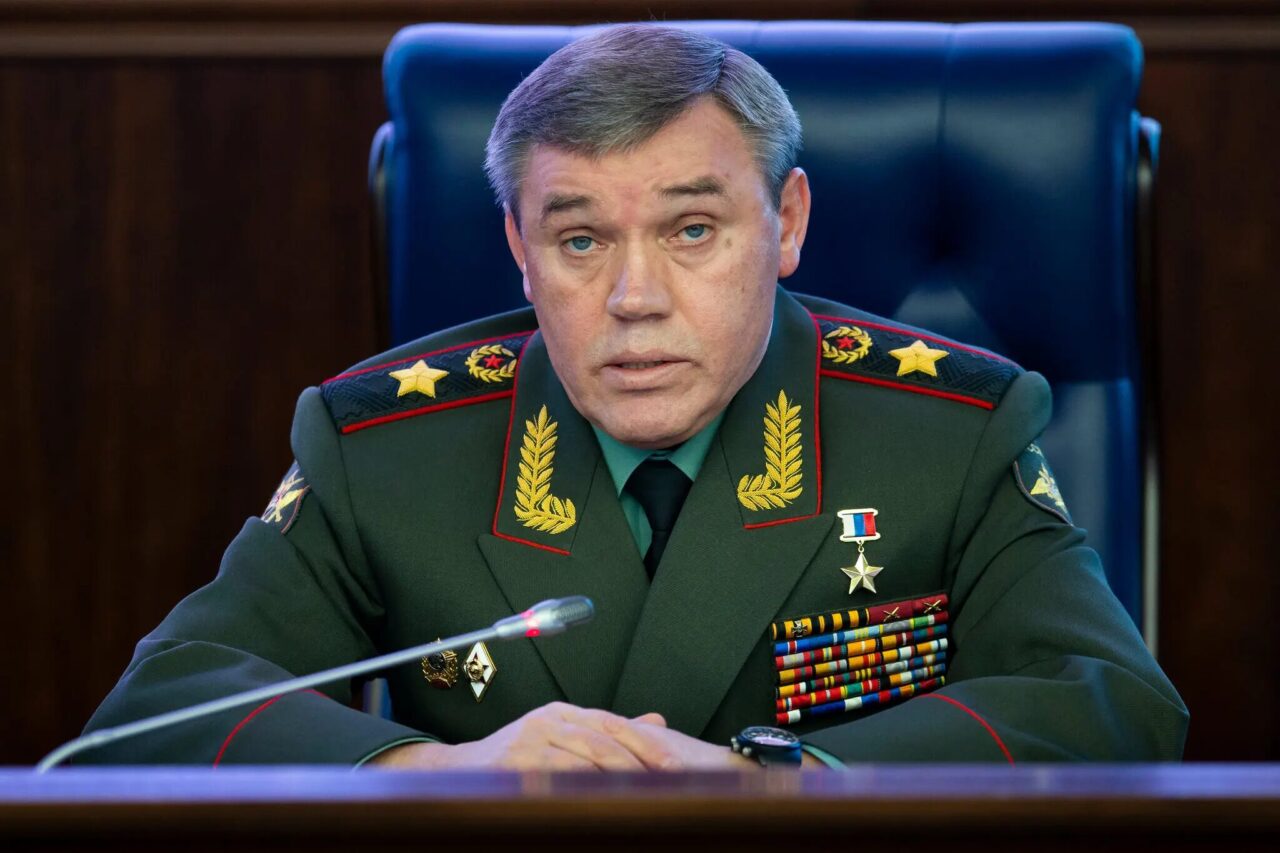
In a highly unusual call, the two men “discussed a number of global and regional security issues, to include the ongoing conflict in Ukraine,” a spokesman said.
Gen. Valery V. Gerasimov last spoke with his American counterpart in 2022, when he and Gen. Mark A. Milley had a phone call. Credit: Alexander Zemlianichenko/Associated Press
Gen. Valery V. Gerasimov, the architect of President Vladimir V. Putin’s invasion of Ukraine, called President Biden’s top military adviser last week and talked about how to manage escalation concerns between the two countries, according to defense and military officials.
The rare phone call took place last Wednesday, the day before Thanksgiving and just six days after Russia launched a new, nuclear-capable, intermediate-range ballistic missile at Ukraine that Mr. Putin said was in response to Ukraine’s use of American and British weapons to strike deeper into Russia.
During the call, General Gerasimov told Gen. Charles Q. Brown Jr., the chairman of the Joint Chiefs of Staff, that the Oreshnik ballistic missile launch had been planned long before the Biden administration agreed to allow Ukraine to use American ATACMS to strike deeper into Russia, officials said.
Though the Oreshnik missile carried only conventional warheads, using it signaled that Russia could strike with nuclear weapons if it chose. The missile struck a Ukraine weapons facility in Dnipro.
Capt. Jereal Dorsey, a spokesman for General Brown, said in a statement after he was approached by a reporter about the call that “at the request of General Gerasimov, General Brown agreed to not proactively announce the call.”
The two men “discussed a number of global and regional security issues, to include the ongoing conflict in Ukraine,” Captain Dorsey said.
The call came at a tense time. Mr. Putin had escalated an already tense showdown with the West, asserting that Russia had the right to strike the military facilities of countries “that allow their weapons to be used against our facilities.”
“The regional conflict in Ukraine, previously provoked by the West, has acquired elements of a global character,” Mr. Putin said in a rare address to the nation at the time. “We are developing intermediate- and shorter-range missiles as a response to U.S. plans to produce and deploy intermediate- and shorter-range missiles in Europe and the Asia-Pacific region.”
Mr. Putin’s comments came as Mr. Biden loosened restrictions that he had kept in place for much of the war. He authorized the use of those missiles, known as ATACMS, for Army Tactical Missile Systems, deeper into Russia, and Ukraine has used them, including in a strike last month on an ammunition depot in southwestern Russia, according to Ukrainian officials.
The Biden administration also last month approved supplying Ukraine with American anti-personnel mines to bolster defenses against Russian attacks as front lines in Ukraine’s east buckled.
It was unclear why General Gerasimov wanted the phone call with General Brown kept quiet. General Gerasimov last spoke with his American counterpart in October 2022, when he and Gen. Mark A. Milley, General Brown’s predecessor as chairman of the Joint Chiefs of Staff, spoke on the phone. That call also came amid fears that Moscow was looking to escalate its war in Ukraine.
Helene Cooper is a Pentagon correspondent. She was previously an editor, diplomatic correspondent and White House correspondent.
Eric Schmitt is a national security correspondent for The Times, focusing on U.S. military affairs and counterterrorism issues overseas, topics he has reported on for more than three decades.
Donald Trump Should Not Repeat Woodrow Wilson’s Failure
April 30th is an important date in American politics. This is the day 100 for the American President in the White House, and all attention will be on the reports of his achievements and failures. But nothing can be more critical than Peace…
○
6 mins read
A Holocaust perpetrator was just celebrated on US soil. I think I know why no one objected.
Russia’s invasion has made ordinarily outspoken critics of antisemitism wary of criticizing Ukrainian Nazi collaborators
○
1 min read
Qi Book Talk: The Culture of the Second Cold War by Richard Sakwa
Richard Sakwa has for many years been one of the most distinguished and insightful observers of relations between the West and Russia, and one of the leading critics of Western policy. In this talk with Anatol Lieven, director of the Eurasia program at the Quincy Institute, Sakwa discusses his book, The Culture of the Second Cold War (Anthem 2025). The book examines the cultural-political trends and inheritances that underlie the new version of a struggle that we thought we had put behind us in 1989. Sakwa describes both the continuities from the first Cold War and the ways in which new technologies have reshaped strategies and attitudes.