Kyiv has been sending drones and operators to Syria and offering more to give Russia ‘a bloody nose’
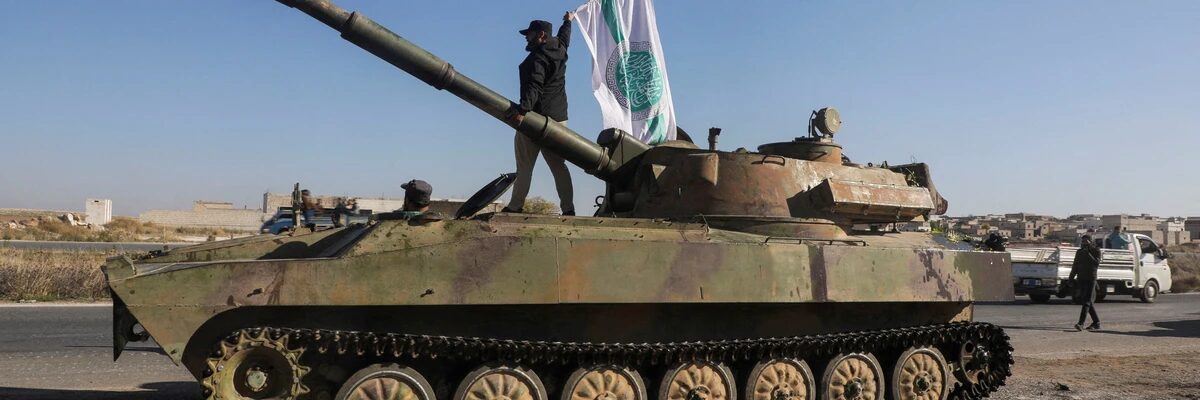
A rebel fighter stands atop a military vehicle as he carries a Hayat Tahrir al-Sham flag in Saraqeb town in northwestern Idlib province, Syria December 1, 2024. REUTERS/Mahmoud Hassano/File Photo
As Islamist, al-Qaida-linked group Hayat Tahrir al Sham (HTS) overruns Syria amid President Assad’s sudden ouster, evidence suggesting Ukraine has assisted the group’s triumph continues to mount.
The New York Times reported earlier this month, moreover, that Ukraine and HTS were coordinating efforts including “countering Russian misinformation and providing medical assistance.” The reporting also highlighted Ukrainian intelligence head Kyrylo Budanov’s repeated suggestions that Ukraine would target its enemy Russia internationally.
Washington Post columnist David Ignatius mused that Ukraine’s intentions for assisting HTS were obvious, writing that the war-torn nation was looking for other ways to “bloody Russia’s nose and undermine its clients.” In turn, a source told the New York Times that the HTS offensive in Syria was likewise timed in part to strike a blow against mutual enemy Russia.
Indeed, Russian officials have repeatedly complained that Ukraine and HTS collaborate within an intelligence or military capacity. As Russia’s special representative for Syria, Alexander Lavrentyev, told Russian News Agency TASS in November: “We do indeed have information that Ukrainian specialists from the Main Intelligence Directorate of Ukraine are on the territory of Idlib.”
“Cooperation between Ukrainian and Syrian terrorists… is underway both when it comes to the recruitment of fighters to the Ukrainian army and to mounting attacks against the Russian and Syrian troops in Syria,” permanent Russian representative to the UN Vassily Nebenzia likewise alleged in early December. “Far from concealing the fact of Ukraine’s support, the HTS fighters are openly flaunting this.”
The overall impact of Ukraine support to HTS ultimately seems unclear. On one hand, an anonymous Ukrainian official recently confirmed Kyiv-Idlib cooperation to Middle East Eye, but explained that their engagements ultimately did little to steer outcomes in the militia’s successful December attack. “We might claim less than a fraction of help for [the recent] offensive,” the Ukrainian official said. On the other hand, as Middle East Eye also reported, Turkish observers posit drones gave HTS forces an advantage over Syrian government fighters.
All matters considered, Ukraine’s assistance to HTS may partially be intended to accrue legitimacy with the West amid continued war with Russia.
“Ukraine’s alleged assistance to HTS forces is of limited military significance insofar as the SAA was inherently unprepared to resist the rebel offensive,” said Dr. Mark Episkopos, Quincy Institute Research Fellow and Adjunct Professor of History at Marymount University.
“But it is part of Kyiv’s broader effort to court Western support for its NATO accession bid by demonstrating to the US and other stakeholders its effectiveness in countering Russian interests around the world.”
Stavroula Pabst is a reporter for Responsible Statecraft.
Donald Trump Should Not Repeat Woodrow Wilson’s Failure
April 30th is an important date in American politics. This is the day 100 for the American President in the White House, and all attention will be on the reports of his achievements and failures. But nothing can be more critical than Peace…
○
6 mins read
A Holocaust perpetrator was just celebrated on US soil. I think I know why no one objected.
Russia’s invasion has made ordinarily outspoken critics of antisemitism wary of criticizing Ukrainian Nazi collaborators
○
1 min read
Qi Book Talk: The Culture of the Second Cold War by Richard Sakwa
Richard Sakwa has for many years been one of the most distinguished and insightful observers of relations between the West and Russia, and one of the leading critics of Western policy. In this talk with Anatol Lieven, director of the Eurasia program at the Quincy Institute, Sakwa discusses his book, The Culture of the Second Cold War (Anthem 2025). The book examines the cultural-political trends and inheritances that underlie the new version of a struggle that we thought we had put behind us in 1989. Sakwa describes both the continuities from the first Cold War and the ways in which new technologies have reshaped strategies and attitudes.