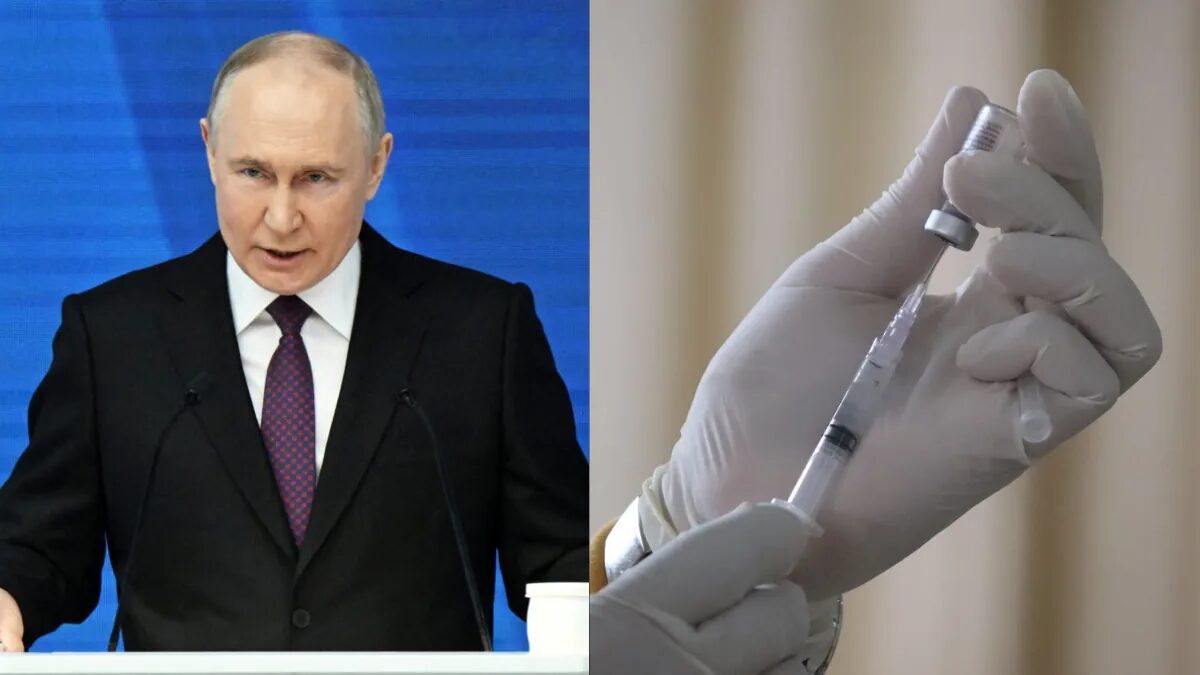
The vaccines will be administered starting early 2025.
Russia has announced the development of cancer vaccines which will be soon be accessible to the public. According to reports, the vaccines will be administered starting early 2025 free of cost. Instead of distributing it to the general public, the vaccines will reportedly be personalised for cancer patients.
The announcement about the m-RNA vaccines was made by Andrey Kaprin, the General Director of the Radiology Medical Research Center of the Russian Ministry of Health, per Russia’s state-owned agency TASS.
It further reported that Alexander Gintsburg, director of the Gamaleya National Research Center for Epidemiology and Microbiology in Moscow, said that the vaccines were able to suppress tumour growth in clinical trials, and thus are capable of stopping the cancer spread.
Notably, it is unclear what kind of cancer the vaccines will help against. The name has also not been revealed. The announcement comes after Russian President Vladimir Putin said in February that researchers are close to developing a cancer vaccine.
How will the m-RNA vaccines work?
To understand how the m-RNA vaccines work, we first need to learn about what m-RNAs are.
Short for messenger RNA, m-RNA is a molecule that carries genetic instructions from DNA to cells, telling them how to make specific proteins. In the context of vaccines, mRNA is used to instruct cells to produce a specific protein that triggers an immune response.
When an mRNA vaccine is administered, the mRNA is taken up by cells, which then use the genetic instructions to produce the desired protein. The immune system then recognises this protein, triggering an immune response. The immune system learns to recognise and attack cells displaying this protein, providing immunity against specific diseases, including cancer.
In the case of cancer, mRNA vaccines work by instructing cells to produce proteins that are specifically associated with cancer cells. The immune system then learns to recognise and attack these cancer cells.
According to the National Cancer Institute, the immune cells which take up the mRNA, which encodes proteins associated with cancer cells, are called dendritic cells.
Personalized mRNA cancer vaccines are also being developed, which involve creating a customised vaccine for each patient based on the specific genetic mutations present in their tumor. This approach has reportedly shown encouraging results in early clinical trials.
This is being seen as a significant development in beating cancer which is one of the most fatal diseases in the world. According to the World Health Organisation (WHO), there were 20 million new cases and 9.7 million deaths due to the disease in 2022. Lung cancer was the most common. The vaccines may also reduce the cancer burden on Russia which reported 6,35,000 cases in 2022, per FirstPost.
Donald Trump Should Not Repeat Woodrow Wilson’s Failure
April 30th is an important date in American politics. This is the day 100 for the American President in the White House, and all attention will be on the reports of his achievements and failures. But nothing can be more critical than Peace…
○
6 mins read
A Holocaust perpetrator was just celebrated on US soil. I think I know why no one objected.
Russia’s invasion has made ordinarily outspoken critics of antisemitism wary of criticizing Ukrainian Nazi collaborators
○
1 min read
Qi Book Talk: The Culture of the Second Cold War by Richard Sakwa
Richard Sakwa has for many years been one of the most distinguished and insightful observers of relations between the West and Russia, and one of the leading critics of Western policy. In this talk with Anatol Lieven, director of the Eurasia program at the Quincy Institute, Sakwa discusses his book, The Culture of the Second Cold War (Anthem 2025). The book examines the cultural-political trends and inheritances that underlie the new version of a struggle that we thought we had put behind us in 1989. Sakwa describes both the continuities from the first Cold War and the ways in which new technologies have reshaped strategies and attitudes.