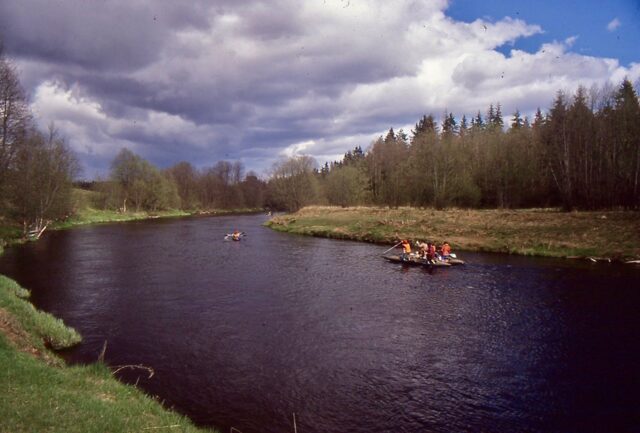
The year is 1990. I am traveling to Borovichi, Russia, as part of an 8-person delegation visiting Borovichi from its sister city in the USA, Binghamton, NY. Russia is still part of the Soviet Union. The Iron Curtain still lives. We don’t know a thing about the Russians who will host us, and they don’t know a thing about us. We both know our governments like to trade nuclear threats. On each side, this venture will demand a large measure of trust.It turns out, liking one another takes all of about fifteen minutes. These folks from “The Evil Empire”, we shortly realize, remind us a lot of – well – us.The Russians have invited us to join them on a 70-mile kayak trip, camping along their home river, the Msta (Mis-tah).
Our flotilla on the Msta River
In buddy-system fashion, each American has been assigned a Russian teammate. Mine is Nicolai Rashev. His friends call him Kolya. I call him Nick, which he likes.
An excellent kayaker and outdoorsman, Nicolai has a firm grip on English but hasn’t approached fluency. I learn this when our river trip takes us from the Valdaika River into Lake Piros. We have to cross the lake (several miles) before entering another river emerging from it. Rashev and I take the lead in our heavily loaded bi-darka (Russian kayak). As we began crossing the lake – in a stiff wind with fairly large waves – I notice Nicolai has wedged small American and Soviet flags between boxes of supplies in the middle of our craft. I think this would make a good photo; flags in the foreground, with Rashev in the stern as our captain.
Obtaining this snapshot requires turning from the bow to face Rashev while elevating myself slightly off my seat.
As I do this, he glances nervously at waves slapping close to our gunnels and even more nervously at me. “Rick!” he exclaims, “One moment!”
He then begins digging into his jacket pockets for what the Russians call their “paper helper” – a dog-eared Russian/English dictionary.
Obviously, Rashev needs a word and he needs it fast. I photograph him while he thumbs rapidly through the book, brow furrowed intensely.
Ah hah! He has found it. “Rick,” he exclaims. “Boat unstable!”
The poor man thinks I am about to stand up and throw us both into chilly Lake Piros.
“No problem, Nick,” I reply assuringly. “I need only do this for a photo.”
Twisted like a corkscrew but not tilting our craft, I take a second picture of my greatly relieved Russian friend. Trust comes a bit slowly when cultures have long feared each other.
A relieved Nicolai, paper helper in hand, thinking: “Looks like the American isn’t going to drown me after all.”
Donald Trump Should Not Repeat Woodrow Wilson’s Failure
April 30th is an important date in American politics. This is the day 100 for the American President in the White House, and all attention will be on the reports of his achievements and failures. But nothing can be more critical than Peace…
○
6 mins read
A Holocaust perpetrator was just celebrated on US soil. I think I know why no one objected.
Russia’s invasion has made ordinarily outspoken critics of antisemitism wary of criticizing Ukrainian Nazi collaborators
○
1 min read
Qi Book Talk: The Culture of the Second Cold War by Richard Sakwa
Richard Sakwa has for many years been one of the most distinguished and insightful observers of relations between the West and Russia, and one of the leading critics of Western policy. In this talk with Anatol Lieven, director of the Eurasia program at the Quincy Institute, Sakwa discusses his book, The Culture of the Second Cold War (Anthem 2025). The book examines the cultural-political trends and inheritances that underlie the new version of a struggle that we thought we had put behind us in 1989. Sakwa describes both the continuities from the first Cold War and the ways in which new technologies have reshaped strategies and attitudes.