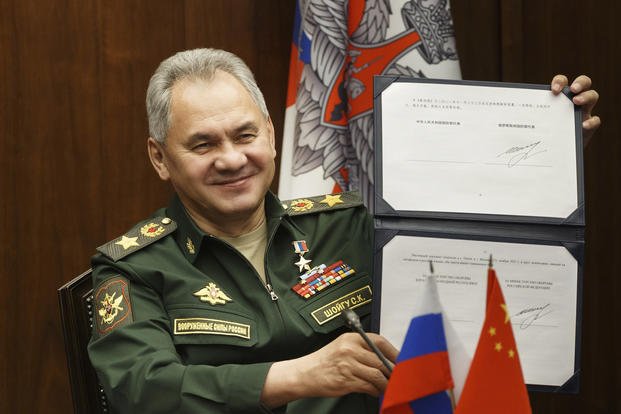
MOSCOW — Russia's defense chief on Tuesday signed a roadmap for closer military ties with China, pointing to increasingly frequent U.S. strategic bomber flights near both countries' borders.
Vadim Savitskiy/Russian Defense Ministry Press Service via AP
During a video call, Defense Minister Sergei Shoigu and his Chinese counterpart Wei Fenghe “expressed a shared interest in stepping up strategic military exercises and joint patrols by Russia and China,” according to the Russian Defense Ministry.
“China and Russia have been strategic partners for many years,” Shoigu said. “Today, in conditions of increasing geopolitical turbulence and growing conflict potential in various parts of the world, the development of our interaction is especially relevant.”
Shoigu pointed to increasingly intensive flights by the U.S. strategic bombers near Russian borders, saying that there were 30 such missions over the past month alone.
“This month, during the U.S. Global Thunder strategic force exercise, 10 strategic bombers practiced the scenario of using nuclear weapons against Russia practically simultaneously from the western and eastern directions,” Shoigu said, adding that they came as close as 20 kilometers (12 miles) to the Russian border.
He also noted a rise in the number of U.S. bomber flights over the Sea of Okhotsk where they practiced reaching the points for launching cruise missiles, saying that it poses a threat to both Russia and China.
“In such an environment, the Russian-Chinese coordination becomes a stabilizing factor in global affairs,” Shoigu said.
Wei praised Russia for successfully countering what he described as U.S. pressure and military threats.
Shoigu and Wei hailed a series of maneuvers that involved Russian and Chinese warplanes and naval ships, and signed a plan for military cooperation for 2021-2025.
On Friday, two Russian Tu-95MS strategic bombers and two Chinese H-6K strategic bombers flew a joint patrol over the Sea of Japan and the East China Sea, prompting South Korea to scramble fighter jets.
The bomber patrol followed joint naval maneuvers by Russian and Chinese warships and aircraft in the Sea of Japan last month.
In August, Shoigu visited China to attend joint war games, which marked the first time that Russian troops had taken part in drills on Chinese territory.
They were the latest in a series of war games in recent years, intended to underline increasingly close military relations between Moscow and Beijing.
Russian President Vladimir Putin and China’s leader, Xi Jinping, have developed strong personal ties to bolster a “strategic partnership” between the former Communist rivals as they both faced tensions with the West.
Russia has sought to expand ties with China as its relations with the U.S. and its allies sank to post-Cold War lows over Moscow’s 2014 annexation of Ukraine’s Crimea Peninsula, accusations of Russian hacking attacks, interference in elections and other disputes.
Even though Russia and China in the past rejected the possibility of forging a military alliance, Putin said last year that such a prospect can’t be ruled out. He also has noted that Russia has been sharing highly sensitive military technologies with China that helped significantly bolster its defense capability.
Donald Trump Should Not Repeat Woodrow Wilson’s Failure
April 30th is an important date in American politics. This is the day 100 for the American President in the White House, and all attention will be on the reports of his achievements and failures. But nothing can be more critical than Peace…
○
6 mins read
A Holocaust perpetrator was just celebrated on US soil. I think I know why no one objected.
Russia’s invasion has made ordinarily outspoken critics of antisemitism wary of criticizing Ukrainian Nazi collaborators
○
1 min read
Qi Book Talk: The Culture of the Second Cold War by Richard Sakwa
Richard Sakwa has for many years been one of the most distinguished and insightful observers of relations between the West and Russia, and one of the leading critics of Western policy. In this talk with Anatol Lieven, director of the Eurasia program at the Quincy Institute, Sakwa discusses his book, The Culture of the Second Cold War (Anthem 2025). The book examines the cultural-political trends and inheritances that underlie the new version of a struggle that we thought we had put behind us in 1989. Sakwa describes both the continuities from the first Cold War and the ways in which new technologies have reshaped strategies and attitudes.