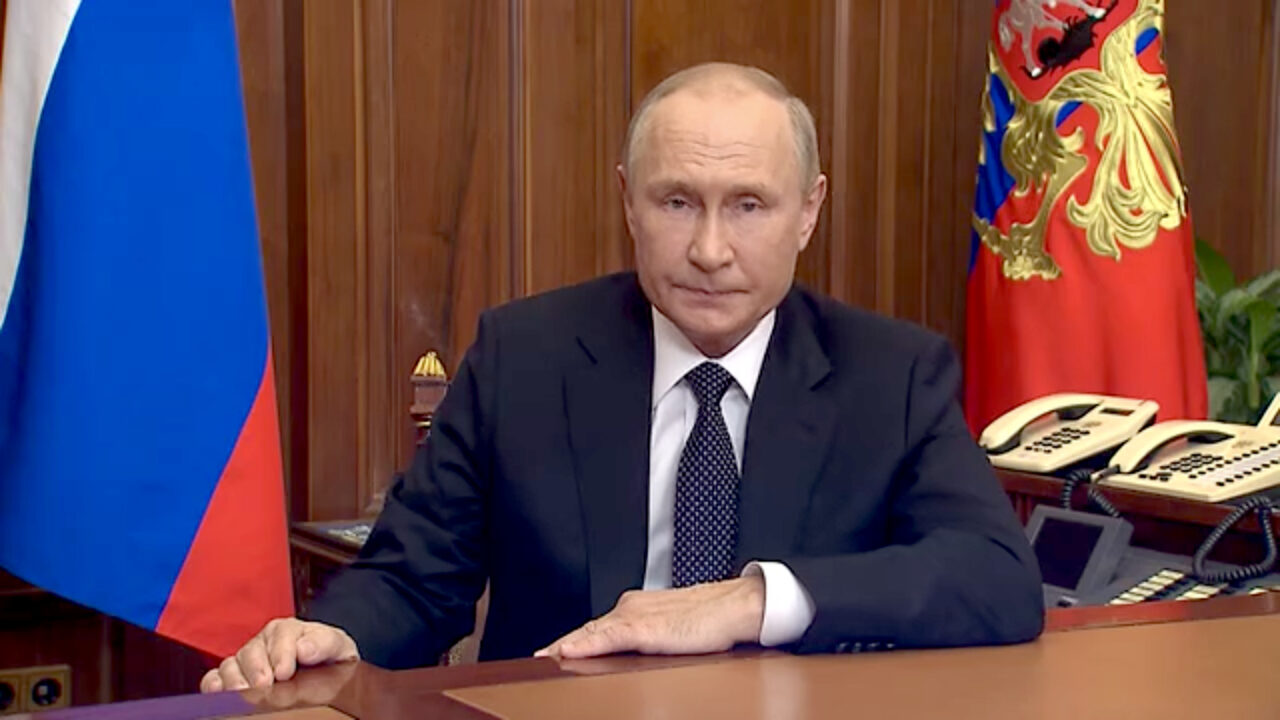
By declaring referenda in four Ukrainian regions and vowing to defend new Russian territory with all means necessary, Vladimir Putin has created a whole new war.
Putin speaking at the Kremlin on Wednesday. (Screenshot/kremlin.ru)
From Russia’s perspective, the war in Ukraine until now has been a “special military operation” intended to defend the self-declared independent republics of Luhansk and Donetsk.
For eight years Moscow had rebuffed entreaties from Donbass to recognize those republics. Now Russia is prepared to absorb them as part of the Russian Federation itself, along with the Kherson and Zaporozhye regions.
On Wednesday in Moscow President Vladimir Putin announced that referenda to decide whether to join Russia would be held in those four places from this Friday until next Wednesday. After that, the Russian Duma must decide whether to accept the results and formally annex those territories into Russia.
All that is expected to happen, and once it does the game on the battlefield will change dramatically. From Russia’s point of view, it will no longer be assisting the militia of independent republics with Russian regular units against attacks by Ukraine. It will now be defending Russian territory, against attacks by Ukraine. [The Russian Ministry of Defense said it was mobilizing 300,000 reservists and other soldiers with combat experience.]
Putin did not threaten offensive nuclear war as his remarks in the West are being spun, but warned Russia would defend its own territory with nuclear weapons if necessary. It isn’t known what level of Ukrainian attack against what Russia would now consider its own territory would be needed to bring about such a response.
But the nuclear warning will surely have Pentagon planners for Ukrainian troops thinking twice about whether to launch major offensives to recapture Ukrainian territory from Russia.
Joe Lauria is editor-in-chief of Consortium News and a former U.N. correspondent for The Wall Street Journal, Boston Globe, and numerous other newspapers, including The Montreal Gazette and The Star of Johannesburg. He was an investigative reporter for the Sunday Times of London, a financial reporter for Bloomberg News and began his professional work as a 19-year old stringer for The New York Times. He can be reached at joelauria@consortiumnews.com and followed on Twitter @unjoe
The details of the peace deal presented today by US special envoy Steve Witkoff are consistent with the report in the Financial Times discussed in my previous article and with Larry Sparano in the posted interview. Putin will halt the Russian advance prior to driving Ukrainian soldiers out of all of the territory that has been reincorporated into Russia. It appears to be the case that the borders between Russia and Ukraine will be the current front line, so Putin is withdrawing Russia’s claim to the Russian territories still under Ukrainian occupation.
Russia and the US seem near a Ukraine peace deal. Kyiv’s role may be moot.
President Donald Trump’s hopes of securing a quick Ukraine peace deal hang in the balance after Washington’s envoy, Steve Witkoff, held his fourth Kremlin meeting with Russian President Vladimir Putin Friday.