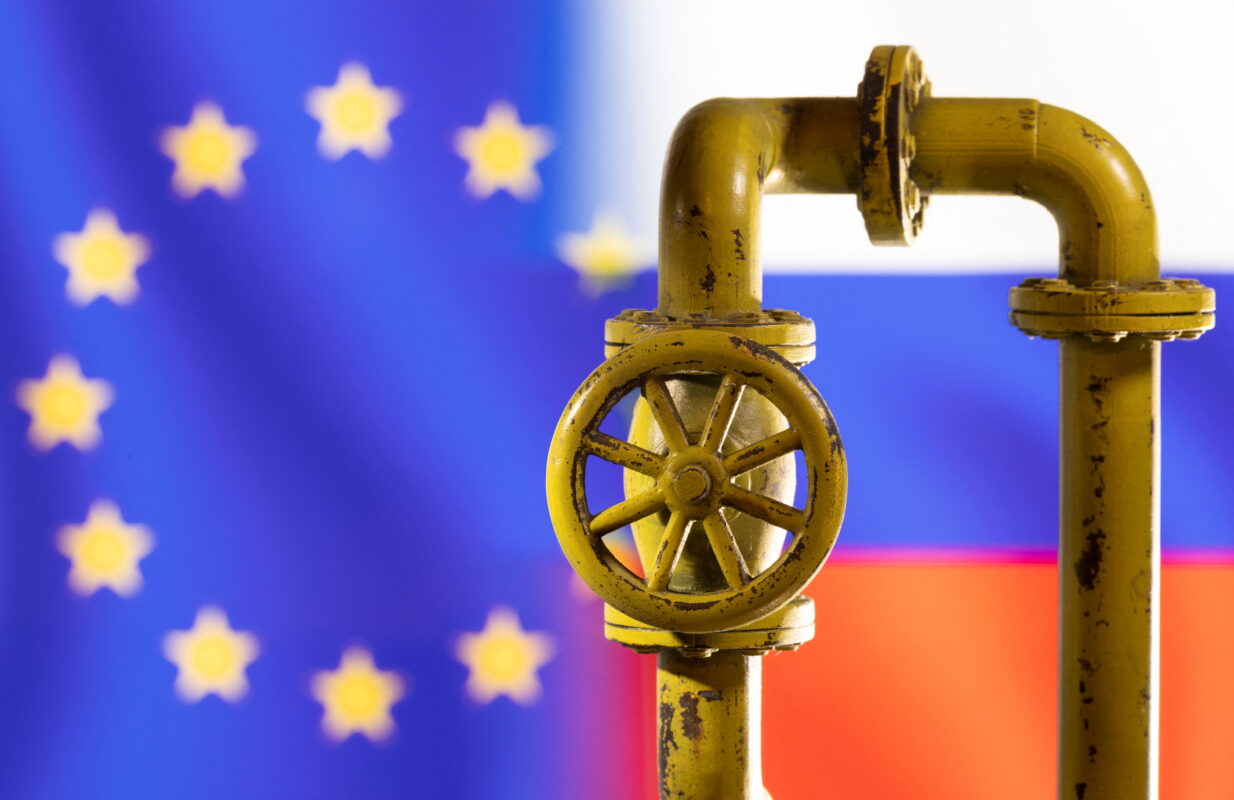
Sabotage on the Nord Stream pipelines is a man-made case. How will this affect the future of the industry of strategic importance? Fyodor Lukyanov spoke about this with Valery Bessel, a professor at the Gubkin Russian State University of Oil and Gas, specifically for the International Review . We publish the full version of the conversation.
INTERVIEW PREPARED SPECIFICALLY FOR THE PROGRAM “INTERNATIONAL REVIEW” (RUSSIA 24)
To what extent is the factor of physical stability, safety laid down during the construction of such infrastructure facilities? Simply put, what do they have to endure?
— Such objects withstand almost everything. When designing them, the load that occurs during compression, rupture, shear, which can occur during the movement of ice under the condition of a shallow shelf, is taken into account. Pipes must withstand loads, including in the event of accidental contact between the pipe and the anchor chain – everything is calculated and redundant many times.
Is it believed that it is not necessary to take into account the factor of military, sabotage influence?
— This factor is difficult to take into account. The USSR designed a gas transportation system taking into account a possible nuclear strike. But not from the point of view that the pipe will withstand a nuclear strike, but in the sense that it will be possible to switch to parallel pipes – it is easier to do this on the ground than in water.
In fact, it is impossible to take everything into account. Four or five years ago, a book was published in Sweden, I think it was called “Opportunities to Combat Underwater Pipelines.” I remember that after its publication, I discussed with foreign colleagues and shared with them the idea that it is much easier to torpedo a gas carrier than to blow up a gas pipeline.
And for what purpose was the book written? In the wake of the “green transition”?
— I don’t know what the author meant, probably the destruction of gas pipelines. But there were no such precedents in history before the current events.
Are there any international agreements, documents regulating energy security in the literal, physical sense?
— As far as I know, there are no such documents yet. The operation of the gas pipeline is carried out in accordance with the contract signed with the management company ” Nord Stream” with Swiss jurisdiction, and in accordance with the legislation of the countries through whose territorial waters the pipeline passes – Russia, Finland, Sweden, Denmark, Germany. As far as I remember, there was no point in preparing any special agreements.
Are there no large international treaties in this area?
— I don’t think there are any special agreements. All this is done within the framework of a certain contractual concept of security within the EU.
Damage to gas pipelines occurred in the territorial zones of Sweden and Denmark. Are these countries responsible for the safety of the pipeline or are they just watching?
— I would say that these countries are obliged to bear responsibility for security, because they themselves are interested in the operation of the gas pipeline. In particular, they are buyers of the product. But there is one small “but” – now all laws are so infinitely violated that no one thinks about it.
Do different objects have their own specifics? For example, is Nord Stream different from Blue Stream or Turkish Stream, Norwegian and British gas pipelines?
— The implementation of each project involves taking into account technical factors – the depth of water, which determines the pressure, aggressiveness of water. The Baltic Sea is still less salty than the Black Sea, which is distinguished not only by an increased concentration of salt, but also by a colossal amount of hydrogen sulfide. All these are technical and technological factors, they are taken into account when designing each gas pipeline.
If you imagine the explosion of a gas carrier, a giant ship filled with gas, a completely apocalyptic picture arises in the imagination. I understand that there were no such precedents, but, probably, now it would be worth thinking about such a thing.
— There is such a thing as a laminar velocity of methane flow. This rate is not so high, methane has some viscosity, so it will take time to form an explosive mixture. Yes, the explosion will occur, but the consequences will not come immediately. After the gas begins to flow, the crew will have some time to leave the ship. Still, there’s nothing good about what’s started happening. A precedent has been set. This has never happened before, and therein lies the danger.
From the relatively recent – three years ago in Beirut, a warehouse with saltpeter exploded, there was a feeling of the end of the world.
— Yes, if we talk from the point of view of chemistry, saltpeter at low temperatures, at 20-30 degrees, is able to release oxygen into the free phase and become explosive. Under conditions of improper long-term storage, this happens. In the case of a gas carrier, I am not able to quickly calculate the force of the explosion, but it will not seem enough either.
It turns out that today the last line connecting Russia and Western Europe is the gas pipelines going through Ukraine.
— No, don’t forget about the Turkish Stream. In addition, there is a gas pipeline running through the territory of Poland. Compared to Ukrainian, it is relatively new. Soyuz was launched in 1980, and in 1984 Urengoy – Pomary – Uzhgorod was launched. Through Belarus and Poland, the gas pipeline was launched only in 2009.
If we talk about Ukrainian branches, it is rather curious that in the conditions of intense hostilities we did not hear anything about their damage. Is this a happy accident?
— No, it’s a pure deal. Moreover, we also have not heard anything about problems with the operation of the Druzhba oil pipeline passing through the territory of Ukraine, which has been in operation since 1960. Quietly passed and the information that we have extended the agreement on its use for another five years. This is how the world works – being is primary, consciousness is secondary.
Perhaps this is a little comforting.
— I would say that it takes time, you need to wait. All of us have encountered a situation of a hysterical state, and such a state arises in society. You just need to survive a certain crisis in order to get out of it. I think when Europe survives this winter (and it will be very difficult for Europeans to experience it), Europe will come to its senses a little and understand that it is necessary to negotiate. From my conversations with my colleagues who live in Europe and America, I know that everyone understands that one more step, and that’s it, there will be no one to figure out who is right and who is wrong, we need to slow down.
Do you think that energy cooperation between Russia and Europe will resume after some time?
— I don’t believe—I’m absolutely sure of it. What is the specificity of hydrocarbon, organic fuel? The fact is that significant hydrocarbon reserves are located in ten or twelve countries, and everyone needs these reserves. Such an imbalance creates powerful geopolitical fractures. This situation has always been and always will be. People want to drive cars, fly planes, so all these issues will be resolved sooner or later.
VALERY BESSEL
Professor of the Russian State University of Oil and Gas named after IM Gubkin
FYODOR LUKYANOV
Editor-in-chief of the journal “Russia in Global Affairs” since its foundation in 2002. Chairman of the Presidium of the Council on Foreign and Defense Policy of Russia since 2012. Research Director of the Valdai Discussion Club. Research Professor at the National Research University Higher School of Economics.