Kyiv’s recent gains capitalized on geography and surprise, advantages less evident now along new front lines
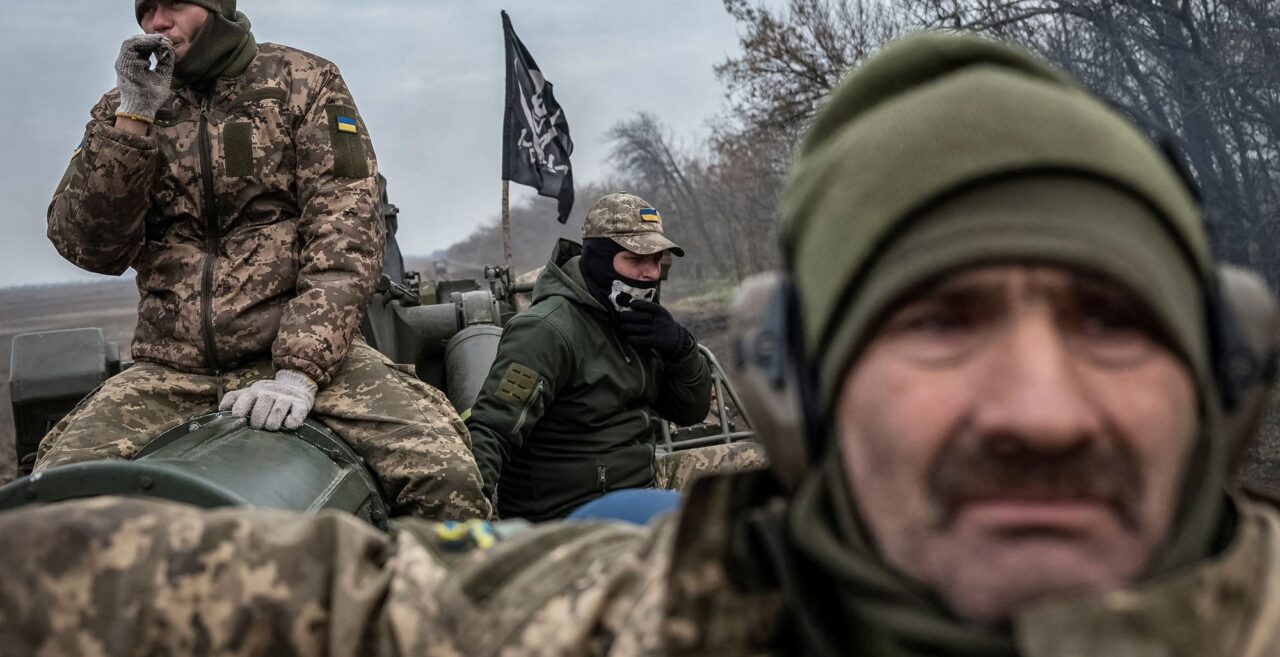
Ukrainian soldiers near a front line in the Kherson region of southern Ukraine. REUTERS/VIACHESLAV RATYNSKYI
After a string of pivotal wins against Russian forces since the summer, Ukraine faces mounting obstacles in achieving battlefield gains as it confronts troops who are dug in more deeply and the weather slows the tempo of fighting.
Ukraine will need to keep Moscow’s struggling forces destabilized and on the defensive without the likely prospect of achieving quick territorial advances, military analysts say. The degree of damage Ukraine can inflict on Russian troops while preserving its own forces will play a big role in shaping bigger battles when they resume, probably in coming months, they say.
Ukrainian President Volodymyr Zelensky in his nightly address Wednesday, following Russia’s announcement of its withdrawal from Kherson, acknowledged “a lot of joy” over the development but avoided discussing what comes next.
“I will definitely not feed the enemy all the details of our operations,” he said. “When we have our results, everyone will see it.”
Ukrainian forces since late August have relied on bravery, agility, favorable geography and Western-supplied weaponry to clear Russian troops from hundreds of square miles of territory east of the northern city of Kharkiv and to force Russia’s retreat from Kherson.
Around Kharkiv, where Kyiv’s troops stunned Moscow and the world in September with a speedy advance, broadly dispersed villages and open countryside allowed the nimble Ukrainian forces to dodge and encircle Russian troops.
In Kherson, a regional capital that Russia took without a fight in the war’s opening days and represented one of Moscow’s few trophies from the start of the invasion, Ukraine capitalized on the city’s location abutting the Dnipro River. Ukrainian forces destroyed the few bridges across the wide river, stranding thousands of Russian troops in the front-line city and impeding their resupply.
Few other areas still under Russian control offer such advantageous conditions for a Ukrainian offensive, say military strategists. The further east Ukraine pushes, the closer its forces get to Russia, where resupply is easier for Moscow. Many areas along the new front have been under Russian control for months or years, meaning troops have had time to emplace defenses.
Territory between Kharkiv and Kherson under Russian control, mostly the Donbas area, is heavily urbanized, offering defenders strongholds and complicating attacks. For Ukraine, which strove to avoid battlefield casualties, options for quick flanking maneuvers like around Kharkiv have grown more limited.
Ukraine will “move very carefully, without emotions, without unnecessary risk…so that the losses are as small as possible,” Mr. Zelensky said Wednesday.
“The terrain is going to get harder for the Ukrainians,” said John Nagl, a retired U.S. Army lieutenant colonel who teaches warfighting studies at the U.S. Army War College.
The shifting balance of conditions likely means Ukraine’s attacking forces are near what military strategists call a culminating point, or the time when advancing troops outrun their supplies or are no longer able to achieve their military objective. A well-managed culmination can be followed by regrouping, securing gains and preparations for new attacks.
“I don’t anticipate huge shifts in territorial control in the near future, other than in Kherson,” said Dmitry Gorenburg, an expert on security issues in the former Soviet Union at defense-research organization CNA in Arlington, Va.
Despite limited apparent prospects of quick territorial gains, Ukraine will want to keep showing its Western backers that it is maintaining the battlefield initiative. Its survival and success this year have relied on contributions of advanced weaponry including portable antitank and antiaircraft weapons, and precision artillery such as M142 Himars mobile rocket launchers. Recently, Ukraine has also received a growing supply of Western air-defense systems to help thwart drones and missiles Russia has launched to hit Ukraine’s civilian infrastructure.
Ukraine has a limited supply of both advanced Western equipment and less-sophisticated former-Soviet materiel that it can call upon. Russia, in contrast, still has deep reserves of Cold War-era munitions, though much is of questionable quality and reliability, and large numbers of troops, though many have little or no military training.
One thing Ukraine appears to have a far greater supply of than Russia is will to fight, said Mr. Nagl.
“Russia can burn through a lot more resources because it has a lot more resources,” said Mr. Nagl. “Russia’s biggest strategic vulnerability is its will,” he said, noting that during World War I, Russian forces lost the will to fight and exited the conflict.
A big question for Russian forces now is how many troops and munitions have been evacuated intact from Kherson. If large quantities were removed across the Dnipro, Russia would be better positioned to defend its gains in Ukraine and potentially launch counterattacks.
A looming test of Russia’s will to fight is likely to be winter weather, for which Russian forces are ill-prepared, according to accounts on social media and from open-source intelligence. Ukrainian troops, in contrast, have been supplied with modern winter gear by the U.S., the U.K., Canada and Nordic allies.
If Ukraine can maintain attacks—either using artillery or commando raids—on bases and supply lines of Russian troops who are cold and uncomfortable in poor conditions, Kyiv might be able to undermine their ability or will to fight, say analysts. In doing so, the analysts say, Ukraine’s forces could eventually achieve some gains that frontal attacks couldn’t otherwise accomplish.
Before the weather in Ukraine turns bitterly cold, the challenge for both sides is fall rain that turns fields and many roads to mud. Cloudy skies and rain also complicate the use of drones, which have been valuable surveillance tools and weapons for both sides.
“It’s late fall that’s the problem,” said Mr. Gorenburg. During winter, the ground generally freezes and skies often clear, especially in Ukraine’s east, far from the Black Sea. For troops with proper gear, operating in winter gets a bit easier, he said.
The details of the peace deal presented today by US special envoy Steve Witkoff are consistent with the report in the Financial Times discussed in my previous article and with Larry Sparano in the posted interview. Putin will halt the Russian advance prior to driving Ukrainian soldiers out of all of the territory that has been reincorporated into Russia. It appears to be the case that the borders between Russia and Ukraine will be the current front line, so Putin is withdrawing Russia’s claim to the Russian territories still under Ukrainian occupation.
Russia and the US seem near a Ukraine peace deal. Kyiv’s role may be moot.
President Donald Trump’s hopes of securing a quick Ukraine peace deal hang in the balance after Washington’s envoy, Steve Witkoff, held his fourth Kremlin meeting with Russian President Vladimir Putin Friday.