You can find additional info in this RT story, in English. I also saw this excellent technical analysis by Brian Berletic:
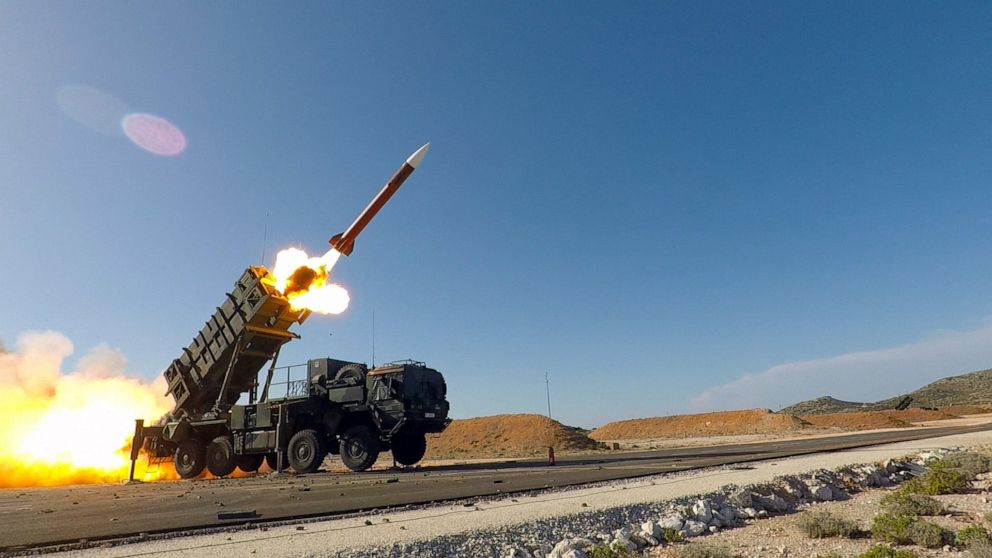
This week we learned that the U.S. most likely will provide Ukraine with Patriot Air-Defense Missile complexes. You can find additional info in this RT story, in English. I also saw this excellent technical analysis by Brian Berletic:
From the Russian mainstream press, I have this piece by reporters Darya Volkova and Evgeny Pozdnyakov.
It could happen as early as next week, according to Westie media such as CNN and the Washington Post. Russian analysts are pretty sure that the final decision has already been made behind the scenes.
A Patriot battery consists of up to 8 launchers, each of which contains 4 rockets ready to launch. Russian media has not yet been able to determine, just how many of these batteries will be shipped to the Ukraine. It is thought that the batteries will be shipped to Germany first, for initial deployment and training. Russian analyst Malek Dudakov, an expert in American Studies, contends that there is little to worry about just yet: “To service just one system requires 90 people, and their training takes up to half a year. Ukrainians will get the accelerated course though. These factors are what have constrained the White House up until now; likewise the cost of servicing. Just one rocket costs $3 million dollars, and an entire battery costs up to a billion dollars.”
yalensis: I have learned to discount such opinions, of the nature, “Oh, it will take so long to train people”. Pessimistically, just assume that the training has already been completed, or that the complexes will be operated by secret Americans posing as Ukrainians. (Berletic makes the same point, and I think he is right.) So, let’s just assume worst case scenario: these Patriots will be in place and functional within just weeks, if not days.
The Ukrainians have been down on their knees begging for these Patriots, like a child begging for candy, as far back as 2018, long before the start of the Special Military Operation. But the Americans always said no. Up until now. One factor: American military was not so eager to take the reputational risk, in case the Patriots performed less than spectacularly. After all, Raytheon, the manufacturer, has an image and a brand to protect. There was also the worry that Russian technology would be able to defeat the Patriot, or perhaps even capture one of these batteries as a trophy.
But, realistically, the Americans don’t have a choice either. Once they decided to keep this war going as long as possible, then it’s their duty to help the Ukrainians protect their skies from Russian rockets. That way the Ukrainians can preserve whatever infrastructure they have left, while continuing to fight until their last man falls.
“This Represents A Serious Threat To Our Armed Forces”
Here is some analysis from Konstantin Sivkov, who has a Doctorate in Military Sciences. Unlike most of the other analysts, who diss the Patriot and point out how Yemen Hoothis have been able to thwart it with Flying Doritos [drones], Sivkov takes a contrarian view by expressing his respect for this joint product of Raytheon and Lockheed-Martin:
Sivkov: This weapon system has a dual use. It can be used for rocket attacks as well as interception. “The handing over of even one of these complexes [to the Ukrainians] will present a serious threat to our armed forces.
“This type of rocket has a great distance and is one of the most effective in the world. The Patriot is a multi-channel anti-aircraft missile system, which showed itself quite well in all the wars and conflicts of the 1990’s, and in the current time as well. It possesses a huge attack potential combined with speed: It is even able to strike ballistic targets.
“Against our rockets of small radius of action, for example the Iskander, the Patriot is ineffective. However, it is fully effective against cruise missiles. On the other hand, the Saudi experience showed it to be ineffective against drones. But against piloted aviation, yes, it represents a true danger.
“And one should not forget that, as of the current day, Ukraine has already been provided with eight NASAMS and an equal number of medium-radius IRIS-T’s, and also Crotale complexes, and a series of other short-range complexes of Western manufacture.
“Having patched together around 150 anti-aircraft missile systems of varying brands, the Ukrainian Armed Forces (UAF) will be able to fully cover the sky over their territory. Currently, in my estimation, they have around 20. And frankly I don’t see any impediments preventing the West from increasing their deliveries [of these complexes]. All of this behooves us to work more actively on preventative suppression of these complexes, which are at the disposal of the enemy.”
By “preventative suppression”, I have a feeling that Sivkov means finding a way to blow these things up before they are deployed.
A more optimistic (from the Russian point of view) assessment is given by a different military analyst, Alexei Leonkov. He doubts that these Patriots will be able to provide a true “layered defense system” for Ukrainian anti-air. Recall that the Ukrainian dream is to “cover the sky” with an impenetrable shield. Which is what a layered defense system would be. Instead, according to Leonkov, isolated “safe islands” would be created, along with Ukraine’s episodic ability to employ their own aviation from time to time. None of this will be enough to change the overall tactical situation.
Leonkov: “In order to build a layered anti-air defense system, it would take more than just the delivery of Western anti-air and artillery complexes. Of course the Kiev propagandists are chattering constantly how the UAF will close the sky over the country. But factually, it is the Russian armed forces, with their aviation and air-defense systems, who control this sky.”
yalensis: For now. But the real question is whether the delivery of the Patriots can change this equation. And if so, is there anything the Russians can do to nip them in the bud, before they even arrive at their new stations?
Eppur si muove
Being a pessimist myself (or what I consider a “realist”), I would caution against complacency. I recall how Scott Ritter, much earlier in the war, was literally burned at the stake (by pro-Russian community) for declaring the HIMARS a “game changer”; and yet they did change the game, and even led directly to the loss of Kherson city. If the Russians had somehow been able to nip those HIMARS in the bud, like, blow them up while still on the road from Poland…
I saw this Debbie Downer of a comment on MOA yesterday, and I tend to agree with the points made therein, however bitterly and reluctantly:
Granted that the western corporate press is completely dishonest, and the entire narrative about Russia being on the verge of collapse might (or might not?) be a fantasy, from what little I can tell, the Russians are not ten feet tall.
HIMARS rockets really have been a game changer. The main thing is the astonishing level of western targeting analysis: Ukraine is under a microscope, and nearly every static Russian ammo depot, troop concentration etc. is identified. The Ukrainians just drive the trucks in range, dial in the coordinates given to them by the western powers, push the button, and skoot. So the Russians can shoot down a HIMARS rocket or two? These are launched in salvos of 6 per truck, four trucks gives you a salvo of 24, and embedded in salvos of dumb cheap unguided rockets. Yes this is hurting Russia very big time.
The Patriot missiles are not I think going to be as much of a game changer, but could still be painful for Russia. At 3 million dollars a missile – and doctrine has them being launched in salvos of two – not even the west can afford to use them against $20K Iranian drones. But: they could make life impossible for Russian combat aircraft operating just outside the front lines.
The main thing is if Russia can ramp up the acquisition/manufacturing of these cheap drones fast enough. If they can get their hands on ten thousand or so, they will exhaust even the western stocks of anti-air missiles and then finally get air superiority over Ukraine. We will see.
It also needs to be pointed out that lack of air superiority is why Russia has not been able to interdict the Ukrainian supply lines from Poland. If Russia had dynamically targetable drones that could strike moving trains, or stealth drones that could survive loitering that deep inside Ukrainian territory and taking out trains and truck convoys, the war would be over in a month. But as long as Ukraine has a functioning supply line to the west, the war will never end no matter how many Ukrainians freeze.
The details of the peace deal presented today by US special envoy Steve Witkoff are consistent with the report in the Financial Times discussed in my previous article and with Larry Sparano in the posted interview. Putin will halt the Russian advance prior to driving Ukrainian soldiers out of all of the territory that has been reincorporated into Russia. It appears to be the case that the borders between Russia and Ukraine will be the current front line, so Putin is withdrawing Russia’s claim to the Russian territories still under Ukrainian occupation.
Russia and the US seem near a Ukraine peace deal. Kyiv’s role may be moot.
President Donald Trump’s hopes of securing a quick Ukraine peace deal hang in the balance after Washington’s envoy, Steve Witkoff, held his fourth Kremlin meeting with Russian President Vladimir Putin Friday.