U.S. promises (not always kept) of protection end up sidelining more prudent, diplomatic paths and protracting war.
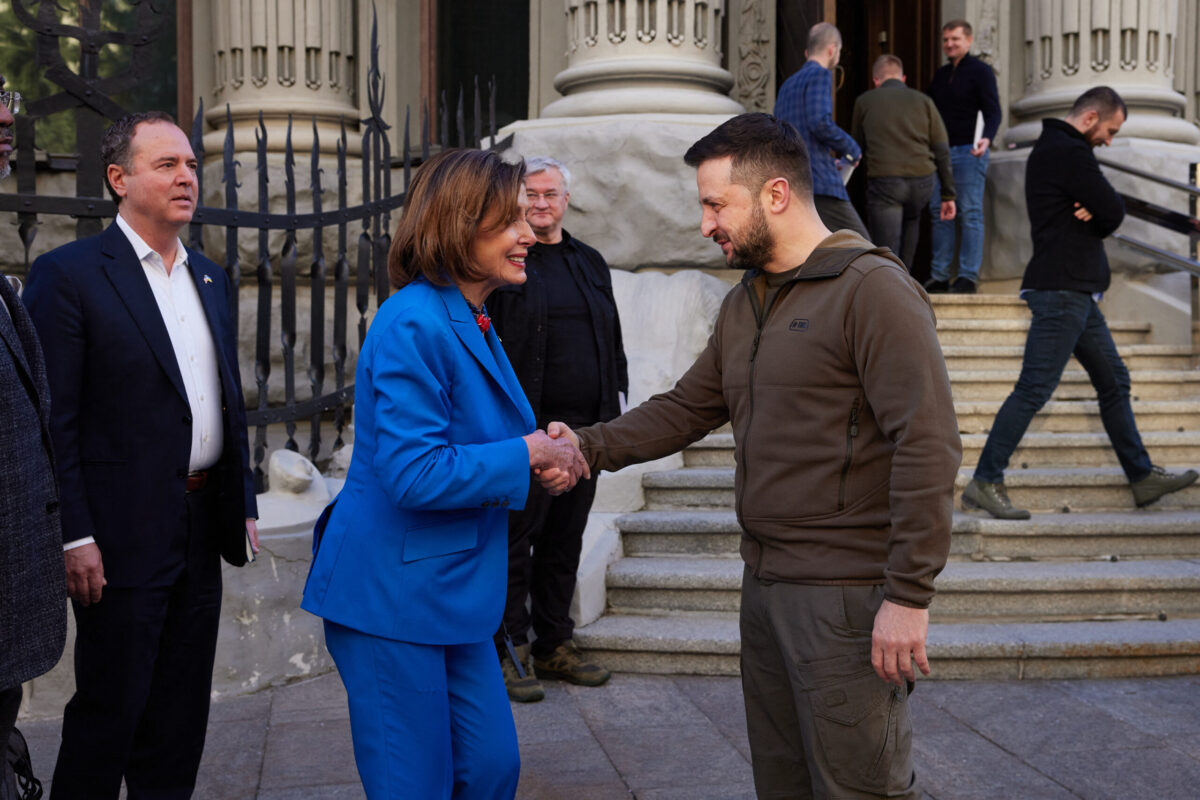
Handout photo shows Ukrainian President Volodymyr Zelenskyy meets with Nancy Pelosi, Speaker of the U.S. House of Representatives, during her visit to the Ukrainian capital of Kyiv, Ukraine, on May 1, 2022. Pelosi is now the highest-ranking U.S. official to visit Ukraine during the war, with the surprise visit adding to the growing momentum behind the West’s support for the country's fight against Russia. Photo by Ukrainian Presidency via ABACAPRESS.COM
At a recent virtual summit, NATO leaders reaffirmed their intent to admit Ukraine to the alliance.
In doing so, they indicated an odd preference to directly defend Ukraine at some point, just not now while it’s under attack. As the dominant power in the NATO alliance, this puts the United States in the familiar, but dangerous, position of vaguely and half-heartedly offering to defend a non-ally.
These states, which we call “quasi-allies,” in our recent report, are not true allies, in that the United States has no treaty commitment to defend them. But they hover in a kind of geopolitical purgatory, encouraged by Washington to believe that they might be under the U.S. defensive penumbra. Quasi-ally status creates danger, not only for the United States, but also for those states it feints at protecting. Washington should stop creating quasi-allies, with word and deed, and either commit to defending states or, as should be the case most of the time, be clear that we won’t.
Quasi-allyship is a murky status, created by official rhetoric, such as overzealous Congressmen or speechifying presidents talking falsely — calling states “allies,” speaking of “enduring bonds,” and “ironclad” commitments. Heavy arms sales and talk of formal commitments exacerbate the trouble. Quasi-ally status generally applies to states — Iraq, Saudi Arabia, the United Arab Emirates, Qatar, Bahrain, Ukraine, Georgia, and Taiwan, and probably Israel, which is arguably so close to an actual ally that it is one — but can also describe relations with sub-state entities like the Mujahideen fighting the Soviet-backed government in 1980s Afghanistan or the Kurds in Syria today.
Quasi-allies create danger for the U.S. due to potential entanglement in wars or controversies where U.S. interests are scant. Alliances intentionally entangle nations in each other’s defense. However, while treaty alliances are at least intended to serve U.S. security interests, the U.S. interest in defending quasi-allies is generally dubious, which is typically a reason why the U.S. has no treaty obligation to these states.
Entanglement with quasi-allies occurs by two mechanisms. First, rhetoric from U.S. leaders about quasi-allies can create the idea amongst the U.S. public that the country has a collective obligation to that state or group, as arguably occurred recently with Saudi Arabia and the Syrian Kurds. This can put political pressure on U.S. leaders to get involved and run needless risk if the quasi-ally is threatened or attacked.
The second source of entanglement with quasi-allies concerns credibility among U.S. leaders. They often fear that once the United States has made even a murky commitment to defend someone, not defending them willundermine U.S. credibility to actual allies. Even though history suggests this belief is wrong, it persists and threatens to make half-hearted promises that help quasi-allies into real military problems.
U.S.-Gulf relations are one example of such an entanglement. The U.S. relationship with Gulf States, especially Saudi Arabia, has contributed to the sprawling and costly basing infrastructure in the region, resistance to negotiations with Tehran, and heightened risk of war with Iran. Entanglement with despotic quasi-allies like Saudi Arabia can be costly and harmful to the United States even if it doesn’t lead to war, due to reputational damage by association with aggression and human rights abuses, as with the bombing of civilians in Yemen.
Quasi-allyship is arguably even more dangerous for the quasi-ally than the United States. That is because of moral hazard. Moral hazard in international politics occurs when a state runs excessive risk because it expects another state will bear the cost. In other words, states with vague commitments from the United States take dangerous chances in the expectation that they will avoid the consequences due to U.S. protection.
Moral hazard leads states to misconstrue the real balance of power. That can lead to insufficient self-defense. For example, should Taiwan turn out to be wrong that the United States will assist them if China invades, they will have badly mismanaged self-defense investments. Moral hazard more commonly leads to undue risk-taking. Georgia in 2008 and Saudi Arabia during the Trump administration are arguably both examples of states that took excessive risks in relations with neighbors expecting some greater degree of U.S. support and suffered attacks as a result.
Of course, these are all examples where U.S. military help — beyond the indirectkind — never arrived when an attack came. So why, you might ask, would the next quasi-ally under duress be deluded into thinking the U.S. cavalry would arrive? For one, they might think that the mere threat of U.S. intervention in adversaries’ minds will be enough to protect them. Further, leaders under pressure, and buoyed by nationalistic politics, may tend toward dangerously wishful thinking.
Ukraine is a tragic example. The United States has continually and deliberately encouraged Kyiv’s hopes that they will get U.S. protection, causing Ukraine to take a harder line in relations with Russia than it otherwise would have. In 1994, with the Budapest Memorandum on Security Assurances, the United States seemed to commit to protect Ukraine, though the text actually commits signatories only to not violate Ukraine’s sovereignty and complain at the United Nations if someone else does. In 2008, at the Bucharest Summit, the United States pushed NATO to say Ukraine and Georgia would eventually join, though neither got Membership Action plans, the standard first step toward membership. Instead, Ukraine got increased U.S. military support, especially after Russia seized Crimea in 2014 and a NATO “Enhanced Opportunities Partner” designation in 2020.
It is difficult to assess the counterfactual where the United States did not make all this effort to imply its support for Ukraine. Maybe Russia would have invaded anyway. But it seems likely that Ukraine might have made more concessions to Russian demands, most importantly committing to neutrality and fully implementing the Minsk II accords. After being attacked in 2014, Ukrainian politics naturally became more nationalistic and resistant to compromise, and U.S. support gave its leaders false hope of salvation and reason to avoid the politically painful steps that would have been required. Thus, Ukraine’s status as a U.S. quasi-ally was not perhaps a direct cause of Russia’s invasion. But it was arguably a reason that Ukraine did not do enough to avoid it.
The partial U.S. embrace of quasi-allies has proven quite dangerous. It encourages confusion and excessive risk-taking in the United States, though U.S. geography and power let us opt out of danger at the last minute, as generally occurs. This leaves quasi-allies like Ukraine in the lurch, encouraged to hope for protection that never arrives and thus overly cavalier as dangers mount. Sometimes it is vital to be clear who you won’t help.
The details of the peace deal presented today by US special envoy Steve Witkoff are consistent with the report in the Financial Times discussed in my previous article and with Larry Sparano in the posted interview. Putin will halt the Russian advance prior to driving Ukrainian soldiers out of all of the territory that has been reincorporated into Russia. It appears to be the case that the borders between Russia and Ukraine will be the current front line, so Putin is withdrawing Russia’s claim to the Russian territories still under Ukrainian occupation.
Russia and the US seem near a Ukraine peace deal. Kyiv’s role may be moot.
President Donald Trump’s hopes of securing a quick Ukraine peace deal hang in the balance after Washington’s envoy, Steve Witkoff, held his fourth Kremlin meeting with Russian President Vladimir Putin Friday.