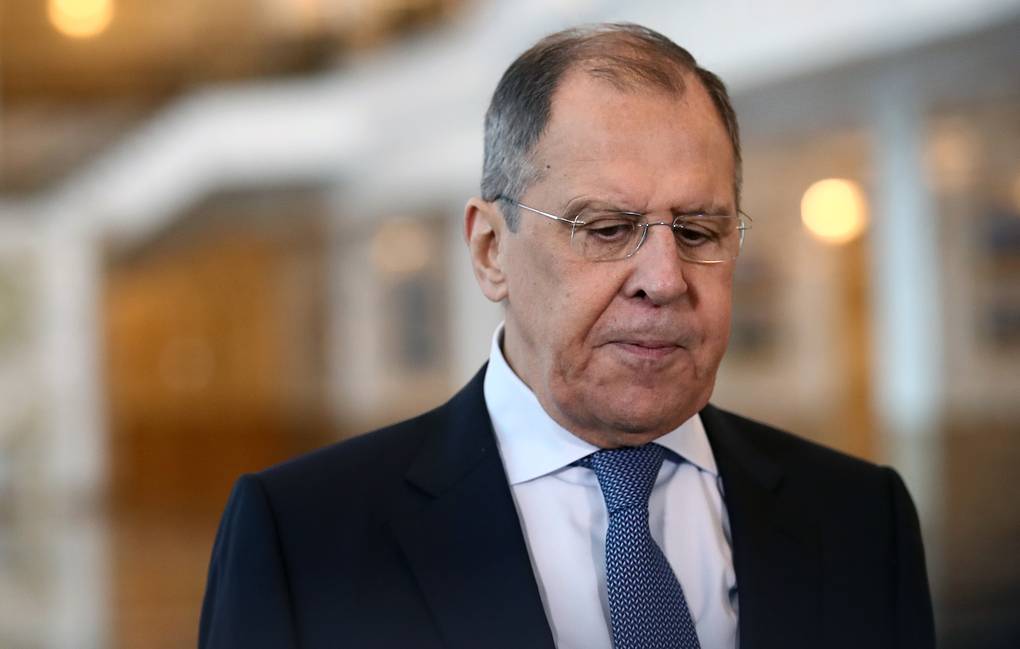
Moscow ready for joint work with Washington on int’l stability issues, not looking for confrontation – Lavrov
Moscow ready for joint work with Washington on int’l stability issues, not looking for confrontation – Lavrov
○
2 mins read
viaRussia is not looking for confrontation with the United States, Russian Foreign Minister Sergei Lavrov said.“We’re not looking for any sort of confrontation. President of the Russian Federation Vladimir Vladimirovich Putin has said on multiple occasions, including after the regretful […]
MINSK, BELARUS - NOVEMBER 26, 2020: Russia's Foreign Minister Sergei Lavrov talks to media after a meeting with Belarus' President Alexander Lukashenko at the Palace of Independence. Valery Sharifulin/TASS
Áåëîðóññèÿ. Ìèíñê. Ìèíèñòð èíîñòðàííûõ äåë Ðîññèè Ñåðãåé Ëàâðîâ âî âðåìÿ îáùåíèÿ ñ ïðåññîé ïîñëå âñòðå÷è ñ ïðåçèäåíòîì Áåëîðóññèè Àëåêñàíäðîì Ëóêàøåíêî âî Äâîðöå íåçàâèñèìîñòè. Âàëåðèé Øàðèôóëèí/ÒÀÑÑ
via Russia is not looking for confrontation with the United States, Russian Foreign Minister Sergei Lavrov said. “We’re not looking for any sort of confrontation. President of the Russian Federation Vladimir Vladimirovich Putin has said on multiple occasions, including after the regretful interview given by [U.S. President] Joe Biden to the ABC television channel, that we are prepared to work with the United States to the benefit of the people of the two countries and international security,” Lavrov said in an interview with the Bolshaya Igra program aired on Channel One. As he was commenting on the U.S. policy involving harsh, confrontational rhetoric aimed at altering Russia’s position, Lavrov said, “My opinion on these events ranges from ‘exercises in meaninglessness’ to ‘playing a very dangerous game with matches’.” “The policy you have mentioned, which is being pursued in the forms we are currently observing, has no chance of succeeding,” Lavrov said. This kind of U.S. policy aimed to impose sanctions on Russia and employ harsher rhetoric and pressure “on all fronts” is not “something new,” Lavrov said. “This has been going on for years. The sanctions began with the Barack Obama administration or, historically speaking, even earlier. Same as many other restrictions, they simply evolved into a hypertrophied and ideologized form since 2013, i.e., before Ukraine,” he said. “You must be aware of the current fashion to describe everything with lifelike images. All of us used to play in the backyard as kids. So, kids of various ages and upbringing ran outside (everyone was living next door, together), and every backyard had its own two or three bullies, who abused, penalized, forced to clean their boots and robbed everyone (they took away the pennies mothers gave for buying some pies, breakfast). Two, three or four years later, the younger kids grew up and stood up for themselves. In our case, we do not even need to grow up,” Lavrov said.
Donald Trump Should Not Repeat Woodrow Wilson’s Failure
April 30th is an important date in American politics. This is the day 100 for the American President in the White House, and all attention will be on the reports of his achievements and failures. But nothing can be more critical than Peace…
○
6 mins read
A Holocaust perpetrator was just celebrated on US soil. I think I know why no one objected.
Russia’s invasion has made ordinarily outspoken critics of antisemitism wary of criticizing Ukrainian Nazi collaborators
○
1 min read
Qi Book Talk: The Culture of the Second Cold War by Richard Sakwa
Richard Sakwa has for many years been one of the most distinguished and insightful observers of relations between the West and Russia, and one of the leading critics of Western policy. In this talk with Anatol Lieven, director of the Eurasia program at the Quincy Institute, Sakwa discusses his book, The Culture of the Second Cold War (Anthem 2025). The book examines the cultural-political trends and inheritances that underlie the new version of a struggle that we thought we had put behind us in 1989. Sakwa describes both the continuities from the first Cold War and the ways in which new technologies have reshaped strategies and attitudes.