Newly uncovered Soviet sources show that the 1962 confrontation could easily have spiralled into nuclear war—a useful warning as we face a new arms race today By Serhii Plokhy viaThe world is at the start of a new, undeclared nuclear […]
Newly uncovered Soviet sources show that the 1962 confrontation could easily have spiralled into nuclear war—a useful warning as we face a new arms race today
By Serhii Plokhy via
The world is at the start of a new, undeclared nuclear arms race. In August 2019, the U.S. and Russia officially abandoned the Intermediate Range Nuclear Forces Treaty signed by Ronald Reagan and Mikhail Gorbachev in 1987, leaving the door open to the development of new missiles. China has 300 nuclear weapons and is expected to double its arsenal in the next decade. Last month, the U.K. raised the cap on its nuclear stockpile by more than 40%, the first projected increase since the end of the Cold War.
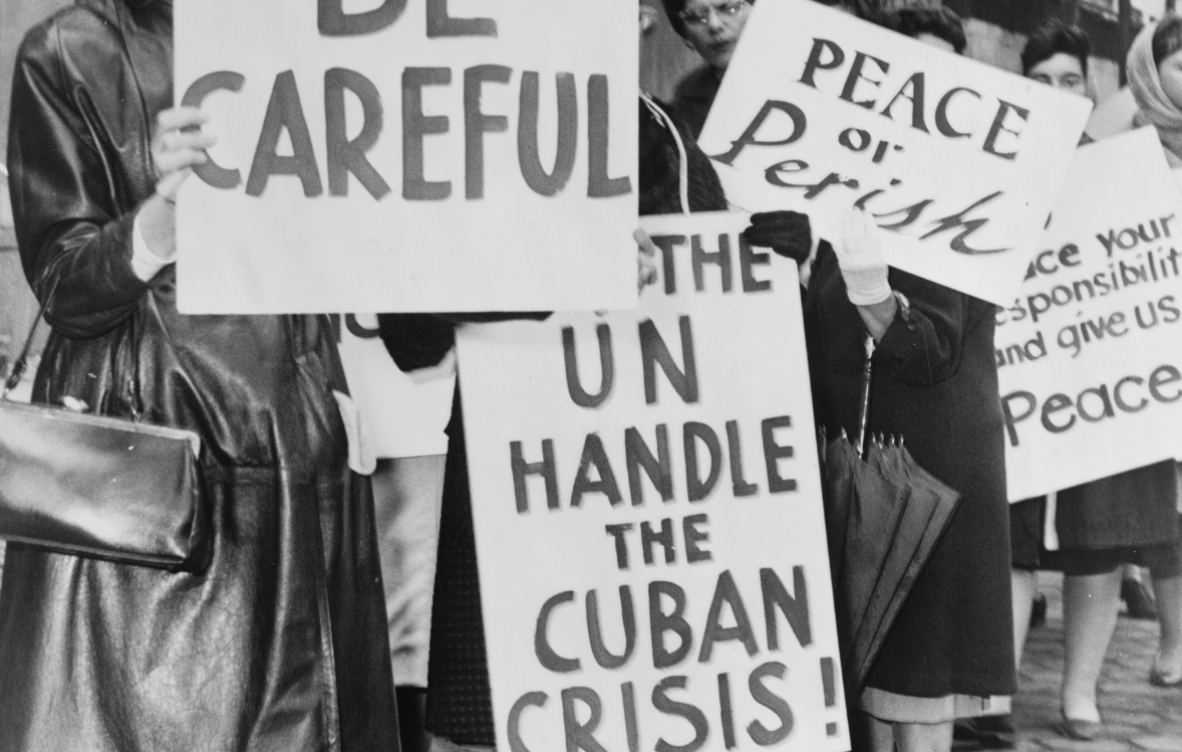
With Cold War-era arms control agreements gone, we are facing the first uncontrolled arms race since the 1960s. The nuclear competition of that era culminated in the Cuban missile crisis of 1962, arguably the most dangerous moment not only of the Cold War but in world history. If we want to avoid a repetition of that crisis, it’s high time to relearn its lessons—which look different today than they once did, in the light of newly uncovered Soviet sources.
Dozens of Soviet missiles, warheads and tactical nuclear weapons had been placed in Cuba before an American U-2 spy plane detected them in mid-October 1962.The Cuban missile crisis was triggered by Soviet Premier Nikita Khrushchev’s decision to redress the disparity in nuclear arms between the USSR and the U.S. President John F. Kennedy had won election in 1960 by arguing that there was a “missile gap” between the two countries that favored the Soviets, but in fact the situation was the opposite. The Soviets had very few strategic ballistic missiles capable of reaching the American mainland, while by 1962 the Americans had plenty of bombers and missiles that could reach Soviet territory.
When Cuban leader Fidel Castro, who survived a U.S.-backed invasion at the Bay of Pigs in 1961, begged the Soviets for military assistance, Khrushchev seized the opportunity to deploy medium-range nuclear missiles within striking range of the U.S. Dozens of missiles, warheads and tactical nuclear weapons had been placed in Cuba before an American U-2 spy plane detected them in mid-October 1962. The operational range of the missiles was 1,290 miles, enough to reach Washington, D.C.
The U.S. was caught by surprise, and Kennedy spent the week of October 15 brainstorming for a solution with a group of aides that became known as the Executive Committee. After considering several options, including airstrikes and a full-fledged invasion of Cuba, Kennedy decided to establish a naval blockade of the island. Faced with the Americans’ refusal to accept the Soviet nuclear presence in Cuba, Khrushchev backed down and on October 28 he agreed to remove the missiles. In exchange, the U.S. agreed not to invade Cuba. Kennedy also agreed in secret to remove America’s nuclear armed missiles from Turkey.
Ever since, the dominant narrative of the crisis has been that Kennedy won thanks to decisiveness and good judgment, and Khrushchev lost. But American, Soviet and Cuban sources that have become available in the last few decades put that idea in question. From beginning to end, the American response to the crisis was “distorted by misinformation, miscalculation and misperception,” in the words of Kennedy’s defense secretary Robert McNamara. The Soviets’ ability to deliver missiles to Cuba undetected was one of the worst intelligence failures in American history, and Kennedy’s weeklong deliberation about an appropriate response gave the Soviets enough time to make the missiles combat-ready.
The miscalculations did not end there. Only after the end of the Cold War did McNamara learn that the Soviets had deployed tactical nuclear weapons to Cuba as well as ballistic missiles. There were more than 40,000 Soviet troops on the island, not 10,000, as the Americans believed at the time. If Kennedy had ordered an attack on the missile sites from the air, or if Attorney General Robert Kennedy and the Joint Chiefs of Staff had won support for their plan to invade Cuba, nuclear war would have become all but inevitable. McNamara retroactively estimated the probability at 99%.
Even as American leaders were deliberating, the situation on the ground came close to spiraling out of control. The memoirs of Soviet participants in the crisis show that at its height, Soviet commanders were considering the use of tactical nuclear weapons in self-defense. An American U-2 plane was shot down contrary to orders from Moscow, and only sheer luck prevented the firing of a Soviet nuclear-armed torpedo at American ships in the Caribbean: A Soviet signalman got stuck with his equipment in the hatch of a submarine, preventing a senior officer from getting inside and ordering the strike.
Bringing the Soviet and Cuban sides of the story into focus also dramatically changes the chronology of the crisis. Contrary to the widespread belief fostered by Robert Kennedy’s memoir “Thirteen Days,” the crisis did not come to an end on October 28; it lasted another 23 days. In mid-November, the Executive Committee was still holding regular meetings to discuss how to respond if an American plane were shot down over Cuba, since Fidel Castro had renewed his orders to fire at American reconnaissance planes. Even after the Soviets agreed to remove their missiles from Cuba, they refused to remove bombers capable of delivering nuclear weapons until November 20, effectively ending the crisis.
If the Cuban missile crisis didn’t turn into a nuclear war it was partly thanks to pure luck.The main lesson to be drawn from this more detailed story is that history cannot be reduced to the agony of decision-making in the White House. A nuclear crisis has many participants, all acting in a fog of mutual suspicions and misunderstandings, to say nothing of the simple lack of timely, reliable information. Political leaders can lose control over troops on the ground, leaving it to chance to decide the outcome of a complex and dangerous situation. If the Cuban missile crisis didn’t turn into a nuclear war it was partly thanks to pure luck.
After the crisis ended, Kennedy and Khrushchev were sufficiently terrified of the possibility of a nuclear exchange to start arms control talks, leading to a partial ban on nuclear testing in 1963—Kennedy’s last contribution to international politics. The arms control process helped to stabilize the Cold War and eventually end it.
We cannot wait for another nuclear confrontation on the same scale as the Cuban missile crisis to renew our commitment to the principles of nuclear arms control. Today’s communication technology makes nuclear command and control systems more reliable than they were in 1962, but advances in cyberwarfare put that security in doubt. And some of today’s nuclear-armed states are much more unpredictable than the Cold War superpowers. No one knows what to expect from North Korea in a nuclear crisis, or from Iran if it manages to become a nuclear power.
The only way to put limitations on the new nuclear arms race is to return to negotiations not only on strategic nuclear weapons but also on tactical, medium- and intermediate-range nuclear weapons of the kind delivered to Cuba in 1962.