STOCKHOLM – The European Union’s plans to seize Russian assets following Moscow’s invasion of Ukraine, prioritising state assets of around US$350 billion (S$466.5 billion), are unprecedented and tricky, the EU task force head told AFP on Friday.
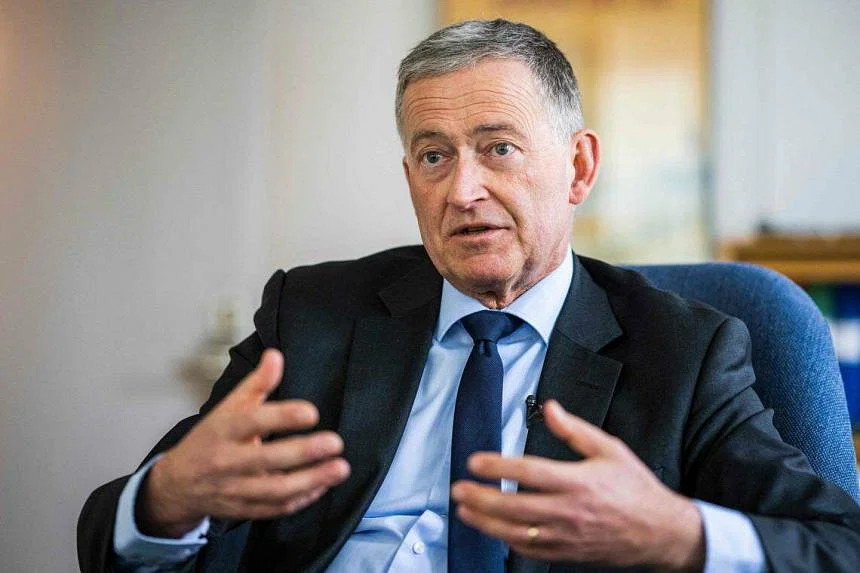
Seizing Russian wealth in a legal manner is easier said than done, says Mr Anders Ahnlid, but Europe plans to be “innovative”. PHOTO: AFP
“Nothing is simple” when it comes to finding the massive sums intended to be diverted to pay for Ukraine’s reconstruction, Swedish career diplomat Anders Ahnlid said in an interview in Stockholm.
But Europe plans to be “innovative”, he said.
From oligarchs’ yachts to the Russian central bank’s foreign reserves, there is a mountain of wealth to be had, but seizing it in a legal manner is easier said than done.
“It is a challenge to find legal means that are acceptable,” Mr Ahnlid said, a week after the EU working group’s first meeting.
Many Russian citizens targeted by sanctions have contested them in court.
That “just shows that our European Union is a union built on the rule of law”, Mr Ahnlid said.
No timeline
This is the first time the EU plans to not only freeze assets but also seize them and redistribute the capital – or at least the interest.
Precedents are rare even at the global level, apart from Iraqi assets seized by the United States at the end of Saddam Hussein’s regime, Mr Ahnlid said.
Appointed last month, Mr Ahnlid would not be drawn on when Kyiv could see its first cheque made up from Russian funds.
“Hopefully, we can achieve results during (Sweden’s EU) presidency” which ends in June, he said.
“But these are complicated matters. There will be short-term and long-term aspects of what we’re doing.”
Mr Ahnlid, the director-general of Sweden’s National Board of Trade, does have experience in this field. He previously worked on the sanction packages imposed on Moscow following its 2014 annexation of Crimea.
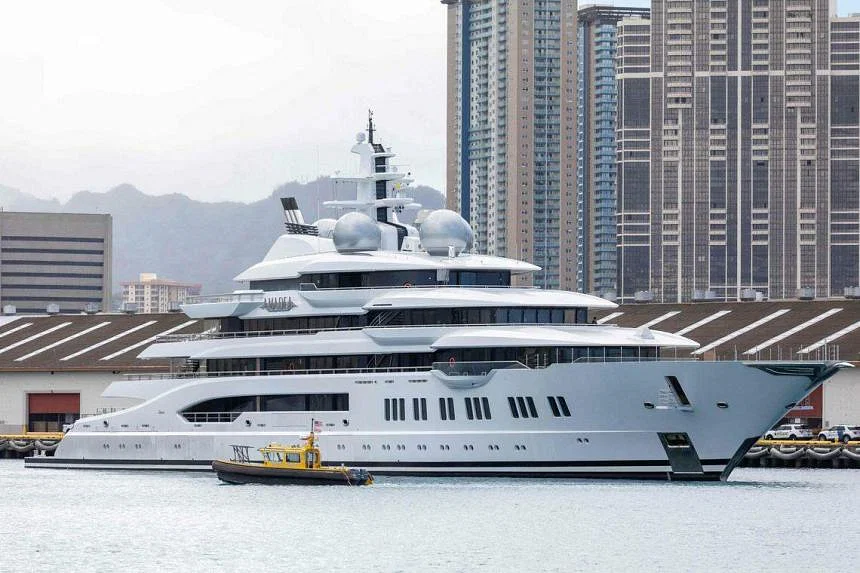
A harbour pilot boat in Hawaii in 2022, cruising past a seized yacht owned by sanctioned Russian oligarch Suleiman Kerimov. PHOTO: AFP
The task force will have “to be a bit innovative in order to move forward”, he said.
Legal experts make a distinction between private assets frozen by Western governments – an oligarch’s yacht, for example – and state property, such as the foreign currency reserves of Russia’s central bank.
State assets are usually larger – Russia’s foreign currency reserves alone amount to almost US$300 billion, according to the EU – and easier to seize legally.
‘Aggressor should pay’
In the case of private assets, legal safeguards mean Western states can permanently seize them only in very limited circumstances – usually when they can be proven to be the proceeds of crime.
In the United States, Congress has been holding hearings on ways in which US law could be changed to enable permanent seizures, although President Joe Biden’s administration has been publicly cautious about the idea.
Targeting the lawyers, bankers, accountants and financial experts who manage oligarchs’ offshore wealth would be more effective than imposing sanctions on individuals close to the Kremlin, says a new academic study using ICIJ data. #Russia#Putinhttps://t.co/NNGxufh3Yepic.twitter.com/Q3fjzZwVhT
One option, Mr Ahnlid explained, would be to not confiscate assets permanently, and seize only income or interest on the capital.
The EU task force is still trying to identify the Russian assets, and hopes to have made progress on that by May.
“Which assets are we talking about and where are they? That picture is not yet quite as clear as it needs to be,” Mr Ahnlid said.
Private assets are often protected by dummy companies, making them more difficult to seize.
But despite the difficulties, Mr Ahnlid said “it is natural that this aggressor should pay and make up for the brutal destruction of Ukraine that is taking place”.
Donald Trump Should Not Repeat Woodrow Wilson’s Failure
April 30th is an important date in American politics. This is the day 100 for the American President in the White House, and all attention will be on the reports of his achievements and failures. But nothing can be more critical than Peace…
○
6 mins read
A Holocaust perpetrator was just celebrated on US soil. I think I know why no one objected.
Russia’s invasion has made ordinarily outspoken critics of antisemitism wary of criticizing Ukrainian Nazi collaborators
○
1 min read
Qi Book Talk: The Culture of the Second Cold War by Richard Sakwa
Richard Sakwa has for many years been one of the most distinguished and insightful observers of relations between the West and Russia, and one of the leading critics of Western policy. In this talk with Anatol Lieven, director of the Eurasia program at the Quincy Institute, Sakwa discusses his book, The Culture of the Second Cold War (Anthem 2025). The book examines the cultural-political trends and inheritances that underlie the new version of a struggle that we thought we had put behind us in 1989. Sakwa describes both the continuities from the first Cold War and the ways in which new technologies have reshaped strategies and attitudes.