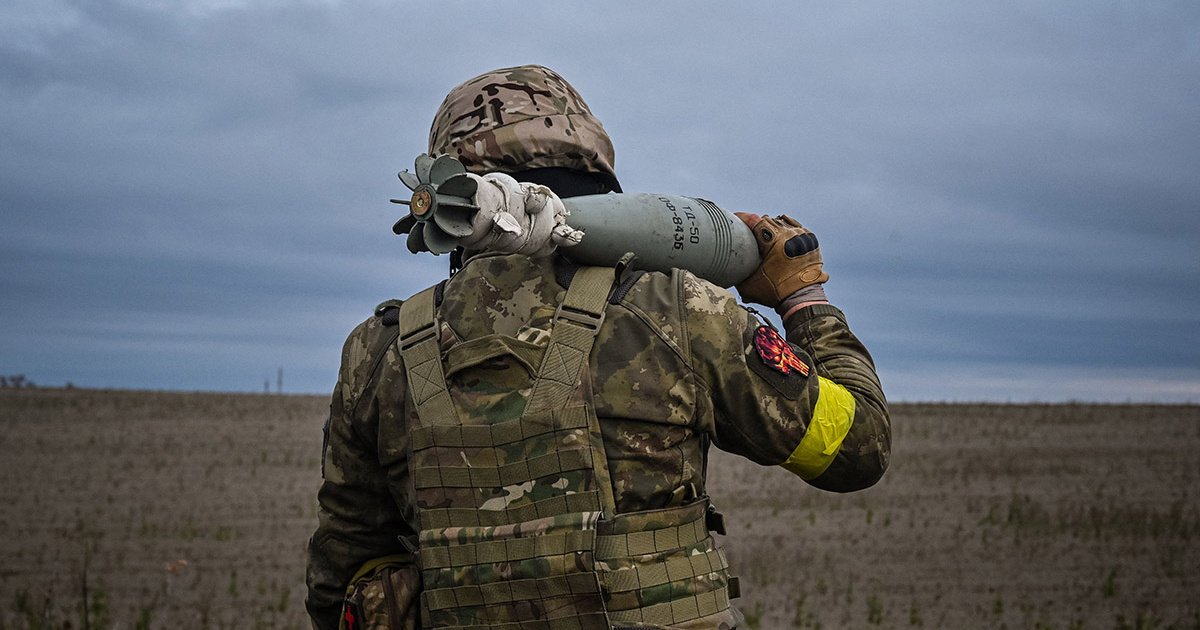
Ukraine and its allies have entered a difficult military, diplomatic and economic phase. Russia is taking advantage of this, writes Le Monde columnist Sylvie Kauffmann.
If it can’t triumph in Ukraine, what war can the West win? It’s a fair question, raised by Ukrainian Foreign Minister Dmytro Kuleba in an interview with the German newspaper Die Welt, on Friday, November 10. Indeed, the significance of the query lies not so much in the response it might generate as in the fact that it is being asked today, after 20 months of war. It implies that, in spite of Western support, the likelihood of a Ukrainian defeat is not only possible but plausible.
Launched by Russia against Ukraine on February 24, 2022, the destructive and deadly conflict, although geographically limited, has challenged the continent’s sense of security: Defending the invaded country has therefore been presented as an existential imperative by European leaders. Nonetheless, the conflict has now reached an impasse, and enough clouds have formed that a perfect storm is looming: a particularly serious crisis, caused by the convergence of several adverse factors.
Negative developments everywhere are converging for Ukraine and its allies. On the military side, the front is not budging. In a much-commented interview with the British magazine The Economist, Ukrainian Army Chief of Staff General Valeriy Zaluzhny acknowledged that the counteroffensive his forces have been waging for the past five months “will most likely be no deep and beautiful breakthrough.”
“Just like in the First World War,” he said, “we have reached a level of technology that puts us into a stalemate.” He has given up hope of making Russia back down by inflicting massive losses: “That was my mistake. Russia has lost at least 150,000 men. In any other country such casualties would have stopped the war.”
Large-scale Russian recruitment
Yet while Russia has apparently given up on the idea of drafting civilians − its September 2022 measure aimed at doing so was massively unpopular − it has managed to rebuild its forces through heavy recruitment for its professional army and has been concentrating most of its manpower on the war in Ukraine. “Right now, Norway could take Murmansk using its police forces, so bald is Russia’s North,” said a Scandinavian expert in jest. The size of Ukraine’s population, which has also been suffering heavy losses, does not allow for recruitment on such a scale. In recent days, there have even been protests in Ukraine by the wives of soldiers at the front who’ve been without leave for 18 months.
Attempts to compensate for low numbers through sheer firepower have met with difficulty in terms of both quantity and quality. Russia is in war-economy mode, with all of its industrial might concentrated on its defense industry, which has been churning out munitions around the clock. While some in Europe have talked about doing the same, it has yet to happen. Despite promises of delivering a million rounds of ammunition to Ukraine by March 2024, only 300,000 units have been produced so far.
European Union (EU) High Representative for Foreign Affairs Josep Borrell has said that the European arms industry’s production level is inadequate and remains primarily for its export customers. The EU does not requisition major private weapons companies in Europe, the way the Kremlin does with the Russian defense industry. As for the “technological leap” that General Zaluzhny has called for, the dilemma reflects more of a strategic decision: Ever since the war broke out, the West has been preoccupied with the need to avoid escalating matters and has therefore carefully calibrated each step in the level of sophistication of the aid it provides − belatedly − to the Ukrainian army.
Embarrassment for Western leaders
On the diplomatic front, the eruption of war between Israel and Hamas has monopolized the attention of the United States, which has been forced to reinvest in the Middle East after having been compelled to reinvest in Europe in response to Russia’s aggression. Ukraine has now become worried about having to compete with Israel over the available supplies of American weaponry and ammunition. The rallying of public sentiment around the world against the treatment inflicted on the civilian population of Gaza by the severity of Israel’s response to the Hamas terrorist attacks of October 7 has embarrassed Western leaders. Inevitably, Russia has begun taking advantage of this humiliation to discredit Western support for Ukraine.
Finally, the decision taken almost a year ago by the G7 and EU to cap the price of a barrel of Russian sea-borne oil at $60 (€55) in order to reduce Russia’s revenue has now been demonstrated as ineffective. Circumvention of this sanction has been so successful that Russia’s oil revenues in October increased by a quarter compared with October 2022, due largely to the creation of “ghost fleets” of tankers.
Russian propagandists have been pushing a triumphant narrative, claiming that, far from collapsing, their economy is perfectly healthy. They have played up disagreements between Ukrainian President Zelensky and his general staff. The challenge to Putin’s power from Wagner’s late leader Yevgeny Prigozhin has become but a bad memory, buried in the smoking ruins of his plane. Could there be any doubt that a victorious Putin will be re-elected in March 2024?
The perfect storm would be complete if Donald Trump returned to the White House. Instead of despairing at the thought, it’s time for Europeans to seal the drafts and seriously reinforce their house, which they have been preparing to open up to Ukraine and Moldova. A few extra solid beams won’t be wasted.