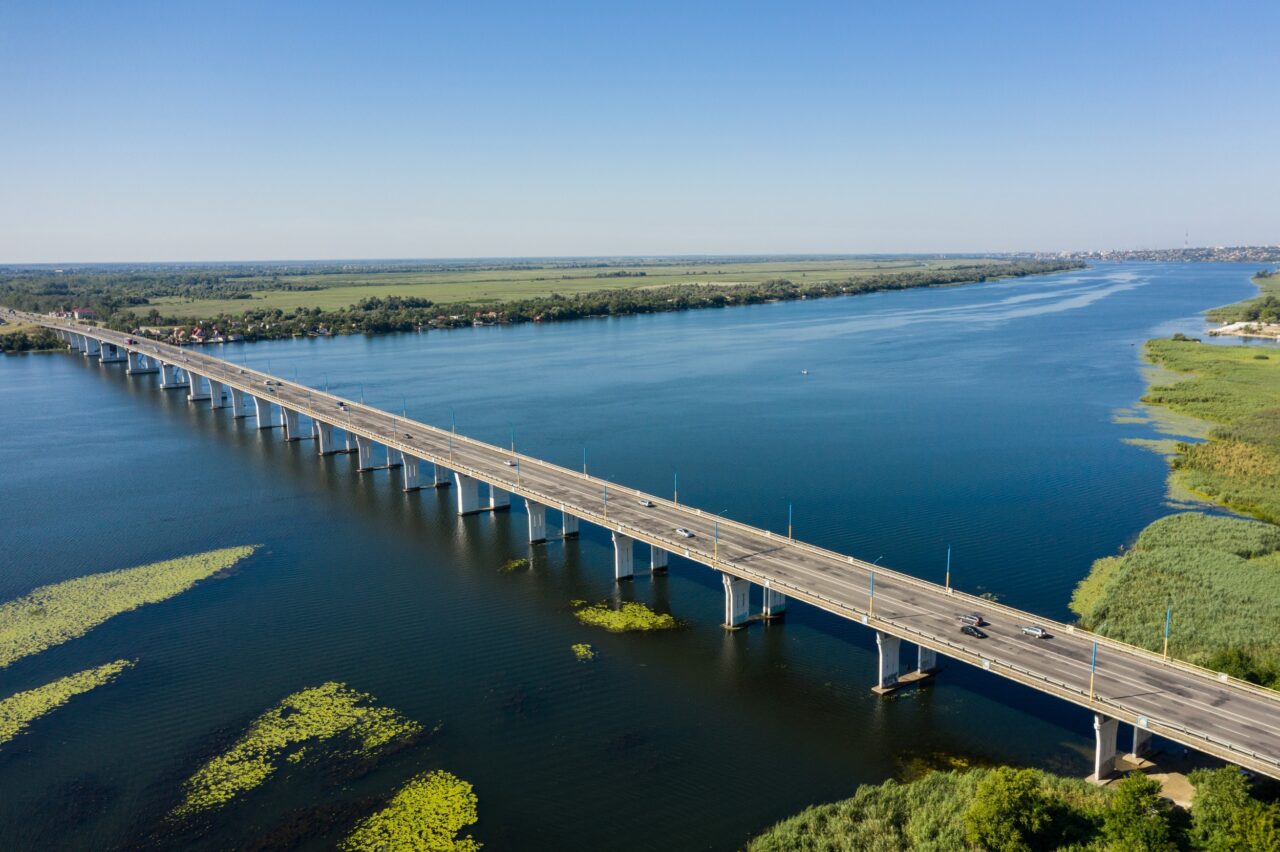
A river runs through Russian and, more recently, Ukrainian history. Ironically enough, the Dnieper River that unites Russia and Ukraine in this and other ways – the river rises in the Valdai Hills of Smolensk, Russia and runs through Belarus and Ukraine – is now the focus of the greatest schism in the history of Russian-Ukrainian relations. Russian forces appear impossible to stop and will arrive at the Dnieper at some point along its snaking length no later than next year, with Russian troops perhaps controlling the river’s and the country’s Left Bank by then. Russia – as well as the West and whatever remains of Ukraine‘s Maidan regime will then face some serious decisions.
The Dnieper River in Russian and Ukrainian History
The Dnieper (Dnipro) River has played a major role in Russian and Ukrainian history and is now positioned to so again. The Dnieper drove the foundation of the first Russian city and state. The first Russian state of Kievan Rus rose from the city-state of Kiev, founded by Vikings as a result of the early small port town‘s location on the great north-south water route, the Amber Road, flowing between Scandinavia (the Swedish Viking Varangians) and Byzantian Constantinople. Thus, the Dnieper gave birth to ‚the mother of Russian cities‘ and connected Kievan Rus to what would become the source of much of Russian culure: Greek or Eastern Orthodoxy.
The Zaporozhian Cossacks, famous in Russia and Ukraine, as well as other Cossack formations, were located on the Dnieper, the Zaporozhians in the marshes and islands on the Lower Dniper near its Black Sea estuary. The Dnieper became the dividing line between Polish- and Russian-controlled ‚Ukrainian‘ lands, with the western side of what today is Ukraine called the ‚Right Bank Ukraine‘ and the eastern side known as ‚Left Bank Ukraine.‘ In the Soviet era, the Dnieper’s six major hydroelectric stations and damns were symbols of communist modernization. One is featured near the end of Boris Pasternak’s famous novel Doctor Zhivago, as well as in the British film version of the novel.
The Dnieper was the focus of great battles during what Russians call the ‚Great Patriotic War‘ and what others call ‚World War II.‘ Following the largest tank battle in history at Kursk, the Battle for Dnieper was one of the largest operations of the war, involving four million troops, stretching over nearly 900 miles of front, and lasting over four months in 1943. It opened the way to the liberation of Kiev from the Nazi fascist army on 28 October 1944.
The Dnieper – more accurately one of its tributaries, the Pripyat – was the locus of the world’s first great nuclear disaster in 1986 at Chernobyl‘. The poetic Ukrainian name for the river, Slavutych or Slavuta, taken from an ancient Kievan Rus name for the river became the name of the town used to house displaced Chernobyl nuclear power plant workers.
Today, the Dnieper finds itself at the center of history once again.
Russia Marches to the Dnieper: What Then?
By the end of next year, if not earlier, Russian forces likely will reach the Dnieper and perhaps already be laying seige to Zaporozhe, Dnipro, Cherkassk, and, perhaps, Right Bank Kiev. This situation will demand key, pivotal decisions by the NATO-Russian Ukrainian War’s participants: NATO, Russia, and Ukraine.
For Russia, there will be at least three choices: (1) stop territorial advance at the Dnieper and offer peace talks with the threat to cross the Dnieper in lieu of an agreement that precludes NATO expansion to rump Ukraine and Moldova; (2) stop at the Dnieper without offering negotiations and warn the West that Russia will cross the Dnieper should NATO or NATO countries continue any activity or relations with Maidan Ukraine; (3) continue to Right Bank Kiev, the city’s center and country’s capitol, and then to the rest of Right Bank Ukraine without offering any negotiations, only conquest, capitulation, and survival of a Ukrainian or Galician state solely on lands not occupied by Russian troops before a capitulation act is signed by Maidan Ukraine, Washington, and Brussels.
The first option — halting Russian forces‘ territorial advance at the Dnieper while offering peace talks and threatening to cross the Dnieper in lieu of an agreement that precludes NATO expansion to rump Ukraine (and Moldova?) and any other NATO activity in Ukraine and meets other Russian demands – has advantages and weaknesses as do the other options. The obvious advantages are the end of NATO expansion to Ukraine and of the war or ‚special military operation‘ (SMO), assuming the West (and Russia) meet their obligations. The downside from Russia’s perspective is the possibility of the agreement collapsing or being violated by Ukraine and the West at some point in the future, necessitating another SMO or fully-declared war. Assuming Ukraine restores something resembling democracy, the presence of a democratic state on Russia’s border is not a threat to Russia, and is not by itself viewed by Russia as such. Such an assumption is based on the false and largely propagandistic notion that ‚Putin abhors democracy‘ and Russia is inherently antagonistic to democracies. This is false, as demonstrated by Putin’s recently warm visit to democratic Mongolia, located on Russia’s border like Ukraine.
It is important to keep in mind that obstacles to this option include Zelenskiy’s 2022 law forbidding negotiations with Moscow as long as Putin is in power and Putin’s post-Kursk incursion statement that talks with Zelenskiy and his Maidan regime were now excluded as an option. However, there are caveats to both of these. To the first, Kiev apparently was negotiating with Moscow through the Qatari Emir on an agreement – ultimately scuttled seemingly by the Kursk incursion – that two sides would not target each other’s energy-related facilities. To the second, Putin subsequently discussed the option of talks with Kiev as if they were still possible, unlikely albeit, in his view.
The second option – stopping Russian forces‘ advance at the Dnieper without offering negotiations and warning Kiev and the West that Russia will cross the Dnieper and seize all of western Ukraine if there is any continuation of military operations or should NATO or NATO countries continue any activity or relations with Maidan Ukraine – is likely a non-starter for Moscow. This option relies on trusting Kiev and the West far beyond what Moscow is now capable of. Without a binding treaty there remains the threat of a NATO-backed and in future NATO member Ukraine on Russia’s border, with the certainty that Washington and Brussels will re-arm Ukraine/Galicia for a future attack as well as support partisan guerilla and terrorist activity by Ukrainian special forces from western Ukraine and anti-Russian resistance fighters in eastern Ukraine. Putin and Russia would be faced with a long quagmire, draining resources and limiting Russia’s ability to defend itself in other places, where NATO or others may pose security threats. This option leaves open the possibility, indeed likelihood of an all-out NATO-Russia war.
One issue that has been raised by some observers is that Russia must „control“ much if not all of western Ukraine in order to ensure full control of the Dnieper River’s infrastructure such as dams, quality control mechanism, and navigation against western rump Ukraine. It is noted also that managing the river will be an expensive proposition (www.nakedcapitalism.com/2024/09/russias-prosecution-of-the-war-in-ukraine-can-it-square-the-circle-of-probable-boundary-conditions.html). River control and management is perhaps one factor that may support any eventual decision to have Russian forces cross the Dnieper, but it is hardly the main one. Key will be the defense of the eastern bank and nearby territories from missile, artillery and drone attacks and from infiltration by sabotage and terrorist cells. Moreover, there are other ways of controlling the river’s west bank and adjacent land other than occupying it or all or most of western Ukraine. The Russians have their own missile, artillery, drone and covert infiltration capacities that can target western Ukraine and perhaps establish a cordone sanitaire within ten or more kilometers from the river. Any peace agreement will have to establish principles and procedures for ensuring the security of the river, broadly conceived, and that of any new Russian territory acquired by Moscow as a result of an agreement or Ukrainian capitulation and attendant consequences and sub-agreements.
The considerations above propose the third option: to cross the Dnieper in order to seize Right Bank Kiev, the city’s center and country’s capitol, and perhaps part or all of Right Bank Ukraine or Galicia without offering any negotiations, only conquest, capitulation, and survival of a Ukrainian or Galician state solely on lands not occupied by Russian troops before a capitulation act is signed by Maidan Ukraine, Washington, and Brussels. This option has the advantages of the first option but expending more Russian blood and treasure. It has the disadvantages of the second in that it holds even greater risk of the rise of an anti-Russia resistance underground and quagmire, and this with the greater expenditure of blood and treasure seizing all of Ukraine would require. This option offers a future of years of more war and prolongs the situation in which an all-out NATO-Russia war can begin, rendering that outcome more likely. This option’s greatest problen is that it will require Moscow after it occupies western Ukraine to uproot any underground resistance, take upon itself a purge of Ukrainian nationalism and its adepts, and, likely impose a puppet or near-puppet regime in Kiev.
As I wrote earlier, it is possible that Moscow will consider and select one of these options but not in relation to crossing the Dnieper but in relation to whether or not to continue to advance after Russian forces have seized all of Donetsk and Luhansk Oblasts and all of Zaporozhe and Kherson Oblasts. Again, the three options would be similar: stop in these conquered territories and propose talks, stop but not propose talks, or continue hoping for capitulation before the Dnieper, where the same options will face Moscow.
There is no guarantee that any Russian negotiation offers will be accepted by the West and or Ukraine. In that event, the future is obvious: a long war to take western Ukraine, risking quagmire, and NATO intervention. Indeed, the present resistance to negotiations demonstrated by Kiev and, after Kursk, by Moscow as well argues in favour of the third and most tragic and dangerous option being the one most likely to be realised.
PART 2
Ukrainian and Western Choices
Russia has made it known that it will not accept Ukrainian membership in NATO, not ever, and lays claim to the entire territories of the noted four oblasts and Ukraine and will certainly not stop its SMO until these two task are assuredly accomplished. If Ukraine does not request Moscow to negotiate, persisting in Volodomyr Zelenskiy’s now delusional goal of returning all these territories to Ukraine’s fold and NATO’s goal of Ukrainian membership, Kiev’s armed forces will be driven back to the Dnieper. As that becomes obviously an inevitable and approaching event, Kiev will be forced to decide whether to make a last suicidal stand with the Dnieper at its army’s back and the advancing Russians in its face or to request talks with Moscow. This is the scenario for next year or early 2026 unless NATO enters the war or Kiev undertakes some sort of spectacular operation such as a nuclear terrorist attack, pushing Moscow to resort to tactical nuclear weapons. Should Ukraine’s Maidan regime choose to withdraw its forces west across the Dneiper and no peace is established, Russian forces will have no choice but to secure its flank by forcing the Dneiper.
Zelenskiy, should he be still be alive and in power by that time, will then face the choice of abandoning Kiev to the Russians and setting up a new government base in Lviv, with all the symbolic significance for both the contemporary military-political situation in and around Ukraine and for the competing claims and myths of Kiev’s origins and national ‚ownership.‘ More importantly, pressure will mount in the West even before Russian forces begin crossing the Dneiper for NATO to intervene in some form in order to prevent Russian forces‘ march to the Polish NATO, Slovakian NATO, Hungarian NATO, Romanian NATO, and Moldovan borders. The West will be faced with a decision to intervene with NATO troops or otherwise on the ground with all the implications that will have for possible direct war with Russia and therefore for global security and the threat of a world and nuclear war.
Options for the form of intervention can be arranged as a ladder of escalatory choices, from massively increasing NATO weapons support, especially for partisan warfare, specal forces‘ attacks, assassinations, setting up the hitherto rejected no fly zone, using Polish and other neighboring NATO states‘ air defense to shoot down Russian missiles, NATO states‘ intervention unilaterally and autonomously from NATO, to a full-scale NATO mobilization and ground intervention into western Ukraine. The last two options could be undertaken in order to occupy it and preempt a Russian assault and/or to engage Russian forces. It is unlikely that Moscow would shrink from fighting the forces of either unlaterally intervening NATO member-states or a formally flagged, full-fledged NATO force.
The Long War Scenario
If the last occurs, then the war will last many more years, i fit remains conventional. There is no guarantee Russia will win, even though its forces are undoubtedly winning at present and will initially have the upper hand against NATO forces, given Russia’s rapid military development in the course of the SMO. Moreover, a window of opportunity could open if the war drags on until Putin’s health wanes or gives out entirely, perhaps sparking a risky succession struggle the course or outcome of which could complicate or end Russia’s military superiority or ability to wage war. All this likely suggests to Western and Ukrainian decision-makers today that Ukrainian forces in fact should retreat behind the Dneiper – and presumably prepare a defense beforehand – in order to force Moscow to send its forces across extending the war.
The just mentioned scenarios include an assumption that Western interests, especially Washington’s interests, and those of Ukraine will remain sufficiently close. But it is equally possible, indeed more likely that as Ukraine’s defeat on the ground becomes more complete and therefore obvious to Western publics as well as irreversible without major Western inputs of finances, weapons, and perhaps blood that those interests will diverge. Much will depend on how much the West is willing to risk in order to preserve its ‚right‘ (there are no rights in international affairs outside of enforcable treaties) to expand NATO to Ukraine and therefore further on. This is the main Western interest that has bound Washington and Brussels to Kiev, but it is opposition to such expansion that is the main driver of Moscow’s actions in Ukraine. For now NATO and the U.S. persist in their claim to have a right to expand. Once the risk gets too high – possible escalation to direct NATO-Russian combat or use of nuclear weapons – the West may pull back. Pulling back will require Ukraine to finally resign itself to defeat and begin negotiations. Current discussions in the West center around a plan quite at odds with Zelenskiy’s ‚Victory Plan‘. The West is discussing with itself and perhaps with Ukraine behind the scenes a ‘territory for NATO membership‘ deal in which Kiev accepts the loss of some territory in return for NATO membership and various security guarantee plans. Ukraine still aims at the return of all territory lost to Russia, including Crimea, and Ukrainian NATO membership. Thus, the West and Kiev could split over the territorial issue. The West is proving itself to be far more interested in bringing some sort of Ukraine into NATO as a buffer and dagger in relation to Russia than in Ukraine’s territorial integrity. Indeed, the Western idea of territory for NATO membership – which will never be accepted by Russia – demonstrates the real goal of the West’s push that Ukraine accept the war challenge from Russia and abandon the attainable peace represented by the March-April Istanbul negotiations and preliminary agreement.
As matters stand now, the reality will be that rather than a deal involving Ukrainian territory going to Russia in exchange for Ukrainian NATO membership, the Russians will perhaps offer the return of territory it takes for Ukrainian neutrality. Russia could move to Dneiper River after taking Pokrovsk and Pavlograd, bringing Russian occupied territory beyond its declared claims. Thus, such regions as Dnipro and — after a northern offensive — Kharkiv, Sumy, and perhaps others north and south but east of the Denier outside the four claimed regions and Crimea could be returned in exchange for Ukrainian neutrality codified in an international treaty and perhaps reinstated in the Ukrainian constitution. We will get an inkling into whether Russia intends to focus on taking all of eastern (Left Bank) Ukraine or just the full territories of the four regions (plus Crimea) it claims after Pokrovsk falls probably next month. If Russian forces take off northwest to Kramatorsk rather than heading west towards Pavlograd, then it may be the latter that will be Putin’s focus.
The pivot of decision-making will then shift to Kiev and the question of whether Zelenskiy or any Ukrainian leader is able to start peace talks at all, no less ones that presuppose loss of territory as part of any settlement with Moscow, without prompting a domestic political crisis. The resulting coup poker game could involve a Kiev-based coup led by intelligence and security forces, the HRU and/or SBU, or emerge from the periphery at the front with ultranationalists and neofascists such as the Ukrainian Volunteer Corps (DUK), Azov, and others, well-armed as part of Ukraine‘s armed forces, turning their guns around and marching on Kiev in order to seize power. A coup could involve a combination of these events. It is crucial to remember that any Rump Right Bank (west of the Dneiper) would be more inclined to support such a radical outcome than Ukraine west of today’s front line or west of the four regions claimed by Russia, or the 1991 Ukraine that Zelenskiy still imagines he can recover for Kiev. It is the birthplace and hotbed of Ukrainian nationalism, includes the hometowns of Ukraine’s neofascist historical heroes, such as Stepan Bandera, and has been the constituency of Ukraine’s ultranationalist and neofascist parties, organizations, and armed formations. A U.S.-backed coup might pre-empt, precede or facilitate such a turn of events. Washington and Brussels might gamble that easing or allowing the radicals‘ rise to power ist he only way to rally what remains of the Ukrainian nation so the effort to hand Moscow a ‚strategic defeat‘ can be realized and further NATO expansion can be secured.
In the event of the kind of political devolution that coups often represent and intensify, Ukraine could fall into great political chaos. Ultranationalist-neofascist, oligarchic-backed and/or Western-backed elements seizing power locally in various regions across Ukraine and engaging in internecine warfare among themselves and partisan guerrilla warfare against the Russians. Would individual Western or NATO forces try to intervene in western Ukraine to put at least parts of Humpty-Dumpty back together again? Unlikely.
More likely is that a Rump Right Bank Ukraine, ruined by war, schism, warlordism, internecine combat, and economic collapse will be left to its own devices and thereby to hell. Meanwhile, Western ‚experts‘ and officials will opine about which among the West’s leaders ‚lost Ukraine‘ largely with an eye to domestic political battles ahead. To this, some will add a word about the ‚shortcomings of Slavic culture‘ and its inclinations to irrationality, authoritarianism, disorder, and violence. At the same time, much of Ukraine will be outraged by the Western betrayal, Western abandonment, and the Western role in pushing Kiev into war with its powerful and once fraternal neighbor and bringing the new Ruin of Ukraine. Some may push for and prevail in fostering a return to normal relations with Russia, assuming the more moderate elements that remain in Ukraine can take and consolidate power and contain the ultranationalist-neofascist forces, which are being strengthened by the war. Dmitro Yarosh, founder of the neofascist Right Sector organization, the military wing of which is the DUK mentioned above, recently reiterated his hopes for a completion of the ‚national revolution‘ he regards Maidan to have been only the first phase (www.facebook.com/dyastrub/posts/pfbid07fbi3Z2u8VLPQU1eESuQq9vPhBF9XY5gHe96TKnnXMnty8FZD89ghB9REvyiNgvil).*
Perhaps the most likely scenario fort he removal of the Zelenskiy version oft he Maidan regime (ZeMaidan), is an alliance of some of those in power [Office of the President (OP) chief Andriy Yermak, Military Intelligence (HRU) chief Kirill Budanov, and/or others] with ultranationalist and neofascist ‚titushki‘ returning to the streets of Kiev from the front lines with arms in hand. Inklings of this sort of development are present. Recent reports of conflict between OP chief Yermak and HRU chief Budanov and of the former’s plans to fire both Budanov and Defense Minister Rustem Umerov have been followed by reports that Zelenskiy and Yermak werer preparing to fire Budanov, Umerov, and Ukrainian Armed Forces chief Oleksandr Syrskiy (https://forbes.ua/war-in-ukraine/khaos-chi-politichni-ambitsii-op-gotue-kadrovu-reformu-v-oboronnomu-sektori-forbes-ukraine-diznavsya-cherez-shcho-budanov-ta-umerov-mozhut-vtratiti-posadi-dlya-sirskogo-girshe-pozadu-04102024-24006). At the same time, a coalition of Ukraine’s 24 soccer teams came forward in the midst of the seeming looming threat to Budanov’s position, declaring him a superb special services leader and national hero (https://t.me/rezident_ua/24519). When any of the noted actors may move is anyone’s guess, but the moment of truth for many decision-makers is approaching as rapidly as Russian forces approach the Dneiper. In sum, a general assumption about some moderate power regime establishing itself in post-Zelenskiy Kiev or Lviv would be folly.
Conclusion
Russia is winning the war and by a solid and widening margin. However, it has not yet won, and there are likely to be or at least very well could be several new iterations in this battle between Russia and NATO, and its ultimate outcome remains an open question. To be sure, any turnaround in the conflict’s current trajectory would require a major additional injection of Western power that markedly increases the costs of the war for Moscow, an arch-risky step that up until now Washington and Brussels have been unwilling to make. Already, we have come so far so as to be just one step away from the slippery slope that leads almost inexorably to uncontrolled escalation and a direct and large-scale war between Russia and NATO. It is folly to escalate further, but US planners have declared a ‚long war‘ against Putin. Regardless, U.S., British, and others‘ long-range missiles hitting deep inside Russia can only strengthen Moscow’s determination to remove the NATO threat from ist doorstep and so cross the Rubicon of the Dneiper.
* As an aside it is a curious thing that such an extremist as Yarosh has remained on Facebook for years, while many American conservatives were banned or censored by Facebook.
Gordon M. Hahn, Ph.D., is an Expert Analyst at Corr Analytics, www.canalyt.com. Websites: Russian and Eurasian Politics, gordonhahn.com and gordonhahn.academia.edu
Dr. Hahn is the author of the new book: Russian Tselostnost’: Wholeness in Russian Thought, Culture, History, and Politics (Europe Books, 2022). He has authored five previous, well-received books: The Russian Dilemma: Security, Vigilance, and Relations with the West from Ivan III to Putin (McFarland, 2021); Ukraine Over the Edge: Russia, the West, and the “New Cold War” (McFarland, 2018); The Caucasus Emirate Mujahedin: Global Jihadism in Russia’s North Caucasus and Beyond (McFarland, 2014), Russia’s Islamic Threat (Yale University Press, 2007), and Russia’s Revolution From Above: Reform, Transition and Revolution in the Fall of the Soviet Communist Regime, 1985-2000 (Transaction, 2002). He also has published numerous think tank reports, academic articles, analyses, and commentaries in both English and Russian language media.
Dr. Hahn taught at Boston, American, Stanford, San Jose State, and San Francisco State Universities and as a Fulbright Scholar at Saint Petersburg State University, Russia and was a senior associate and visiting fellow at the Center for Strategic and International Studies, the Kennan Institute in Washington DC, the Hoover Institution at Stanford University, and the Center for Terrorism and Intelligence Studies (CETIS), Akribis Group.