Not content with the multitude of disasters that they’ve helped set in motion over the past three years, the Biden administration now seems to have put another target in its sights: Central Europe.
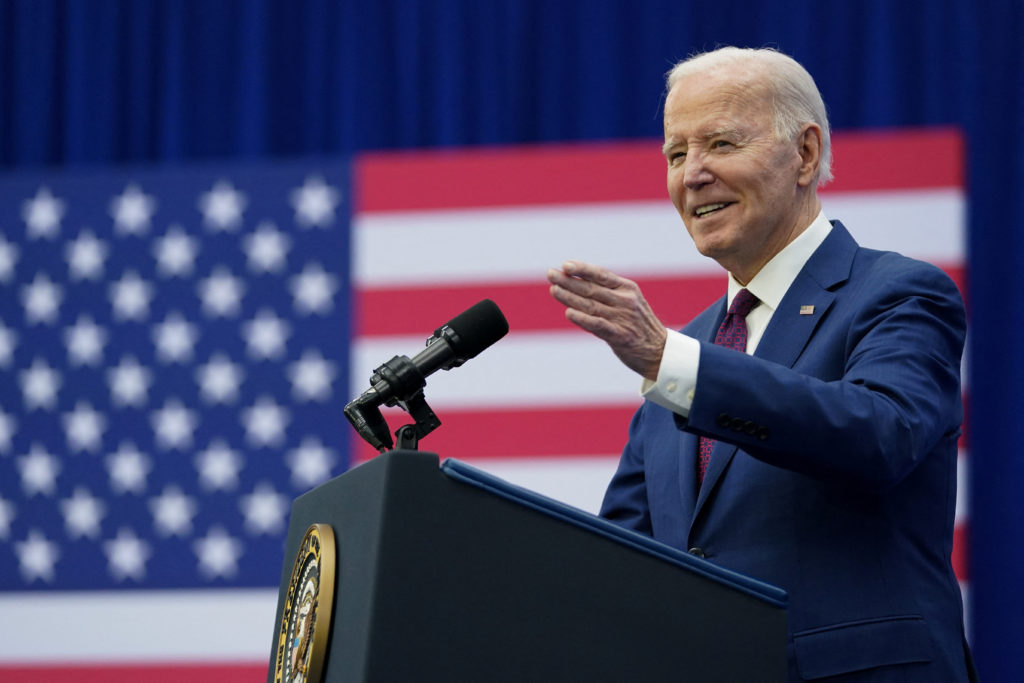
U.S. President Joe Biden delivers remarks on lowering costs for American families during a visit to Goffstown, New Hampshire, U.S., March 11, 2024. REUTERS/Kevin Lamarque
On Friday, US Secretary of State Antony Blinken swept through Vienna and in keeping with the longstanding wishes of Brussels and Washington continued efforts at undermining Austria’s historic 70 year policy of neutrality, a policy first set out in the Austria State Treaty of 1955. During a joint press conference with Austrian foreign minister Alexander Schallenberg, Blinken expressed his view that Austrian neutrality meant that it was “militarily neutral” but “very much not politically neutral.” To be sure, the concept of neutrality has been under assault for decades and the EU itself is by far the most potent threat to the survival of neutrality in countries like Ireland and Austria. The requirements of military “interoperability”embedded with the framework of EU accession agreements makes, for all intents and purposes, the EU a stalking horse for NATO. Neutrality is in essence an expression – perhaps the ultimate expression – of a country’s sovereignty. As such, it is viewed as a threat to the Euro-Atlantic military condominium.
Only a day removed from Blinken’s visit to Vienna, the US ambassador to Hungary, David Pressman gave a remarkable address in which he excoriated the democratically elected leader of his host country. Pressman charged to great fanfare that Hungary is “an ally that behaves unlike any other,” meaning, it has significant reservations about the Washington-Brussels project of taking back by force Russian-occupied territories against the will of the (mainly Russian) people who live in said territories.
The narrative of a disobedient ally does, alas, run up against the fact that another long standing NATO ally, Turkey, for years funded and supported ISIS. But Orban, a traditionalist and conservative, has taken very public stands against the sorts of progressive “values” to which Pressman and his colleagues in the Biden administration have dedicated their careers. Which is the bigger sin in the eyes of Washington elites like Pressman: Propping up ISIS à la Erdogan or opposing progressive social policies à la Orban? The question is entirely rhetorical, of course we know which.
Pressman went on to say,
…We can neither understand nor accept the Prime Minister identifying the United States as a “top adversary” of our Ally, Hungary. Or his assertion that the United States government is trying to overthrow the Hungarian government – literally, to “defeat” him.”
Pressman can deny it all he likes but it is a simple fact that American NGOs such as ‘Action for Democracy’ and American government agencies such as USAID have set their sights on influencing Hungary’s political trajectory. In February 2022, AXIOS referred to the group as “A pro-democracy group advised by top historians, diplomats, journalists and a former NATO supreme allied commander…with an initial focus on Hungary, casting it as the ‘next battleground state in the global fight to defend democracy.’”And only last month USAID administrator Samantha Power, no stranger to regime change operations, traveled to Budapest and, in her words, “relaunched new, locally-driven initiatives to help independent media thrive and reach new audiences, take on corruption and increase civic engagement.”
George F. Kennan once noted with distaste “the projection of attitudes, poses, and rhetoric that cause us to appear noble and altruistic in the mirror of our own vanity but lack substance when related to the realities of international life.” The singling out of countries like Hungary is no accident; Blinken and Pressman quite rightly view expressions of sovereignty in Budapest and Vienna as obstacles to the progressive values imperium which they have long sought to establish.
James W. Carden is a columnist and former adviser to the US-Russia Bilateral Presidential Commission at the U.S. Department of State. His articles and essays have appeared in a wide variety of publications including The Nation, The American Conservative, Responsible Statecraft, The Spectator, UnHerd, The National Interest, Quartz, The Los Angeles Times, and American Affairs.
Donald Trump Should Not Repeat Woodrow Wilson’s Failure
April 30th is an important date in American politics. This is the day 100 for the American President in the White House, and all attention will be on the reports of his achievements and failures. But nothing can be more critical than Peace…
○
6 mins read
A Holocaust perpetrator was just celebrated on US soil. I think I know why no one objected.
Russia’s invasion has made ordinarily outspoken critics of antisemitism wary of criticizing Ukrainian Nazi collaborators
○
1 min read
Qi Book Talk: The Culture of the Second Cold War by Richard Sakwa
Richard Sakwa has for many years been one of the most distinguished and insightful observers of relations between the West and Russia, and one of the leading critics of Western policy. In this talk with Anatol Lieven, director of the Eurasia program at the Quincy Institute, Sakwa discusses his book, The Culture of the Second Cold War (Anthem 2025). The book examines the cultural-political trends and inheritances that underlie the new version of a struggle that we thought we had put behind us in 1989. Sakwa describes both the continuities from the first Cold War and the ways in which new technologies have reshaped strategies and attitudes.