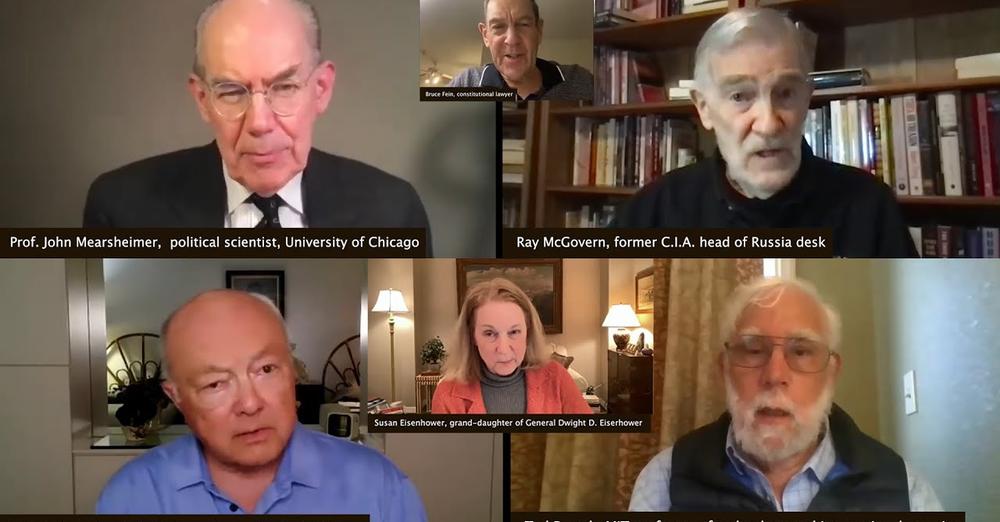
Russian president Vladimir Putin's late-night televised speech from the Kremlin, just hours after talks of a summit, was laced with anger, historical grievances and challenges to the West, The BBC's Sarah Rainsford and Paul Adams in Kyiv give their verdict.
Feeling his oats after receiving effusive adulation from the leaders of NATO — and of Japan at the G-7 summit — Biden provided the Mother of All Faux Pax this afternoon in Poland. (No, sadly, it was not some kind of Polish joke.)
Echoing imperious King Henry II of England, Biden uttered the equivalent of “Will no one rid me of this troublesome priest” … or troublesome president? The priest, of course, was Thomas Becket, Archbishop of Canterbury. The president is Vladimir Putin, who had already warned of a complete break in Russia-U.S. relations.
Referring to President Putin, Biden said, “For God’s sake, this man cannot remain in power.”
Here’s a reminder that should not be necessary: For a host of good reasons, prudent presidents have shied away from saying such extreme things of foreign leaders — sometimes even when the two are at war. In Poland with Ukrainian refugees, Biden was asked what he thought of Putin; he replied: “He’s a butcher.” So add “butcher” to “killer”, “war criminal”, “murderous dictator”, “pure thug”.
Nor do I need to point out that by calling today for Putin’s removal from power, Biden has erected another an extremely high obstacle to the mutual cooperation necessary to arrange an early ceasefire in Ukraine, followed by the kind of negotiations that will be necessary to bring a durable end to what is now a proxy war between Russia and the West, with the Ukrainians as pawns of history — like the Kurds.
It seems unconscionable to hold out the prospect that Putin will be removed from the scene, if the Ukrainians just hold on. Is it all the same to Biden that the carnage continue, with rhetorical promises of support for outgunned Kyiv, weapons that are blown up as soon as they cross the border into Ukraine, faith-based predictions, and crocodile tears?
This will not end well. Among other things, it amounts to public confirmation, at the chief-of-state level, no less, that a cornerstone aim of U.S. involvement in Ukraine (particularly since the U.S.-arranged coup d’etat on Feb. 22, 2014) has been “regime change” in Russia.
That coup has been accurately labeled “the most blatant coup in history”. The main orchestrator, who was caught on tape arranging for the overthrow of the popularly elected Ukrainian president and picking his successor — while arranging to have then-Vice President Biden to come in and help seal the deal, was Victoria Nuland — now number three at the State Department. It is no secret that Nuland gives here nominal boss Tony Blinken instruction on what to say and do on Ukraine.)
Coup No Surprise: Neither Was Russia’s Reaction
After Nuland openly bragged in Dec. 2013 of the U.S. having invested $5 Billion in Ukraine’s aspirations to join the West, and then orchestrated the coup two months later, one agency of the U.S. intelligence community, the Defense Intelligence Agency (DIA) got it right, presaging what slipped out of Biden’s lips earlier today. In an annual “National Security Strategy” report mandated by Congress, DIA Director LT Gen Vincent Stewart on Dec. 2015 signed off on the following text:
“The Kremlin is convinced the United States is laying the groundwork for regime change in Russia, a conviction further reinforced by the events in Ukraine. Moscow views the United States as the critical driver behind the crisis in Ukraine and believes that the overthrow of former Ukrainian President Yanukovych is the latest move in a long-established pattern of U.S.-orchestrated regime change efforts.”
For some reason, the mainstream media gave no play to that key finding. Let’s see how they play Biden’s confirmation of it.
Remembering Edward Lozansky, Towering Prophet of Sanity, Decency and Peace
Soviet and American physicist and political figure Edward Lozansky dies in Moscow, on April 30, 2025.
Edward Dmitrievich Lozansky was born in Kiev on February 10, 1941. He graduated from the Kurchatov Institute of Atomic Energy with a degree in theoretical nuclear physics. He was a researcher at the Kurchatov Institute of Atomic Energy and the Joint Institute for Nuclear Research in Dubna. At the same time, he taught at the Malinovsky Armored Forces Academy.
In 1976, he moved to the United States, became a US citizen, and lived in Washington, DC. In 1990, he founded the American University in Moscow (now Moscow International University).
In recent years, he actively participated in the work of the Assembly of the Peoples of Eurasia and Africa and was the US moderator of the international public forum “The Spirit of the Elbe: A Bridge of Trust, Friendship, and Cooperation,” which was held with great success on April 15, 2025. A word of remembrance from Martin Sieff, joined by the entire editorial staff of the Pluralia project.
○
2 mins read
Open Appeal to Presidents Trump and Putin
We kindly invite you to review and sign the Open Appeal to President of the United States Donald Trump and President of Russia Vladimir Putin
○
1 min read
International Forum “Spirit of the Elbe: A Bridge of Trust, Friendship, and Cooperation”
The organizers of the International Forum “Spirit of the Elbe: A Bridge of Trust, Friendship, and Cooperation” invite media, public figures, and representatives of culture, science, and business to participate in a landmark event taking place on April 15, 2025. The Forum will be held in a hybrid format: in-person at the Conference Hall of the Assembly of the Peoples of Eurasia in Moscow and via Zoom conference (up to 200 participants, approximately evenly split between Russia and the USA). The event begins at 5:00 PM Moscow time (10:00 AM Washington, D.C. time).