The administration’s diplomacy has underperformed—except at time-wasting talk about democracy.
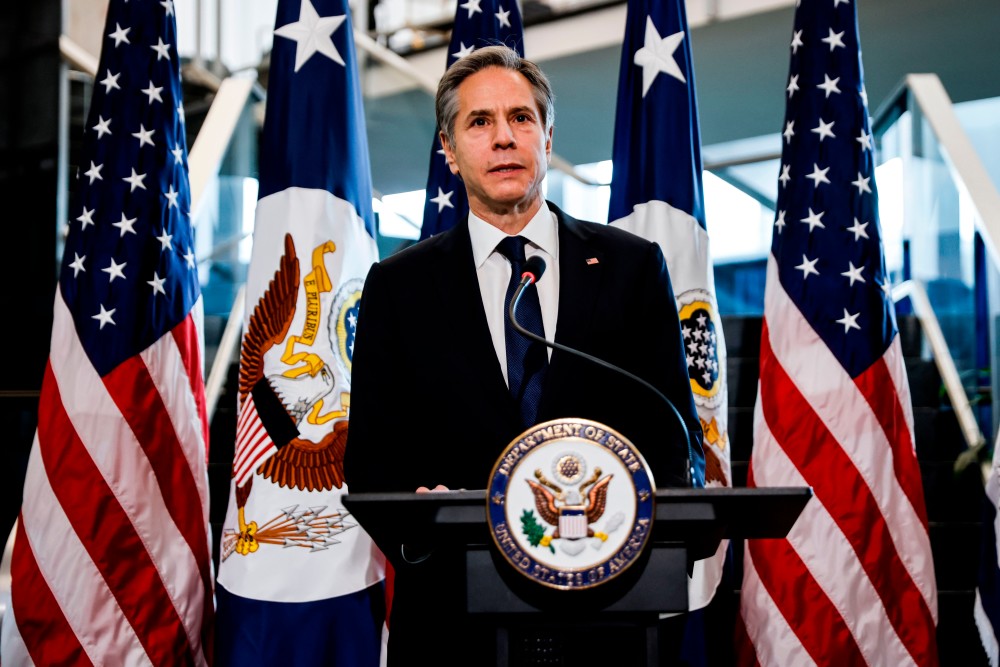
Newly confirmed US Secretary of State Antony Blinken speaks during a welcome ceremony at the State Department in Washington,DC on January 27, 2021. CARLOS BARRIA/POOL/AFP VIA GETTY IMAGES
It is a truth universally acknowledged that America’s diplomatic institutions—and especially the State Department—are under-resourced. This truth is especially evident when you compare the State Department or Agency for International Development budgets with the money allocated to the Defense Department or the intelligence services. It’s even more obvious when you take America’s lofty global ambitions into account. It’s also a truism that the president’s time—and that of top cabinet officials such as Secretary of State Antony Blinken—is the scarcest resource of all.
If this is the case, then why-oh-why did the Biden administration devote any time at all to a second Summit for Democracy? It’s not just the time that U.S. President Joe Biden, Blinken, and other senior officials devoted to this talkfest. Putting something like this together also burned up hundreds of hours of staff time that might have been used to address other problems.
I raise this issue because the Biden administration took office vowing to put diplomacy at the center of U.S. foreign policy, yet it has relatively few diplomatic achievements to show for its first two-plus years. On the plus side, U.S. allies are far more comfortable with Biden and Blinken than they were with former President Donald Trump and former Secretary of State Mike Pompeo, and they’ve been willing to forgive some of the administration’s early blunders (such as the unnecessary snub of the French during the AUKUS submarine deal in 2021). But apart from improved optics, the administration’s diplomatic record is unimpressive.
Part of the problem is the “democracy vs. autocracy” framing that Biden & Co. have embraced. I like democracy as much as anyone and more than some, but this dichotomy causes more problems for U.S. diplomacy than it solves. It doesn’t help the United States work more effectively with the autocratic governments that outnumber the world’s democracies and whose help may be more valuable as great power rivalries intensify. It leaves the United States exposed to accusations of hypocrisy, and it doesn’t seem to motivate Washington’s democratic allies very much. Case in point: European leaders keep traveling to Beijing to safeguard their economic interests with (autocratic) China, behavior sharply at odds with the democracy vs. autocracy template. Similarly, the president of (mostly) democratic India, Narendra Modi, just held talks with one of Russian President Vladimir Putin’s top national security advisors.
Meanwhile, other items on the administration’s agenda remain unfulfilled. Biden took office saying he’d rejoin the nuclear deal with Iran that his predecessor had foolishly left. But he dithered and delayed, Iran’s position hardened, and it is now clear that no new nuclear deal is forthcoming. The result? Iran is closer than ever to nuclear weapons capability, raising the risk of a Middle East war that neither the U.S. administration nor the world needs right now.
Making matters worse, Biden and Blinken have been repeatedly humiliated by their various Middle East allies. The Egyptian government routinely ignores U.S. human rights concerns while continuing to pocket U.S. economic aid. Biden reversed his campaign vow to make Saudi Crown Prince Mohammed bin Salman a pariah for the murder of dissident journalist Jamal Khashoggi, but the fist bump “seen ‘round the world” didn’t convince the Saudis to help ease energy prices or persuade them to put any pressure on Moscow after its invasion of Ukraine. More ominously, the Saudis keep moving closer to Chinese President Xi Jinping. Just this week, Saudi Aramco announced two new oil-related investment deals with China (including building a refinery there); and it was China—not the United States—that helped broker the recent détente between Saudi Arabia and Iran. I don’t blame either the Chinese or the Saudis for acting in their own interest, but it’s hard to see any of this as triumph of U.S. diplomacy.
By Stephen M. Walt, a columnist at Foreign Policy and the Robert and Renée Belfer professor of international relations at Harvard University.
Donald Trump Should Not Repeat Woodrow Wilson’s Failure
April 30th is an important date in American politics. This is the day 100 for the American President in the White House, and all attention will be on the reports of his achievements and failures. But nothing can be more critical than Peace…
○
6 mins read
A Holocaust perpetrator was just celebrated on US soil. I think I know why no one objected.
Russia’s invasion has made ordinarily outspoken critics of antisemitism wary of criticizing Ukrainian Nazi collaborators
○
1 min read
Qi Book Talk: The Culture of the Second Cold War by Richard Sakwa
Richard Sakwa has for many years been one of the most distinguished and insightful observers of relations between the West and Russia, and one of the leading critics of Western policy. In this talk with Anatol Lieven, director of the Eurasia program at the Quincy Institute, Sakwa discusses his book, The Culture of the Second Cold War (Anthem 2025). The book examines the cultural-political trends and inheritances that underlie the new version of a struggle that we thought we had put behind us in 1989. Sakwa describes both the continuities from the first Cold War and the ways in which new technologies have reshaped strategies and attitudes.