Twenty-two countries that have formally applied to join bloc. Putin skipping summit out of consideration for BRICS: Sooklal
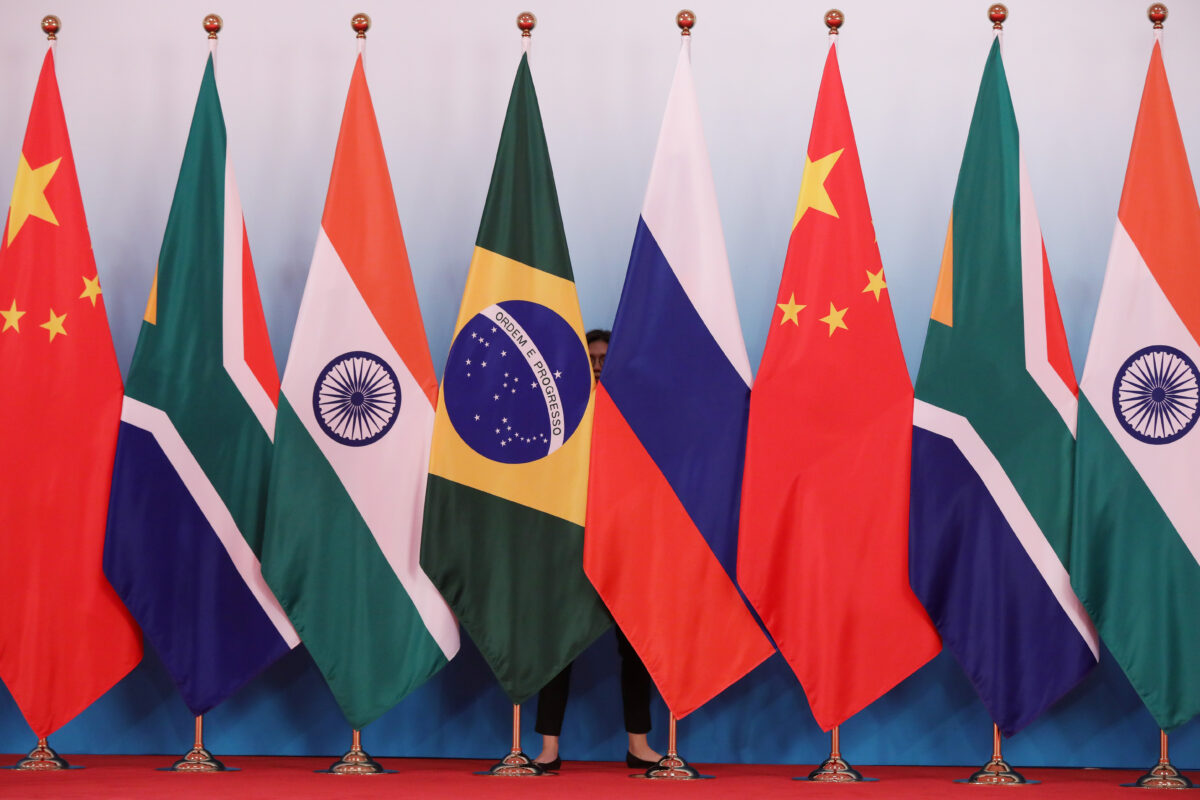
FILE PHOTO: A staff worker stands behind the national flags of Brazil, Russia, China, South Africa and India to tidy the flags before a group photo during the BRICS Summit at the Xiamen International Conference and Exhibition Center in Xiamen, southeastern China's Fujian Province, China September 4, 2017. REUTERS/Wu Hong/Pool
More than 40 nations have indicated an interest in joining the BRICS bloc of major developing economies as it seeks to expand to grow its political clout, South Africa’s ambassador to the group said.
Brazil, Russia, India and China formed the BRICS in 2009, and South Africa joined the following year — the only additional member to be admitted so far. South Africa proposed a further expansion in 2018 and discussions began in earnest last year, said Anil Sooklal, the ambassador.
“This knocking on the door is nothing new,” Sooklal told journalists in Johannesburg on Thursday. “Twenty-two countries have formally approached BRICS, an equal number of informal approaches” have been received about joining, he said.
BRICS, which has established its own multilateral lending institution, was formed as a counterweight to the influence of developed nations in the global economic architecture. While its members account for 42% of the world’s population, they have less than 15% of voting rights in the World Bank and the International Monetary Fund, according to the Pretoria-based Institute for Security Studies.
South Africa was initially admitted as “you could not have a Global South body that excluded the African continent,” Sooklal said, using a term that refers to developing nations as opposed to the industrialized northern powers of Europe and North America.
Sooklal and his counterparts earlier this month discussed four broad areas that needed to be addressed to decide on the criteria for expansion. Those will be elaborated on at a meeting of the bloc’s foreign ministers later on Thursday, he said.
“Argentina, all the major Global South countries” have applied, he said, adding that Bangladesh, the United Arab Emirates, Iran and Saudi Arabia have expressed interest, as have some European nations. “They are quite weighty countries.”
While China and South Africa support expansion and Russia should fall in line with China, Brazil and India are concerned their own influence will diminish and may oppose an enlargement, the Eurasia Group said in a note to clients. They will “instead support keeping interested states as ‘observers,’” it said.
South Africa will host this year’s BRICS summit next month and has invited 69 global leaders to attend related events, showing the bloc’s interest in boosting its influence, according to Sooklal.
Crisis Averted
On Wednesday, South Africa said Russian President Vladimir Putin won’t attend in person, heading off a potential crisis that has weighed on South Africa’s currency and bond markets. If he did attend South Africa, as a member of the International Criminal Court, would be compelled to arrest him.
“It shows the maturity and strength of the partnership,” Sooklal said. “Putin recognized the dilemma and didn’t want to jeopardize the summit.”
Putin will take part in all sessions and deliver an address, even though he is sending his foreign minister, Sergei Lavrov, to represent Russia, Sooklal said.
Putin’s potential arrival has added to tensions between South Africa and some of its biggest trading partners, the US and members of the European Union, who have been exasperated by the African nation’s refusal to condemn Russia’s invasion of Ukraine.
South Africa’s military also held exercises with Russia’s navy over the one-year anniversary of the war and the US ambassador in Pretoria said arms were loaded onto a Russian ship at a naval base in Cape Town.
Those tensions prompted South Africa’s President Cyril Ramaphosa to send some of his most senior ministers to the US in a bid to preserve the country’s eligibility to ship goods duty free to the US under the African Growth and Opportunity Act, which expires in 2025. Last year, South Africa exported $2.7 billion of goods to the US using AGOA and the so-called Generalized System of Preferences.
“There was appreciation” of South Africa’s explanation of our non-aligned stance, Zane Dangor, the director general of the Department of International Relations & Cooperation, said at the briefing. “It was reasonably successful,” he said of the trip.
Antony Sguazzin is a reporter for Bloomberg News based in Johannesburg, South Africa.
Donald Trump Should Not Repeat Woodrow Wilson’s Failure
April 30th is an important date in American politics. This is the day 100 for the American President in the White House, and all attention will be on the reports of his achievements and failures. But nothing can be more critical than Peace…
○
6 mins read
A Holocaust perpetrator was just celebrated on US soil. I think I know why no one objected.
Russia’s invasion has made ordinarily outspoken critics of antisemitism wary of criticizing Ukrainian Nazi collaborators
○
1 min read
Qi Book Talk: The Culture of the Second Cold War by Richard Sakwa
Richard Sakwa has for many years been one of the most distinguished and insightful observers of relations between the West and Russia, and one of the leading critics of Western policy. In this talk with Anatol Lieven, director of the Eurasia program at the Quincy Institute, Sakwa discusses his book, The Culture of the Second Cold War (Anthem 2025). The book examines the cultural-political trends and inheritances that underlie the new version of a struggle that we thought we had put behind us in 1989. Sakwa describes both the continuities from the first Cold War and the ways in which new technologies have reshaped strategies and attitudes.