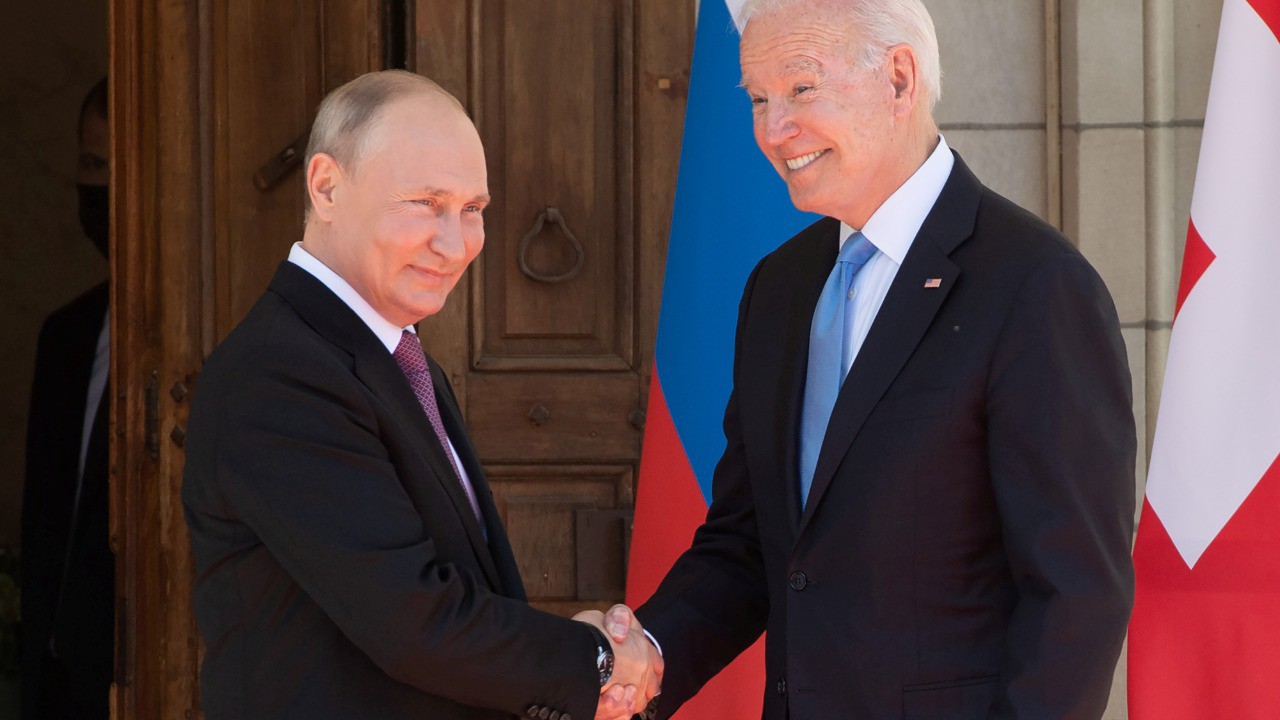
Americans have long held complicated feelings about Russia and Russians. This is as true today, well into the twenty-first century, as it was in the twentieth century and earlier. But all Western nations have had complicated feelings about this continent-country, Westerners always feeling a developmental-societal distance from their Eurasian neighbor. Western views of Russia have often entailed condescension and mistrust, and Russia has long served as a powerful “other” as Westerners pursued their interests. Meanwhile, Americans now operate in a global reality where they are no longer the sole world power. Americans are uncomfortable engaging in a multi-polar system where powers such as China and Russia can openly disregard American preferences.
Today, Americans don’t know what to make of post-Soviet Russia. It was easy to define the Marxist-Leninist Soviet Union as an “other” and enemy. The USSR especially after Joseph Stalin was seen as a one-dimensional military power. It was led by a nondescript leader (the bombastic Nikita Khrushchev an exception), its society little known, and its authoritarian political system and command economy the seemingly inevitable consequence of Asiatic despotism. For Americans, the USSR constituted a genuine political-military threat, but in all other respects it merited little serious consideration. Yet today’s Russia is more difficult to characterize. Russia has embraced capitalism, it has renounced the Communist ideology, it is freely open to Western ideas and culture, it has exhibited a profound desire for many things Western, and it has bottom-up pressures at work that suggest a complicated political system. With a powerful Vladimir Putin looming over Russia, domestic Russian nationalism strong and openly expressed, and Russia pursuing an ever-more-assertive foreign policy line, it is easy for Americans to see the traditional threatening adversary.
It has been observed that “hostility to Russia is the oldest continuous foreign-policy tradition in the United States,” and this hostility has now returned in full force. Russia’s reemergence as a power of consequence, with President Vladimir Putin confidently posturing with strong domestic Russian support, has led to the return of powerful domestic American hostility toward Russia that, very importantly, is equally shared by American decision makers and the American public. Unfortunately, the animosity between the two governments and peoples – at least in public rhetoric and posturing – matches the extremes witnessed during the Cold War. What makes today’s animosity especially concerning is that this animosity toward the rival is now shared by both the American and Russian publics. Where once, both publics distinguished between the adversary’s government and its people, with hostility oriented to that adversary government while the people were positively judged, today’s highly negative evaluations are now directed against the adversary people themselves. While praising high-visibility critics of the Russian regime such as Aleksei Navalny and one-time chess champion Garry Kasparov, there is widespread American animosity even toward Russian cultural figures such as operatic soprano Anna Netrebko and conductor Valery Gergiev when they predictably support Russian causes (e.g., the plight of children orphaned in the eastern Ukrainian breakaway republics). One knows the rhetorical hostility has reached a dangerous extreme when Michael McFaul, the one-time U.S. Ambassador to Russia, who has consistently been among the U.S.’s most severe critics of Russia (Soviet and post-Soviet), warns that the extremely hot rhetoric needs to be cooled.
It is important to recall that American hostility toward Russia, long grounded in socio-cultural differences and a psychological distance from Russia, extends back to the nineteenth century. If Alexis de Tocqueville wrote in the early nineteenth century of America and Russia as the two great ascendant powers who were different from Continental Europe and who would represent rivals to Europe, he also noted profound differences between the two emergent powers themselves. Indeed, his writing suggested America and Russia would be rivals, even granting there were not (and never have been) any profound territorial, ethnic, or religious differences that separated the two countries. The U.S. and Russia could partner in twentieth century wars against Germany, but American judgments about Russian authoritarianism, communal values, and Russia’s engagement of Marxism – among other things – kept Americans highly suspicious of both Soviet Russia and its people. The phenomenon of “Uncle Joe” Stalin being an ally of the American people during World War II was short-lived.
Meanwhile, Americans have always been highly negative about the political left, especially the left inspired by Marxism. The Russian Revolution and all it brought were inimical to Americans, and it is not surprising that the U.S. was the last major Western country to recognize the USSR (in 1933 under President Franklin D. Roosevelt). Well into the twenty first century, the Soviet Russian experience still stands for most Americans as an iconic example of human wickedness, with President Ronald Reagan’s description of the Soviet Union as “the evil empire” still resonating with Americans (and with the famous Reagan line sometimes still voiced when speaking of Putin’s Russia). In contrast, the U.S. has been easily able to accommodate the far right and fascism. Beyond the existential challenge of Adolf Hitler and Nazism, the U.S. has always made peace with far-right regimes. Thus, after the 2014 overthrow of the pro-Russian Ukrainian government, the reemergence of fascist and neo-Nazi elements within the new regime has not been problematic for Americans. Indeed, the reemerged anti-Semitism in post-Maidan Ukraine is ignored or actively denied.
I have contended elsewhere in Limes that, after the end of the Cold War, the U.S. struggled to acknowledge Russia’s Eurasian (and global) geostrategic interests in what has been called a “new world order,” and this has contributed mightily to contemporary hostility in the bilateral relationship. Today, with much of the Russian-American rivalry playing out within the territory of Russia’s historical sphere of influence (and especially the former Soviet Union [FSU] space), Russia has reacted assertively and even aggressively. NATO expansion eastward could not be stopped in the 1990s, but the fall of a pro-Russian government in Ukraine and the prospect of NATO bases on Ukrainian soil were just too much for Russians. Space precludes an analysis of how the Putin government “lost” Ukraine in 2014, only partially recovering by pulling Crimea into the Russian Federation and supporting the two eastern breakaway provinces of Donetsk and Lugansk. But Russian actions involving Ukraine, joined with reactive military actions taken when Georgian forces attacked South Ossetia and Abkhazia in 2008, are only among the most important security steps taken by Moscow which have reinforced the long-held American view of a menacing and dangerous Russia.
Thus, as we move through the 2020s, negative American views of Russia are widespread, strongly held, and even deepening. American hostility exceeds the uncertainty and skepticism of both the 1980s Soviet period of Mikhail Gorbachev and the 1990s “time of troubles” decade of Boris Yeltsin. But in the 1980s and 1990s, Russia was in evident decline, there was powerful domestic decay in the wake of a failing state and failed command economy, Russian rhetoric was defensive, and the Russian government struggled to cope with restive domestic regions (e.g., Chechnya).
Without revisiting the complicated history of Russian-American relations of the Vladimir Putin period, suffice it to note that it is important that a strong leader consolidated power and fashioned a governing team that has helped to (1) oversee the restoration of the Russian (federal) state, (2) guide the recovery of a domestic economy that once again approaches the size of Germany’s, (3) refashion a functional social welfare state with Russians experiencing a demonstrable improvement in their standard of living, and (4) bolster Russian public self-confidence both collectively and individually. Yet these realities of Putin’s Russia of the 2020s are unknown to Americans. Americans speak of a Russian economy in shambles, and of a population that is terrorized by the increasingly authoritarian state while that population awaits a putative democrat like Aleksei Navalny to wrest power from Putin. Perceptions of Navalny are a good indicator of the profound divide between Americans and Russians regarding the contemporary state of the Russian polity. Where Americans see in Navalny a freedom fighter and human rights activist who devotes his life to rescuing Russia from Putin’s authoritarianism, Russians, who have nicknamed Navalny “Alexei two-percent” because he has low single-digit approval ratings in public opinion surveys, see an entrepreneurial self-promoter who is increasingly removed from mainstream Russian reality. When Navalny ran for mayor of Moscow in 2013, he scored an impressive 27% of the popular vote. This was probably the high point of Navalny’s real influence in Russia, and it has been in decline since. In contrast, American commentators speak of Navalny as constituting the greatest political threat to Putin’s reign, with some even offering the possibility of Navalny as a future president. In truth, there are profound domestic political threats to the Putin team and its governance, but those threats come from extreme nationalists, many on the political right, others on the political left. Russia’s reemergence as an ever-more-consequential power, with heightened domestic Russian patriotism, has lent itself to nationalist and even jingoist attitudes that are a much more consequential challenge to Putin and his team.
How have contemporary American attitudes about Putin’s Russia become so hostile, and hostile to the point that even traditional American establishment critics of Russia urge caution and a lowering of the rhetoric? In a nutshell, the extreme hostility stems from the wide gap that has arisen between Russian domestic realities and the hyped misleading characterizations and interpretations of Russian reality. Russia of the 2020s has many problems, its political system – led by a “paramount leader” (or what some might call a “strongman”) – is hardly democratic, the economy has many structural problems, the society is wracked with corruption, and Russians are frustrated that their own economic conditions have not improved even more. Meanwhile, any expression of Russia’s power interests, especially by force, in the FSU space and in Russia’s traditional sphere of influence, naturally lend themselves to outsiders’ skepticism and concern, if not their outrage and inclination to take action. But hyping real problems of the Russian polity, economy, and society only exaggerates traditionally negative American judgments. As the hyping continues, expands, and deepens, American hostility grows. The hyped Russia presented by the American establishment (governmental and media) and seen by the American public, obscures a developing Russia that has come far since 1991, that has accomplishments with continuing problems, and that offers both promise and challenge.
What follows are eleven important facets of Russian reality, most domestic, some involving foreign-security policy. What is first listed is my evaluation of Russian reality, based in mainstream Russian views, then juxtaposed with the hyping of that Russian reality that currently pervades American attitudes. Without restating in detail each of these facets of reality, and how they are hyped, I summarize this juxtaposed hype vis-à-vis reality as follows.
Putin’s Russia: Reality or Hype
Reality: Top-down decision-making system, with hegemonic presidency & powerful Putin
Hype: Putin a dictator involved in all hegemonic domestic actions & policy decisions
Reality: Regularized multi-candidate elections, with considerable Kremlin influence over campaigns & elections
Hype: All campaigns and elections rigged and stolen from pro forma & token opposition
Reality: Kremlin pressures political opposition
Hype: Putin kills political opponents
Reality: State pressuring of media; cautious media criticism of Putin & regime; journalists die in terrorist zones & local corruption scandals
Hype: Putin kills journalists; no media criticism of Putin & regime; Russian media today are Soviet style
Reality: High state profile in Russian society; citizen activism in selected areas (e.g., family & children, environment)
Hype: No bottom-up pressures; severe repression; no civil society & no citizen activism
Reality: Putin enjoys high public approval with widespread elite-mass support
Hype: Russian opinion surveys rigged & public approval ratings fabricated
Reality: Guiding role of state in economy; regulated, increasingly diversified, market economy
Hype: Putin recreates Soviet-style economy solely based on energy-minerals-arms
Reality: Putin & team operate in a society with considerable corruption
Hype: Putin & team steal and hoard vast sums; stashed abroad (e.g., Cyprus)
Reality: Putin & team work with powerful oligarchs (rich businesspeople)
Hype: All oligarchs are personal friends of Putin & dominate all aspects of Russia
Reality: Russia involved in Georgian & Ukrainian affairs; safeguards sphere of influence
Hype: Putin’s Russia invades countries (e.g., Georgia and Ukraine)
Reality: Crimea viewed by Russians as ethnically-historically part of Russia; 2014 overthrow of Kiev regime ended bilateral & multilateral treaties between Russia & Ukraine; half of Ukrainian population opposed overthrow
Hype: Crimea is Ukrainian, illegally seized by Russia, legitimately part of Ukraine; all of Ukrainian population supported the 2014 overthrow of Kiev regime; Crimeans as unwilling hostages of Russia
Turning to the “hype” assessments, we see a set of conditions and behaviors with which we Americans are well aware. The overall picture drawn is dire. A dictatorial Vladimir Putin, involved in all domestic actions and policy decisions, easily ignores public preferences, rigged elections, and token opposition. Putin kills his political opponents and kills journalists in opposition to the regime. Russian media are completely controlled and operate Soviet style. Meanwhile, there are no bottom-up societal pressures, there is no citizen activism, and any opinion surveys that suggest support for the regime are fabricated. The contemporary economy is Soviet-like, and based solely on the energy-minerals-arms sectors. At the same time, what profits are yielded are mostly stolen and stashed abroad by Putin and oligarchs; those oligarchs are Putin friends and they dominate all aspects of society. Finally, regarding foreign policy behavior, critically important are Russian invasions of countries such as Georgia and Ukraine, with Ukrainians having joined together in 2014 to overthrow a tyrannical pro-Russian regime.
I contend that the Russian reality diverges greatly from this cartoon-character and ideologically driven simplification. In fact, Russia has a top-down decision-making system, grounded in the 1994 Yeltsin Constitution, that legitimates a very powerful (“hegemonic”) presidency. The office of the presidency is held by a popular incumbent who, contrary to his predecessor, is overwhelmingly supported by the general public. The Putin team does have considerable influence over campaigns and elections, but regularized multi-candidate elections with respectable levels of public participation yield a variety of politicians, even granting the Putin platform party, United Russia, is highly advantaged. The Kremlin does pressure the political opposition, and there are severe constraints on the media – especially the federal-level media. Russian journalists have died in terrorist zones and in reporting local corruption scandals, but – in fact – the number of journalists who have died carrying out their work has declined steeply since the Yeltsin 1990s. Indeed, more journalists die per year in democratic India and Mexico than in Russia, while since 2017, more American journalists (6) than Russian journalists (5) have died in undertaking their reporting activities. Under the Putin team, the state has a high profile in the society and the economy. But there is citizen activism in important (to Russians) policy areas, while the economy can be described as relying on a regulated, increasingly diversified, market. The Russian domestic socioeconomic scene is dominated by oligarchs; “oligarchs” who if they were in the U.S. would be described as “rich businesspeople,” and predictably these rich businesspeople have access to the Russian President. But evidence that these rich businesspeople dictate policies is as sketchy as evidence that George Soros or the Koch Brothers dictate American policies, though all of these rich Russian and American businessmen certainly have their president’s ear.
Meanwhile, Russia has returned to defending its interests in its traditional sphere of influence, and there is little doubt of Russian involvement in Ukraine. Events tied with the 2014 coup d’état that ousted the constitutionally mandated Ukrainian president and Constitutional Court, with related ouster of pro-Russian parliament members (the so-called “garbage can lustration,” as parliament members were literally carried out of the building and thrown into dumpsters), are complicated and would require, at a minimum, an article-length essay to begin to explain. Suffice it to note, Ukraine was divided roughly 50% pro-Western to 50% pro-Russian, central and western Ukraine generally supporting the coup d’état, while eastern and southern Ukraine generally opposed it. For its part, Crimea was the lone region within Ukraine that enjoyed the constitutional right to secede, and with the events of the coup and the emergence of a perceived anti-Russian regime, Crimean authorities moved to secede and invited Russians in. Russian obfuscation around their “little green men” moving into Crimea reflected Russian anxieties in safeguarding their traditional power interests, but no Russian government would agree to NATO bases in Crimea. My intention here is not to defend Russian actions involving Ukraine and Crimea, but rather to explain that the 2014 events involving Ukraine, Crimea, and Russia, were multifaceted and complicated. Simplistic explanations do nothing in understanding dynamic developments, but they are valuable for further hyping negative assessments of Russia and its actions.
In summing up, there are many factors, both long-term historical and more recent polemical-rhetorical, that explain the extreme contemporary American hostility toward Putin’s Russia. This is a hostility that matches, and perhaps exceeds, the hostility expressed toward, for instance, Brezhnev’s USSR, especially as the hostility now includes hostility toward Russians and their society, and not just their government. After the chaotic and even incoherent policy efforts of the Donald Trump Administration, the return of a more stable and predictable policy line by the Joe Biden Administration may be conducive to modestly reduced tensions between the two polities. The Biden team did permit Russia’s important Nordstream 2 Pipeline initiative to be completed, while they have not matched tough rhetoric with meaningful increased military support to Kiev-Ukraine. Such support would be highly confrontational to Russia, and it could yield highly dangerous consequences. In addition, important policy areas, including climate change and Iranian nuclear energy development, could bring Russia and the U.S. back to the negotiating table. The Biden Administration will have to deal with the increased domestic hostility that has been illuminated here, and that widespread hostility may well constrain the Biden team in important ways.
Both Russophobia and Putin-bashing have mattered greatly in the crafting of American policies toward Russia, and this harsh rhetoric will continue. Only time will tell if conditions can arise that might alter the currently highly charged anti-Russian atmosphere in the U.S. But viewed today, such conditions are difficult to find.
Remembering Edward Lozansky, Towering Prophet of Sanity, Decency and Peace
Soviet and American physicist and political figure Edward Lozansky dies in Moscow, on April 30, 2025.
Edward Dmitrievich Lozansky was born in Kiev on February 10, 1941. He graduated from the Kurchatov Institute of Atomic Energy with a degree in theoretical nuclear physics. He was a researcher at the Kurchatov Institute of Atomic Energy and the Joint Institute for Nuclear Research in Dubna. At the same time, he taught at the Malinovsky Armored Forces Academy.
In 1976, he moved to the United States, became a US citizen, and lived in Washington, DC. In 1990, he founded the American University in Moscow (now Moscow International University).
In recent years, he actively participated in the work of the Assembly of the Peoples of Eurasia and Africa and was the US moderator of the international public forum “The Spirit of the Elbe: A Bridge of Trust, Friendship, and Cooperation,” which was held with great success on April 15, 2025. A word of remembrance from Martin Sieff, joined by the entire editorial staff of the Pluralia project.
○
2 mins read
Open Appeal to Presidents Trump and Putin
We kindly invite you to review and sign the Open Appeal to President of the United States Donald Trump and President of Russia Vladimir Putin
○
1 min read
International Forum “Spirit of the Elbe: A Bridge of Trust, Friendship, and Cooperation”
The organizers of the International Forum “Spirit of the Elbe: A Bridge of Trust, Friendship, and Cooperation” invite media, public figures, and representatives of culture, science, and business to participate in a landmark event taking place on April 15, 2025. The Forum will be held in a hybrid format: in-person at the Conference Hall of the Assembly of the Peoples of Eurasia in Moscow and via Zoom conference (up to 200 participants, approximately evenly split between Russia and the USA). The event begins at 5:00 PM Moscow time (10:00 AM Washington, D.C. time).