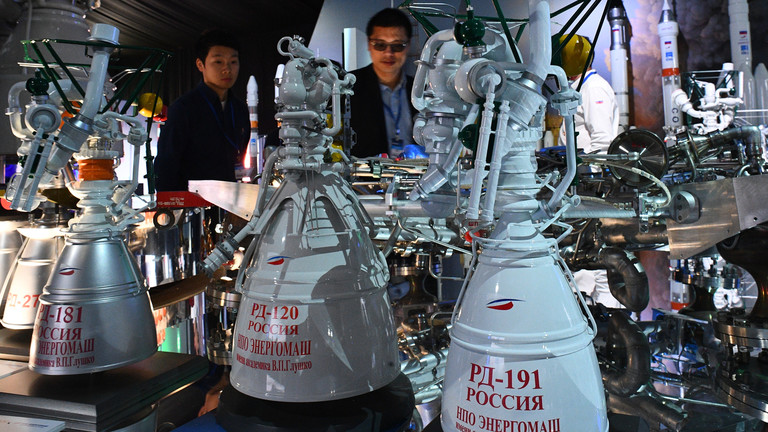
Despite Washington’s sanctions against Moscow, Russia reveals it will continue cooperating with Americans on space rocket engines
Despite Washington’s sanctions against Moscow, Russia reveals it will continue cooperating with Americans on space rocket engines
○
2 mins read
By Jonny Tickle viaMoscow has agreed to allow state-of-the-art domestically made rocket engines to be sold to the US, despite Washington’s sanctions against Russian industry that are significantly hampering the ability of the country’s space agency.According to Roscosmos, the government’s […]
By Jonny Tickle via Moscow has agreed to allow state-of-the-art domestically made rocket engines to be sold to the US, despite Washington’s sanctions against Russian industry that are significantly hampering the ability of the country’s space agency. According to Roscosmos, the government’s support means that Russia will be able to negotiate with the US to supply RD-181M engines, in what the space agency called “mutually beneficial cooperation.” American rockets regularly use Russian-made engines, and they are currently in use with both the government-run NASA and the privately owned SpaceX. In a statement published on Monday, Roscosmos revealed that it would negotiate with Orbital Sciences, an American aerospace and defense technology company that merged with Alliant Techsystems in 2015 to become Northrop Grumman Innovation Systems. The engine is produced by manufacturer Energomash, a “reliable supplier of high-quality high-tech products,” Roscosmos noted. “The new RD-181M engine, which Roscosmos has received an export permit for, represents the next stage of development of the RD-181,” the state agency continued. Last week, Russian Prime Minister Mikhail Mishustin revealed the government’s support for selling the engines. He noted, however, that the space agency must receive guarantees that Russian technology will not be used for military purposes. Roscosmos has repeatedly hit out at Washington for what its head, Dmitry Rogozin, has called “stupid” sanctions. Last year, the US Department of Commerce introduced restrictions on companies that it believes cooperate with the Russian military. The list includes many space-related businesses, such as the Progress Rocket Space Center, which is the developer and manufacturer of the famous Soyuz rocket system. Until last summer, the US was reliant on this very same technology to conduct launches. “The possible use of sanctions by the United States against these Russian enterprises jeopardizes the further implementation of the International Space Station program,” Rogozin said. Last month, Moscow revealed that it would withdraw from the ISS project in 2025 if Washington continues to impose sanctions against the Russian space sector.
Donald Trump Should Not Repeat Woodrow Wilson’s Failure
April 30th is an important date in American politics. This is the day 100 for the American President in the White House, and all attention will be on the reports of his achievements and failures. But nothing can be more critical than Peace…
○
6 mins read
A Holocaust perpetrator was just celebrated on US soil. I think I know why no one objected.
Russia’s invasion has made ordinarily outspoken critics of antisemitism wary of criticizing Ukrainian Nazi collaborators
○
1 min read
Qi Book Talk: The Culture of the Second Cold War by Richard Sakwa
Richard Sakwa has for many years been one of the most distinguished and insightful observers of relations between the West and Russia, and one of the leading critics of Western policy. In this talk with Anatol Lieven, director of the Eurasia program at the Quincy Institute, Sakwa discusses his book, The Culture of the Second Cold War (Anthem 2025). The book examines the cultural-political trends and inheritances that underlie the new version of a struggle that we thought we had put behind us in 1989. Sakwa describes both the continuities from the first Cold War and the ways in which new technologies have reshaped strategies and attitudes.