The practice of leaking proposed diplomatic plans is standard in Western political culture, making the recent publication of a reported framework for resolving the Ukraine conflict – allegedly authored by US President-elect Donald Trump’s pick for special envoy to Kiev Keith Kellogg — unsurprising. Such moves often serve to test the likely reactions of key players before formal talks begin.
From a realpolitik perspective, it would make sense for Trump, after his inauguration, to call Russian President Vladimir Putin and propose sending Kellogg – or another senior figure – to Moscow for negotiations. While the exact content of Trump’s future proposal remains unclear, its general theme — “peace from a position of strength” — seems obvious.
If Trump takes this step, it’s likely that Putin will agree to receive the envoy and assign a senior Russian official for the meeting. The success of any talks, however, will depend entirely on the substance of Washington’s proposal. Judging by what has circulated in the media so far, the terms being floated are clearly unacceptable to Moscow.
Russia has its own clearly defined vision for resolving the Ukraine crisis – one focused on addressing the root causes of the conflict, not simply managing its symptoms. The terms for negotiations with Ukraine have been publicly stated and repeatedly reiterated by Russian officials. For the US, the first step toward meaningful talks should be ceasing its involvement in the war altogether.
Any hypothetical negotiations between Moscow and Washington would center not on Ukraine, but on the broader military and political stability in Europe and beyond. If Trump is prepared to pursue this agenda, meaningful progress may be possible. If not, he will likely face a choice: escalate an increasingly dangerous war or shift the responsibility for supporting Kiev onto the European NATO allies.
Neither option is ideal. German Chancellor Olaf Scholz faces a tough February election, with polls suggesting he is vulnerable. Meanwhile, British Prime Minister Keir Starmer is eager to project “Global Britain” ambitions abroad. At the same time, French President Emmanuel Macron is presently a lame duck and doesn’t even have a functioning government. All will struggle to sustain Western Europe’s commitment to the war without firm US leadership.
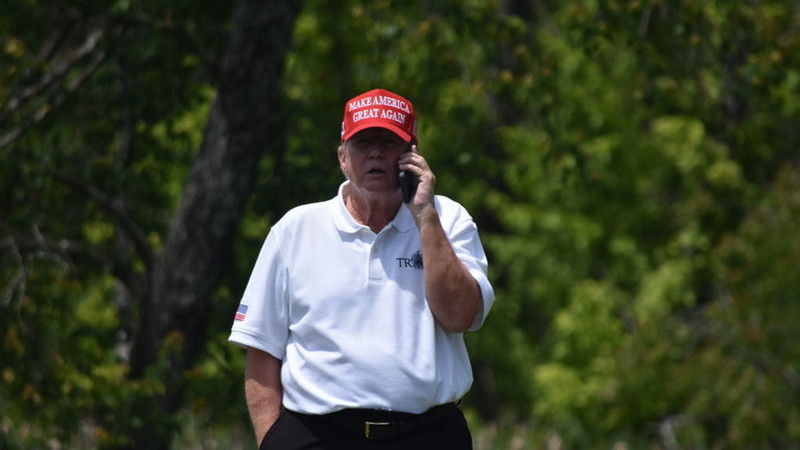
For Trump, the clock will be ticking from the moment he enters the White House. A phone call to Moscow may be a necessary first step — if only to see how much room remains for diplomacy in a world increasingly shaped by force.
By Dmitry Trenin, a research professor at the Higher School of Economics and a lead research fellow at the Institute of World Economy and International Relations. He is also a member of the Russian International Affairs Council (RIAC).
Donald Trump Should Not Repeat Woodrow Wilson’s Failure
April 30th is an important date in American politics. This is the day 100 for the American President in the White House, and all attention will be on the reports of his achievements and failures. But nothing can be more critical than Peace…
○
6 mins read
A Holocaust perpetrator was just celebrated on US soil. I think I know why no one objected.
Russia’s invasion has made ordinarily outspoken critics of antisemitism wary of criticizing Ukrainian Nazi collaborators
○
1 min read
Qi Book Talk: The Culture of the Second Cold War by Richard Sakwa
Richard Sakwa has for many years been one of the most distinguished and insightful observers of relations between the West and Russia, and one of the leading critics of Western policy. In this talk with Anatol Lieven, director of the Eurasia program at the Quincy Institute, Sakwa discusses his book, The Culture of the Second Cold War (Anthem 2025). The book examines the cultural-political trends and inheritances that underlie the new version of a struggle that we thought we had put behind us in 1989. Sakwa describes both the continuities from the first Cold War and the ways in which new technologies have reshaped strategies and attitudes.