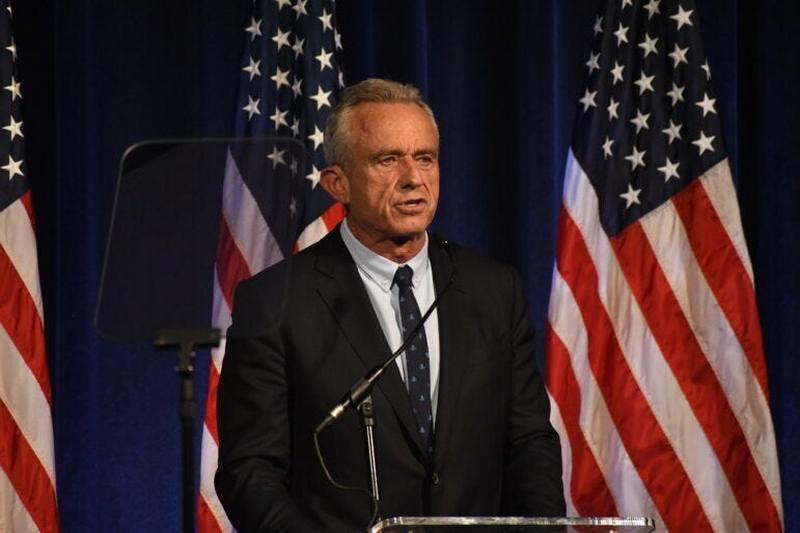
Robert F. Kennedy Jr. Echoes JFK's Peace Speech of June 1963
In New Hampshire, RFK Jr. speaks for the possibility of peace and against the MICC and its forever war
Robert F. Kennedy Jr. is running against the Democratic establishment’s position on the Russia-Ukraine War and for the presidential nomination of the party in 2024. He recently gave a peace speech in New Hampshire that echoed the sentiments of the peace speech given by his uncle, President John F. Kennedy, in 1963.
In his speech, RFK Jr. stated that Russia has legitimate security concerns, that NATO expansion to Russia’s border was a betrayal of promises made to leaders like Mikhail Gorbachev, and that America’s military-industrial-congressional complex (MICC) is enabling forever war rather than actively seeking an end to war. He was also careful to say he abhorred Vladimir Putin’s decision to invade Ukraine.
I’ve already heard RFK Jr. being called a “Putin enabler,” if not a Putin puppet, for suggesting that Russian concerns about Ukraine’s inclusion in NATO are in any sense legitimate. Doesn’t he know, one reader asked, that Putin rejects Ukrainian identity as a country and a people? Doesn’t he know Russia is killing civilians in terror bombings? Why is he acting as an apologist for Putin’s many war crimes?
Obviously I can’t speak for RFK Jr., but I think his message is plain: a state of permanent war is causing deep harm to American democracy, what’s left of it, and any sustainable U.S. recovery must start with a rejection of war and massive military spending, including the more than $100 billion already devoted to what has become a proxy war in Ukraine. That war has greatly contributed to the rhetoric, and increasingly the reality, of a new Cold War with Russia (and China too), strengthening the MICC’s call for even vaster sums for wars and weapons in the cause of maintaining U.S. full-spectrum dominance around the globe.
Like his uncle, President Kennedy, RFK Jr. fears a world-ending nuclear cataclysm, an event that becomes more imaginable as the Russia-Ukraine War continues to escalate. Again, at no time did I hear RFK Jr. express support of the Russian invasion or its brutal methods; what he did express support for is diplomacy as a way of ending the bloodshed while reducing the risk of nuclear Armageddon.
Any reasonable diplomatic effort would have to recognize the legitimate security concerns of Russia, just as that same effort would have to recognize those of Ukraine as well.
Those who advocate for peace often face the charge of being puppets, enablers, or apologists for enemies who are usually presented as monstrous. All credit to RFK Jr. for departing from standard neocon rhetoric and practices and for extending an olive branch to Russia.
Arguing for more war is easy. It even wins salutes (and money) within today’s Democratic establishment. Striving for peace is far harder, and like his uncle, RFK Jr. has decided to take the harder path. More of us should join him.
Donald Trump Should Not Repeat Woodrow Wilson’s Failure
April 30th is an important date in American politics. This is the day 100 for the American President in the White House, and all attention will be on the reports of his achievements and failures. But nothing can be more critical than Peace…
○
6 mins read
A Holocaust perpetrator was just celebrated on US soil. I think I know why no one objected.
Russia’s invasion has made ordinarily outspoken critics of antisemitism wary of criticizing Ukrainian Nazi collaborators
○
1 min read
Qi Book Talk: The Culture of the Second Cold War by Richard Sakwa
Richard Sakwa has for many years been one of the most distinguished and insightful observers of relations between the West and Russia, and one of the leading critics of Western policy. In this talk with Anatol Lieven, director of the Eurasia program at the Quincy Institute, Sakwa discusses his book, The Culture of the Second Cold War (Anthem 2025). The book examines the cultural-political trends and inheritances that underlie the new version of a struggle that we thought we had put behind us in 1989. Sakwa describes both the continuities from the first Cold War and the ways in which new technologies have reshaped strategies and attitudes.